

Neodymium magnets, commonly referred to as NdFeB magnets, are the strongest commercially available permanent magnets. However, not all neodymium magnets deliver the same performance. Magnet grades define their magnetic strength, thermal stability, and suitability for specific operating environments. For engineers, designers, and procurement teams, understanding magnet grades is essential to optimizing performance, reliability, and total system cost.
Selecting the correct grade directly influences torque output in motors, holding force in assemblies, and long-term resistance to demagnetization.
Table of Contents
- What Do Neodymium Magnet Grades Mean
- Understanding Grade Suffixes and Temperature Ratings
- Magnetic Strength vs. Thermal Stability
- How Magnet Grade Affects Real-World Applications
- Surface Coatings and Grade Performance
- Common Misconceptions About Magnet Grades
- Strategic Trends in Neodymium Magnet Grades
- HSMAGNET Expertise in Neodymium Magnet Grades
What Do Neodymium Magnet Grades Mean
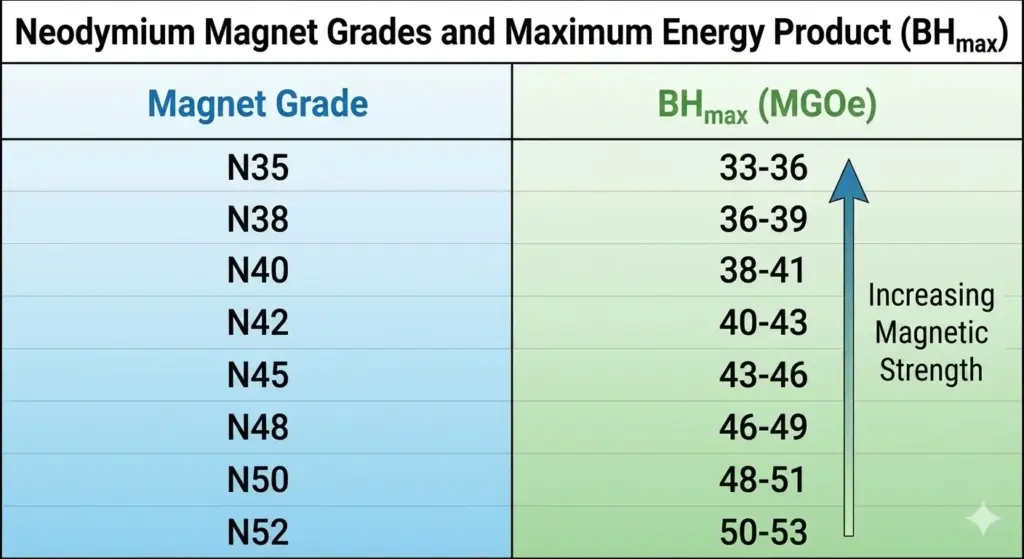
Neodymium magnet grades are designated by a number followed by optional letters, such as N35, N42, N52, or N42SH. The number represents the maximum energy product (BHmax), measured in Mega-Gauss Oersteds (MGOe). A higher number indicates greater magnetic energy density and stronger magnetic performance per unit volume.
For example, an N52 magnet provides significantly higher magnetic strength than an N35 magnet of the same size.
Understanding Grade Suffixes and Temperature Ratings
The letters following the grade number indicate the magnet’s maximum operating temperature and coercivity level. These suffixes are critical in applications exposed to heat or opposing magnetic fields.
Common suffixes include:
- N: Standard temperature grade (up to 80°C)
- M: Medium temperature resistance (up to 100°C)
- H: High temperature resistance (up to 120°C)
- SH: Super high temperature resistance (up to 150°C)
- UH: Ultra-high temperature resistance (up to 180°C)
- EH: Extreme high temperature resistance (up to 200°C)
Higher temperature grades generally trade some magnetic strength for improved thermal stability.
Magnetic Strength vs. Thermal Stability
One common misconception is that higher grade magnets are always better. In reality, application conditions dictate the optimal grade. High-strength grades such as N52 are ideal for compact designs requiring maximum pull force. However, in elevated-temperature environments such as electric motors or automotive systems, an N42SH or N38UH may deliver better long-term reliability despite slightly lower initial strength.
Engineering decisions should balance:
- Required magnetic force
- Operating temperature range
- Exposure to demagnetizing fields
- Mechanical and environmental stress
How Magnet Grade Affects Real-World Applications
Electric Motors and Generators
Higher temperature grades with strong coercivity are preferred to maintain torque and efficiency under continuous operation.
Sensors and Precision Devices
Stable magnetic output is critical, making consistent grade selection more important than peak strength.
Magnetic Assemblies and Fixtures
Higher BHmax grades allow smaller magnet sizes, reducing weight and material usage.
Consumer and Industrial Products
Cost-effective grades like N35 or N38 often meet performance requirements without overengineering.
Surface Coatings and Grade Performance
Neodymium magnets are susceptible to corrosion and typically require surface coatings such as nickel, epoxy, or zinc. While coatings do not change the magnet grade, they influence durability and lifespan, particularly in humid or corrosive environments.
Proper coating selection complements grade choice to ensure long-term system reliability.
Common Misconceptions About Magnet Grades
A frequent sourcing mistake is specifying the highest grade available without considering environmental constraints. This can lead to:
- Increased cost without performance benefit
- Higher risk of thermal demagnetization
- Reduced safety margins in dynamic systems
Grade selection should always be application-driven, not marketing-driven.
Strategic Trends in Neodymium Magnet Grades
As industries focus on efficiency, electrification, and compact system design, demand for high-coercivity and high-temperature grades continues to grow. At the same time, supply chain volatility has increased interest in optimizing magnet grade usage to reduce rare-earth consumption while maintaining performance targets.
HSMAGNET Expertise in Neodymium Magnet Grades
HSMAGNET offers a full range of neodymium magnet grades, from standard N-series to high-temperature SH, UH, and EH grades. With advanced manufacturing control, precision magnetization, and strict quality inspection, HSMAGNET supports customers in selecting the most cost-effective and technically appropriate magnet grade for each application.
By aligning magnet grade selection with real-world operating conditions, HSMAGNET helps global partners improve performance, reliability, and total lifecycle value.
Leave a Reply