
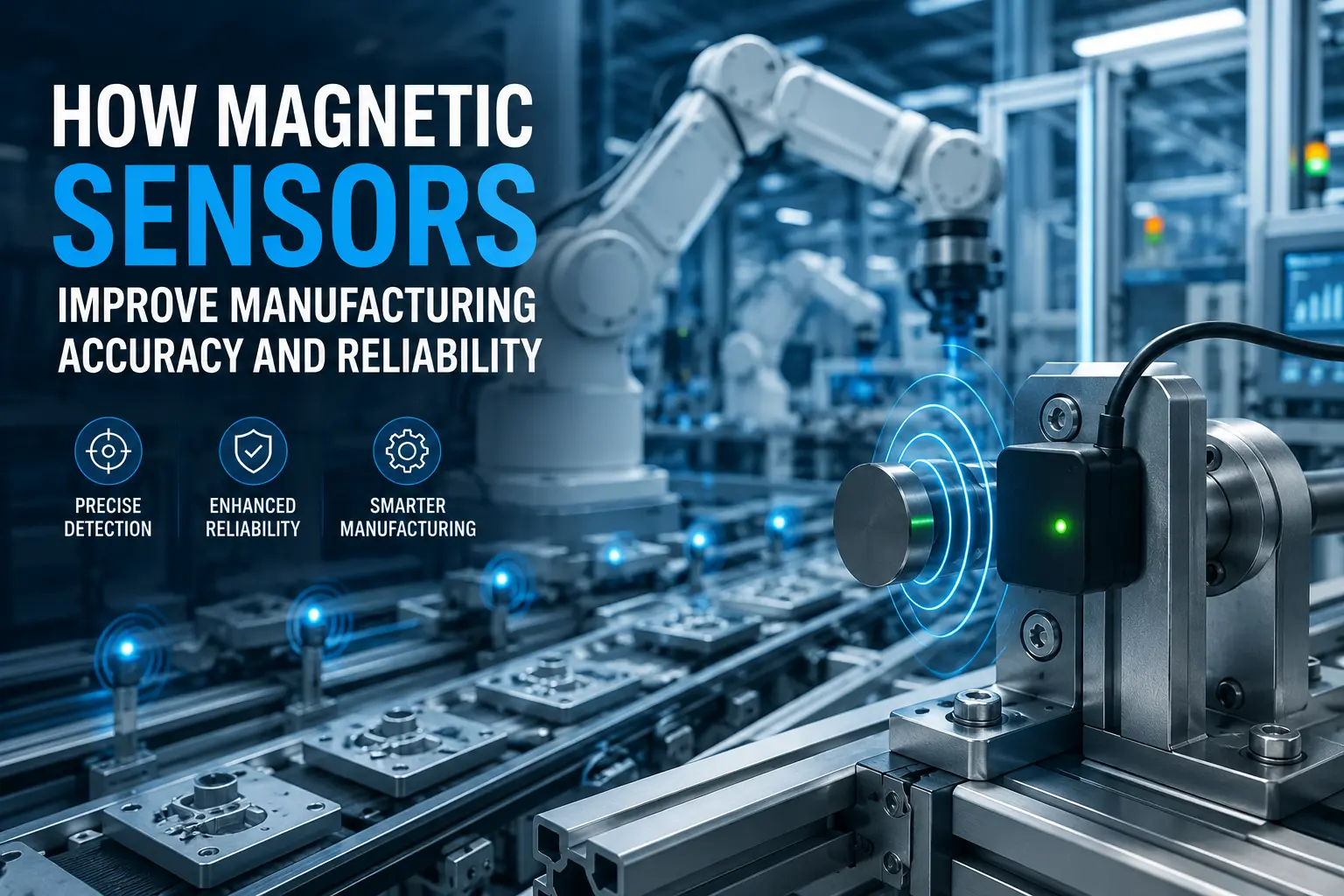
As manufacturing becomes increasingly automated, accurate position detection and reliable motion control are essential for maintaining product quality and production efficiency. Magnetic sensors have become a preferred solution because they provide precise, non-contact detection in environments where dust, vibration, moisture, and temperature fluctuations can reduce the performance of conventional sensing technologies.
Unlike mechanical switches, magnetic sensors experience virtually no physical wear, resulting in longer service life and lower maintenance costs. Their durability makes them ideal for continuous industrial operation.
How Magnetic Sensors Work
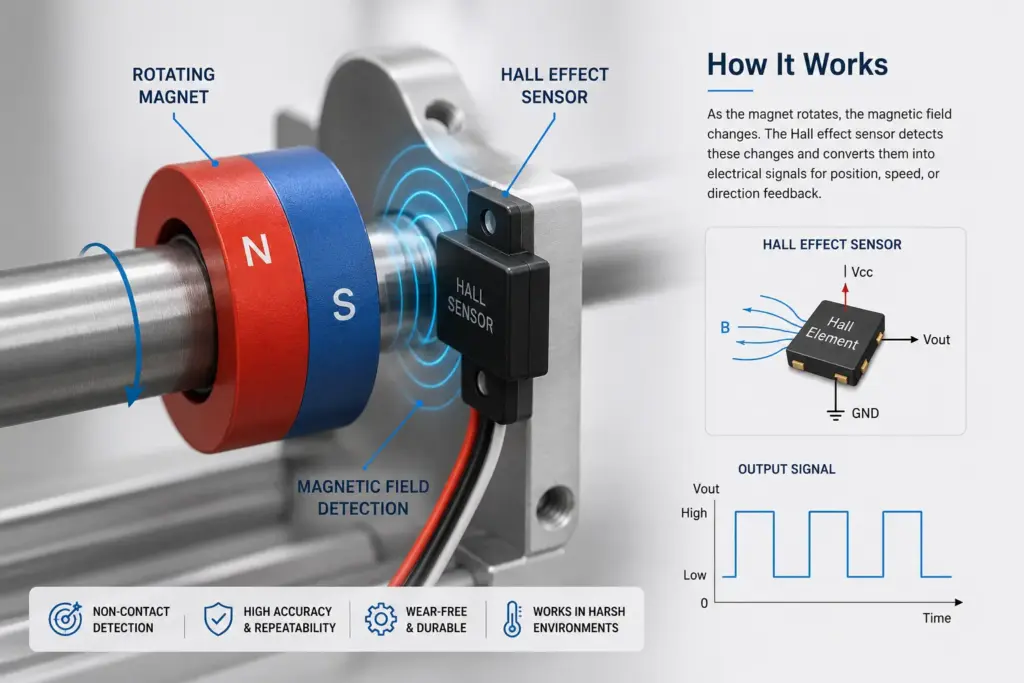
Magnetic sensors detect changes in a magnetic field generated by permanent magnets or electromagnets. Depending on the application, they can determine:
- Position
- Speed
- Rotation
- Direction
- Distance
- Presence or absence of an object
The most common magnetic sensing technologies include:
- Hall Effect sensors
- Reed switches
- Magnetoresistive (MR) sensors
- Giant Magnetoresistance (GMR) sensors
- Tunnel Magnetoresistance (TMR) sensors
When paired with high-quality permanent magnets, these sensors deliver consistent and highly repeatable measurements even in demanding industrial environments.
Improving Manufacturing Accuracy
Magnetic sensors contribute to higher manufacturing precision in several ways.
Precise Position Detection
Production equipment relies on accurate positioning for assembly, machining, and packaging. Magnetic sensors provide repeatable position feedback with minimal drift, helping machines maintain tight dimensional tolerances.
High-Speed Motion Monitoring
In automated production lines, motors and conveyors operate at high speeds. Magnetic sensors accurately detect rotational speed and movement, allowing controllers to synchronize equipment and reduce timing errors.
Non-Contact Measurement
Since magnetic sensing requires no physical contact, there is no friction or mechanical wear. This improves measurement consistency over millions of operating cycles.
Stable Performance in Harsh Conditions
Unlike optical sensors that can be affected by dirt or oil, magnetic sensors continue operating reliably in environments with:
- Dust
- Metal particles
- Water
- Oil mist
- High vibration
This stability helps maintain production accuracy even under challenging factory conditions.
Increasing Manufacturing Reliability
Beyond accuracy, magnetic sensors improve the overall reliability of automated systems.
Reduced Equipment Downtime
With fewer moving parts, magnetic sensors require less maintenance than mechanical switches. Their long operational life reduces unexpected equipment failures and production interruptions.
Better Process Control
Continuous feedback enables PLCs and industrial controllers to make real-time adjustments, reducing scrap rates and improving production consistency.
Enhanced Safety
Magnetic sensors monitor machine doors, actuators, robotic arms, and safety mechanisms without physical contact. Their dependable performance helps support safe machine operation while minimizing maintenance requirements.
Common Industrial Applications
Magnetic sensors are widely used across numerous industries, including:
- Industrial automation
- Electric motors
- Robotics
- Automotive manufacturing
- CNC machinery
- Packaging equipment
- Medical devices
- Renewable energy systems
- Magnetic assemblies
- Precision stamping equipment
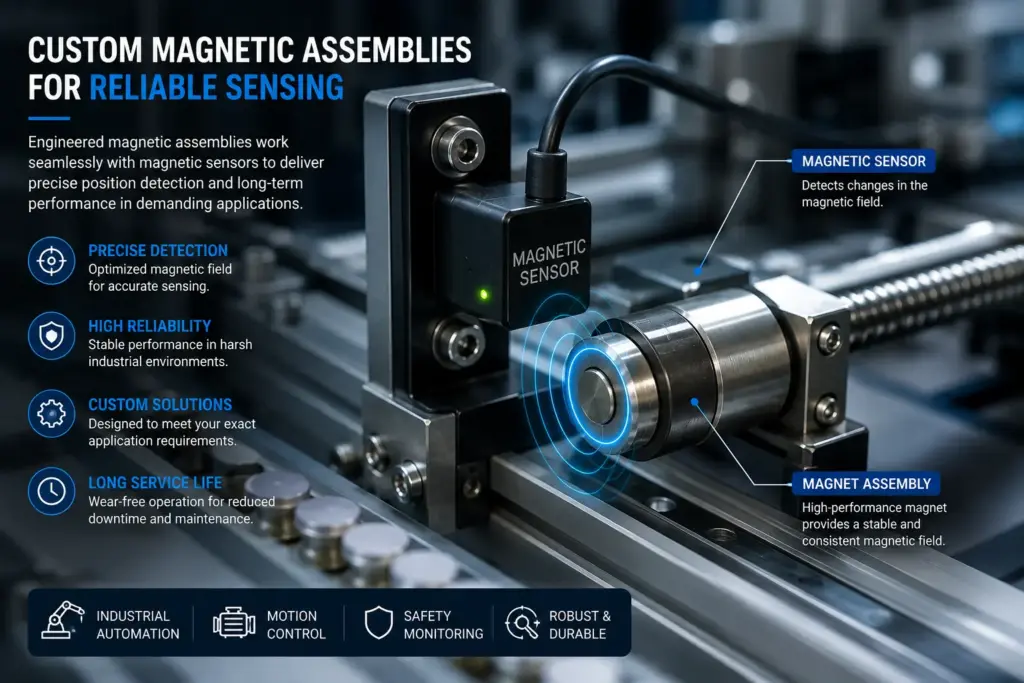
In many applications, custom magnetic assemblies are designed specifically to optimize sensor performance, ensuring reliable detection throughout the product lifecycle.
Selecting the Right Magnetic Solution
Achieving optimal sensor performance requires more than choosing the correct sensing technology. The magnet itself plays a critical role in determining sensing distance, signal stability, and overall system accuracy.
When selecting magnetic components, engineers should consider:
- Magnetic material (NdFeB, SmCo, Ferrite)
- Magnetic field strength
- Operating temperature
- Magnetization direction
- Dimensional tolerance
- Corrosion-resistant coatings
- Assembly integration requirements
Working with an experienced magnetic component manufacturer allows OEMs to optimize both sensor performance and production efficiency.
Conclusion
Magnetic sensors have become indispensable in modern manufacturing because they combine precision, durability, and reliability in a compact, maintenance-friendly solution. Their ability to provide accurate, non-contact measurements improves product quality, reduces downtime, and supports increasingly sophisticated automation systems.
At HSmagnet, we manufacture high-performance permanent magnets and custom magnetic assemblies engineered for industrial sensing applications. Whether you are developing automation equipment, electric motors, or precision manufacturing systems, our engineering team can help deliver magnetic solutions tailored to your specific performance requirements.
Leave a Reply