
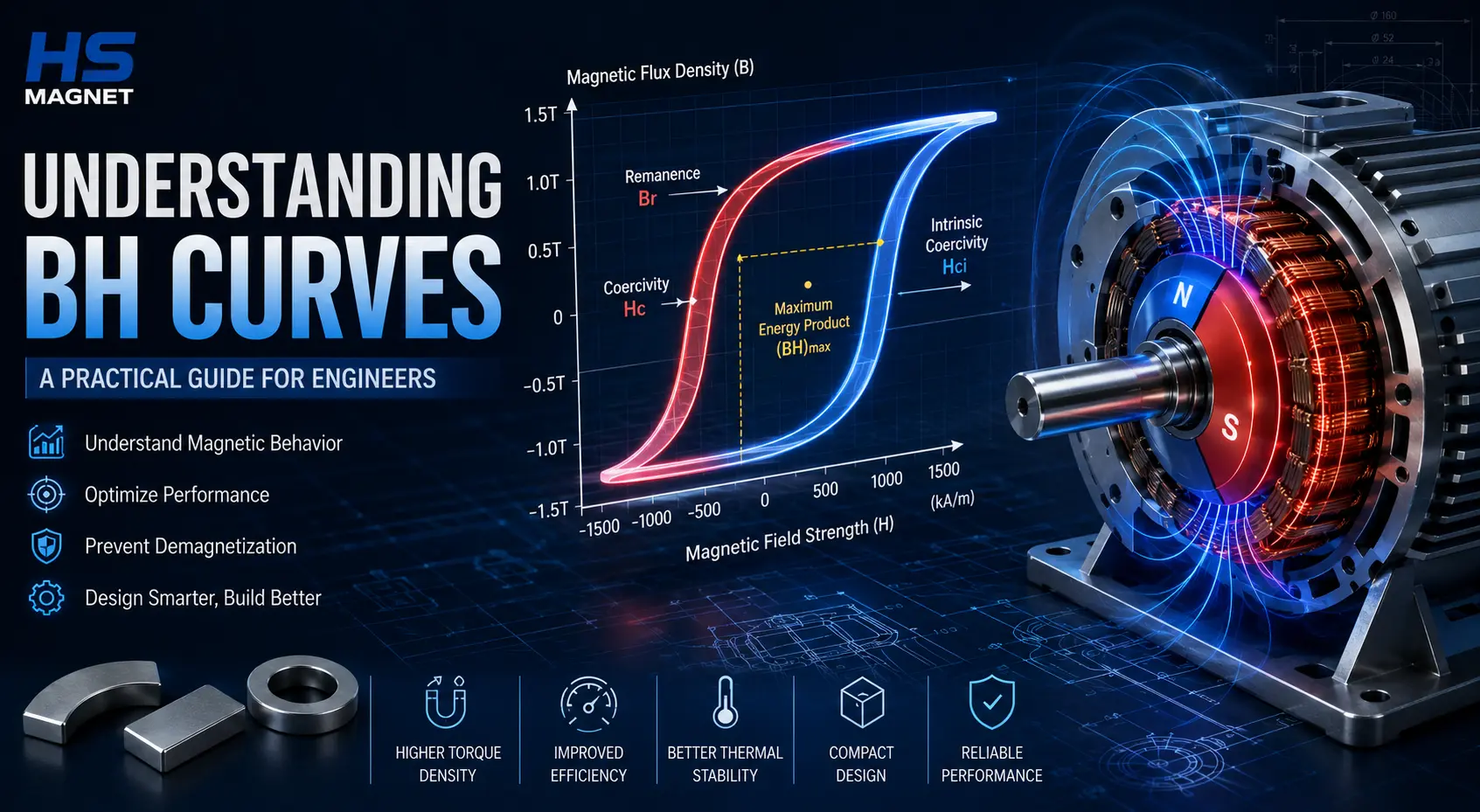
In permanent magnet engineering, few concepts are more important—or more misunderstood—than the BH curve. Whether you are designing electric motors, magnetic assemblies, sensors, or industrial equipment, understanding BH characteristics is essential for optimizing magnetic performance, thermal stability, and system reliability.
This practical guide explains BH curves from an engineering perspective, focusing on how they influence real-world magnet selection and application design.
Table of Contents
- What Is a BH Curve?
- Key Parameters on a BH Curve
- Understanding the Demagnetization Curve
- Comparing BH Curves Across Magnet Types
- BH Curves and Temperature Effects
- BH Curve Selection for Electric Motor Design
- Common Engineering Mistakes
- BH Curves in Simulation and FEA Analysis
- Why Accurate BH Data Matters in Manufacturing
- Why Engineers Partner with HS Magnet
- Conclusion
What Is a BH Curve?
A BH curve, also known as a hysteresis curve or demagnetization curve, describes the relationship between:
- B (Magnetic Flux Density) — measured in Tesla (T) or Gauss (G)
- H (Magnetic Field Strength) — measured in kA/m or Oersted (Oe)
The curve illustrates how a magnetic material responds to an external magnetic field and how it retains magnetization after the field is removed.
For permanent magnet engineers, the BH curve serves as a critical tool for evaluating:
- Magnet strength
- Resistance to demagnetization
- Energy storage capability
- Temperature stability
Key Parameters on a BH Curve
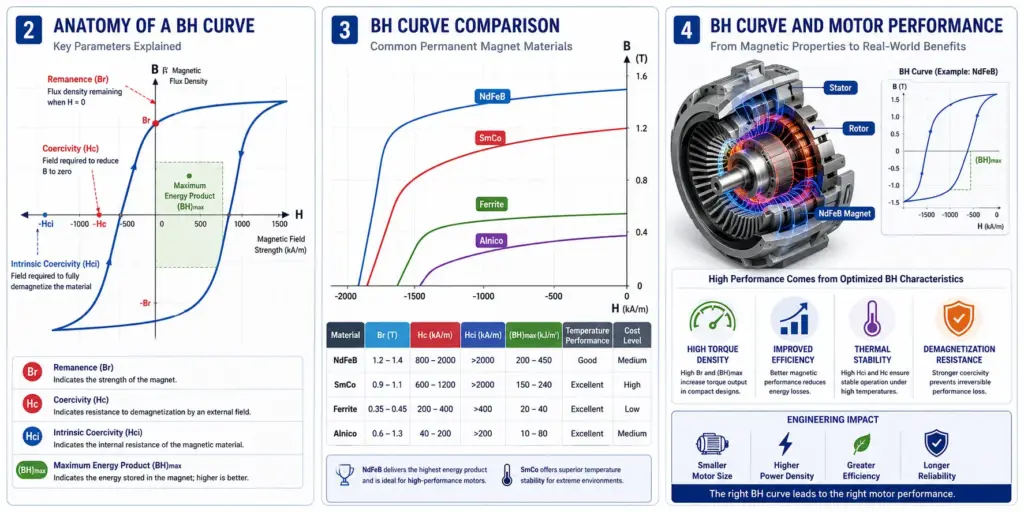
Remanence (Br)
Remanence represents the magnetic flux density remaining after the external magnetic field is removed.
Higher Br values generally indicate:
- Stronger magnetic output
- Higher motor torque potential
- Better magnetic efficiency
NdFeB magnets typically offer very high remanence compared to ferrite magnets.
Coercivity (Hc)
Coercivity measures a magnet’s resistance to demagnetization.
A higher coercivity is critical for applications involving:
- High operating temperatures
- Reverse magnetic fields
- High-speed motors
- Compact magnetic circuits
Applications such as EV traction motors often require high-coercivity NdFeB grades.
Intrinsic Coercivity (Hci)
Intrinsic coercivity represents the magnetic field required to fully demagnetize the material internally.
This parameter is especially important in:
- High-temperature environments
- Dynamic motor systems
- Harsh industrial applications
Maximum Energy Product (BHmax)
The maximum energy product defines the maximum magnetic energy stored within the material.
BHmax
Higher BHmax values allow engineers to:
- Reduce motor size
- Increase power density
- Improve efficiency
NdFeB magnets provide the highest commercially available BHmax among permanent magnet materials.
Understanding the Demagnetization Curve
The second quadrant of the hysteresis loop is typically the most important for permanent magnet applications.
This region shows how the magnet behaves under opposing magnetic fields.
Key Engineering Insight
A magnet operating too close to the “knee point” of the curve risks irreversible demagnetization.
This is particularly important in:
- Electric motors
- Generators
- High-current magnetic assemblies
Engineers should design magnetic circuits with adequate safety margins to avoid entering unstable operating regions.
Comparing BH Curves Across Magnet Types
NdFeB (Neodymium Iron Boron)
Characteristics:
- Very high Br
- Very high BHmax
- Moderate to high coercivity depending on grade
Best for:
- High-efficiency motors
- Compact systems
- EV applications
SmCo (Samarium Cobalt)
Characteristics:
- Excellent temperature stability
- High coercivity
- Lower BHmax than NdFeB
Best for:
- Aerospace
- High-temperature motors
- Defense systems
Ferrite Magnets
Characteristics:
- Lower magnetic strength
- Excellent corrosion resistance
- Cost-effective
Best for:
- Appliances
- Pumps and fans
- Cost-sensitive designs
Alnico Magnets
Characteristics:
- Excellent temperature performance
- Low coercivity
- High remanence
Best for:
- Sensors
- Specialized magnetic circuits
BH Curves and Temperature Effects
Temperature significantly impacts magnetic performance.
Typical Trends
- Remanence decreases as temperature rises
- Coercivity can drop sharply at elevated temperatures
- Excessive heat may cause irreversible demagnetization
For example:
- Standard NdFeB magnets often operate below 150°C
- SmCo magnets can exceed 300°C operating environments
BH Curve Selection for Electric Motor Design
When selecting magnets for motors, engineers should evaluate:
| Parameter | Design Impact |
|---|---|
| High Br | Increases torque density |
| High Hci | Improves demagnetization resistance |
| High BHmax | Enables compact motor design |
| Thermal stability | Maintains long-term efficiency |
Motor applications typically require balancing:
- Performance
- Thermal reliability
- Cost
- Supply chain considerations
Common Engineering Mistakes
Ignoring Temperature Derating
Many failures occur because engineers use room-temperature BH data for high-temperature applications.
Always evaluate BH curves at actual operating temperatures.
Over-Specifying Magnet Grades
Higher-grade magnets increase cost significantly.
In some cases, optimized magnetic circuit design delivers better ROI than simply selecting stronger magnets.
Operating Near the Knee Point
Designing too close to the knee point increases demagnetization risk during overload conditions.
Finite element analysis (FEA) should be used to validate operating margins.
BH Curves in Simulation and FEA Analysis
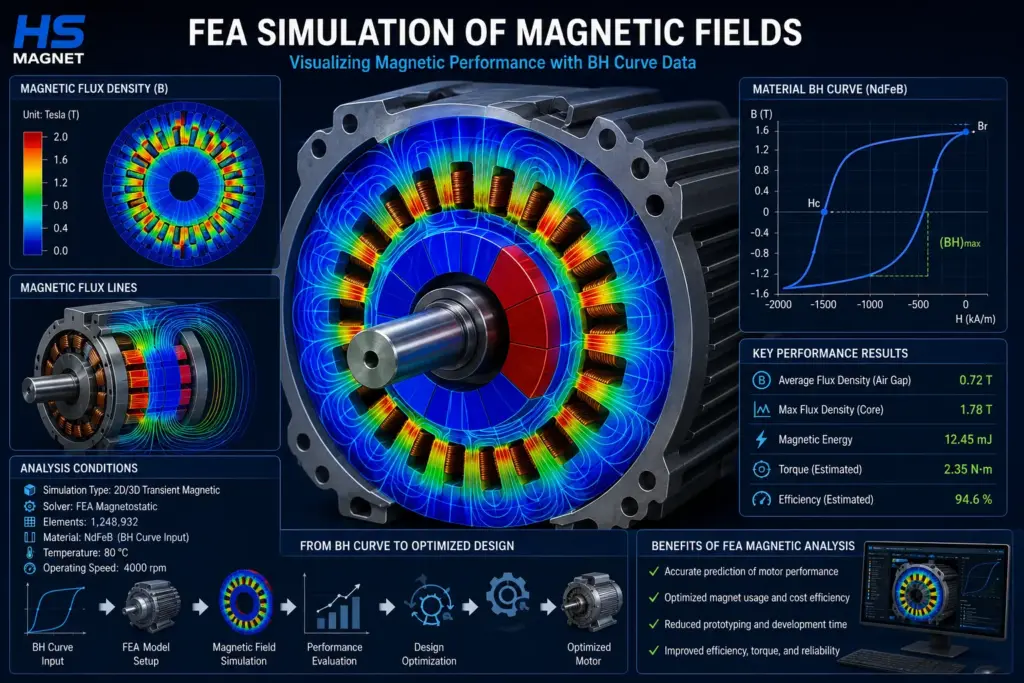
Modern motor and magnetic system design heavily relies on simulation tools.
BH curves are essential inputs for:
- Finite element analysis (FEA)
- Motor optimization
- Thermal simulations
- Electromagnetic performance prediction
Accurate BH data improves:
- Torque prediction
- Efficiency modeling
- Thermal reliability
- Product lifecycle performance
Why Accurate BH Data Matters in Manufacturing
Not all magnets with identical nominal grades perform equally.
Factors influencing actual BH performance include:
- Material composition
- Grain alignment
- Sintering quality
- Coating process
- Manufacturing consistency
Reliable suppliers should provide:
- Certified BH curve data
- Temperature performance data
- Material traceability
- Application engineering support
Why Engineers Partner with HS Magnet
At HS Magnet, we support industrial customers with precision-engineered permanent magnet solutions backed by reliable magnetic characterization data.
Our capabilities include:
- NdFeB, SmCo, Ferrite, and Alnico magnets
- Custom BH curve analysis
- Magnet selection support for motors and industrial systems
- Advanced coating and thermal solutions
- Stable manufacturing quality for global B2B applications
We help engineering teams optimize magnetic performance while balancing cost, reliability, and manufacturability.
Conclusion
BH curves are more than laboratory graphs—they are foundational engineering tools that directly influence motor efficiency, magnetic stability, and product reliability.
By understanding parameters such as:
- Remanence
- Coercivity
- Intrinsic coercivity
- Maximum energy product
Engineers can make smarter magnet selection decisions and build more efficient, durable systems.
In high-performance applications, mastering BH curve interpretation is not optional—it is a core competency for competitive engineering design.
Leave a Reply