
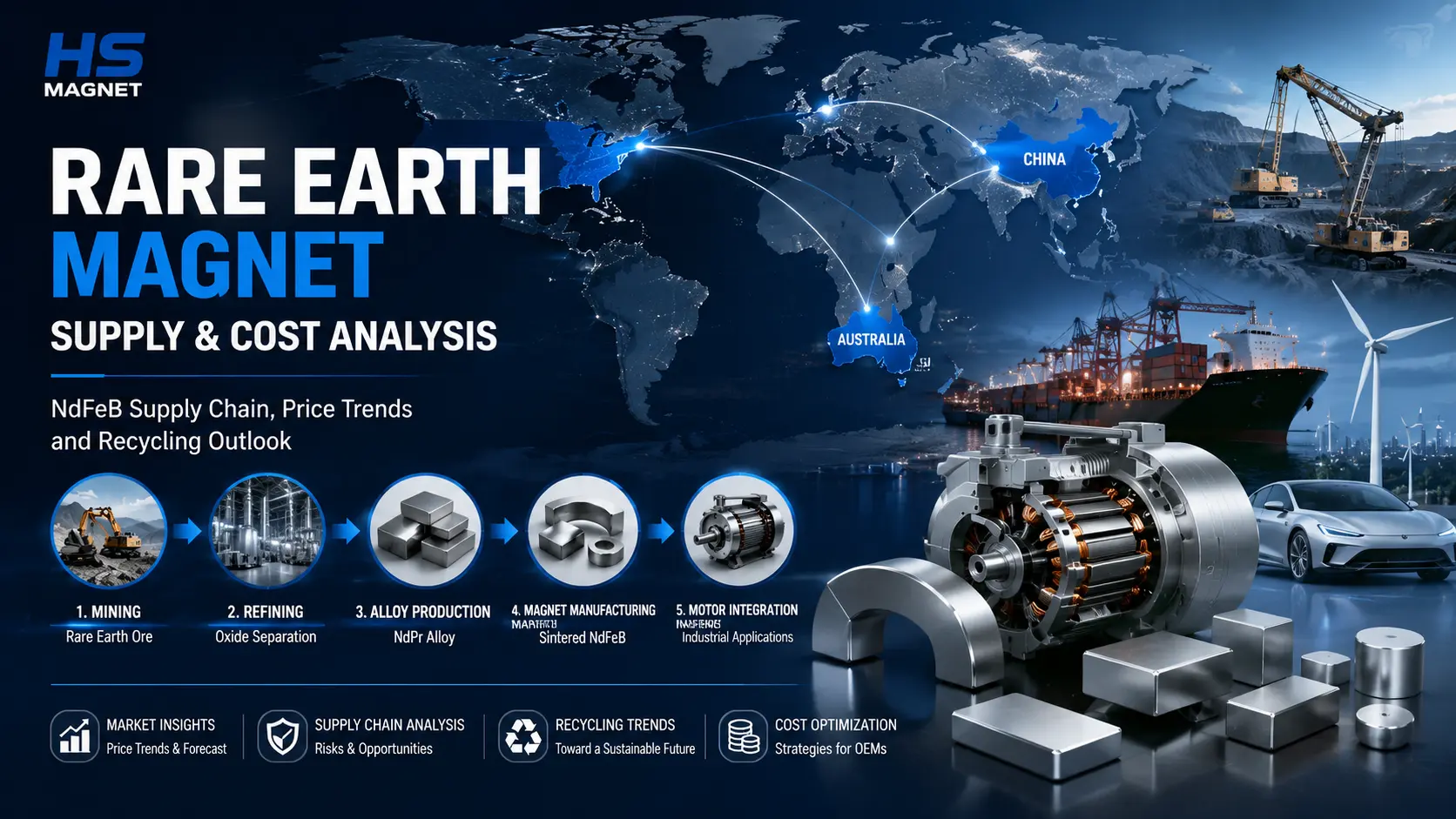
In today’s electrification-driven economy, rare earth permanent magnets—especially NdFeB—have evolved from commodity materials into strategic industrial assets. For motor manufacturers and OEM procurement teams, understanding supply chain dynamics and cost drivers is critical for maintaining competitiveness and mitigating risk.
This analysis outlines the upstream structure, pricing mechanisms, and emerging recycling trends shaping the NdFeB magnet market.
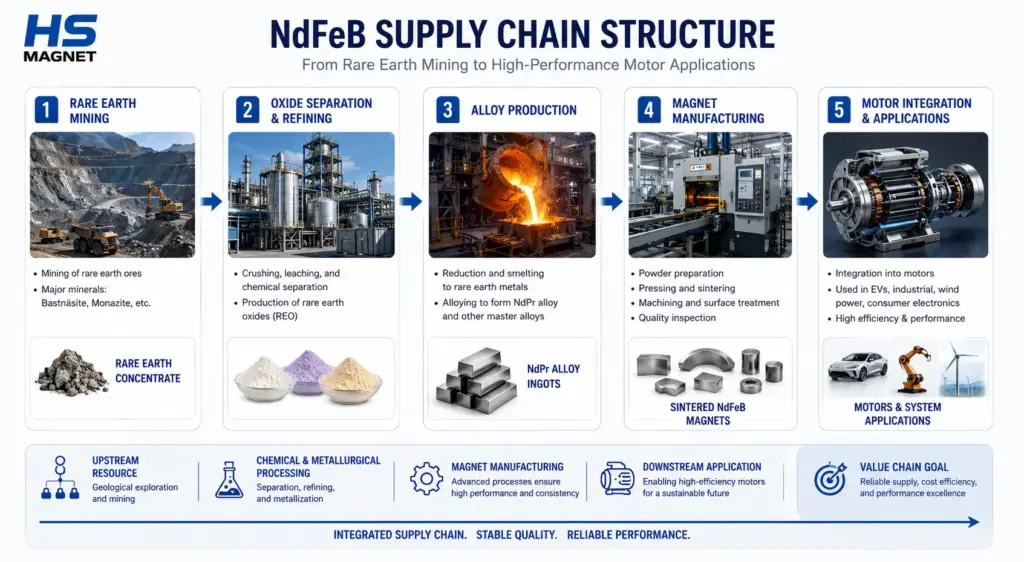
NdFeB Supply Chain Structure
Upstream: Mining and Raw Material Extraction
The NdFeB supply chain begins with rare earth mining, primarily focused on:
- Neodymium (Nd)
- Praseodymium (Pr)
- Dysprosium (Dy) and Terbium (Tb) for high-temperature grades
China dominates this stage, accounting for a significant share of global mining and an even larger portion of refining capacity—often exceeding 70–90% depending on the segment .
Strategic implication:
Supply concentration creates structural dependency and geopolitical exposure for global manufacturers.
Midstream: Separation, Alloying, and Magnet Production
After extraction, rare earth ores undergo:
- Chemical separation into oxides
- Metallization into alloys (NdPr metal)
- Magnet production (sintered NdFeB or bonded magnets)
The NdPr alloy is the primary cost driver, accounting for the majority of magnet material cost—often up to ~70% of total value .
Key bottleneck:
Even when mining expands globally, processing and magnet manufacturing remain highly concentrated in Asia, limiting supply diversification.
Downstream: Motor and System Integration
NdFeB magnets are widely used in:
- Electric vehicles (EV traction motors)
- Wind turbines
- Industrial automation
- Consumer electronics
Demand growth from these sectors continues to outpace supply expansion, reinforcing tight market conditions.
Price Volatility: Core Drivers and Market Dynamics
1. Raw Material Price Sensitivity (NdPr Focus)
NdFeB pricing is highly sensitive to NdPr fluctuations:
- NdPr prices increased sharply, reaching near 1 million CNY/ton in early 2026
- Year-over-year increases approaching 80–90% have been observed in tight supply cycles
Because raw materials dominate cost structure, magnet prices respond almost immediately to upstream price shifts.
2. Supply–Demand Imbalance
Demand growth drivers include:
- EV production scaling
- Renewable energy expansion
- Robotics and automation
At the same time:
- Mining quotas and environmental controls limit supply growth
- Processing capacity expansion lags behind demand
This imbalance leads to structural tightness and periodic price spikes .
3. Policy and Geopolitical Risk
Recent developments highlight increasing geopolitical influence:
- Export controls on rare earth materials and technologies
- Regulatory shifts in the U.S. and EU to reduce dependence on Chinese supply
- Strategic initiatives (e.g., G7 cooperation) to rebuild alternative supply chains
Impact:
Policy-driven disruptions can trigger sudden price surges and supply shortages.
4. Market Cyclicality and Demand Fluctuations
The rare earth market exhibits strong cyclical behavior:
- Periods of rapid price increases due to speculation or policy tightening
- Followed by corrections when downstream demand weakens
For example:
- Prices surged sharply in late 2025
- Then stabilized or declined as procurement slowed
Key takeaway:
Volatility is structural, not temporary.
Cost Structure Breakdown of NdFeB Magnets
Typical cost composition includes:
- 70%+ Raw materials (NdPr, Dy, Tb)
- 10–15% Processing and sintering
- 5–10% Machining and finishing
- 5–10% Coating and logistics
This structure means cost optimization strategies must focus upstream, not just manufacturing efficiency.
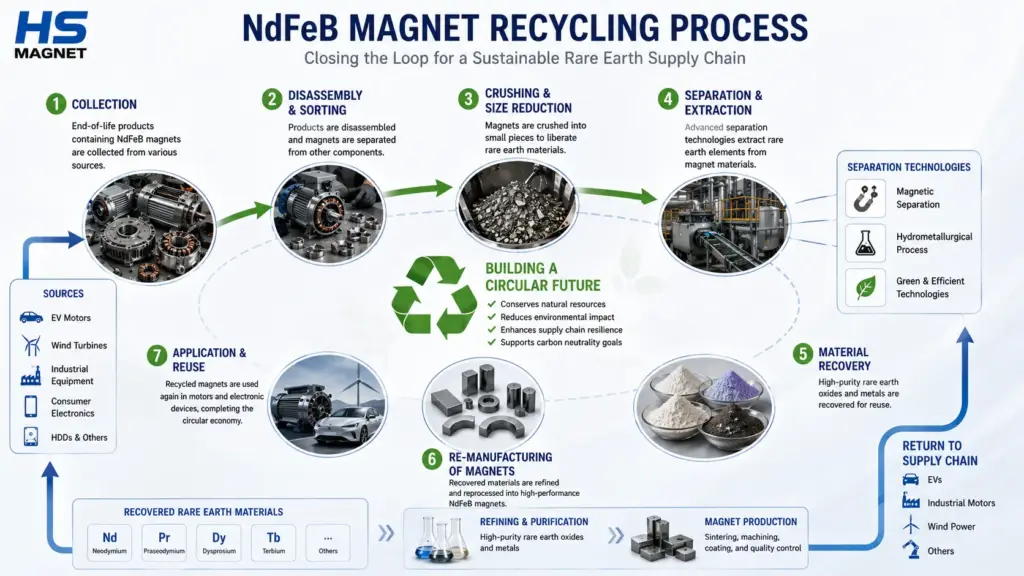
Recycling Trends and Circular Supply Chain Development
1. Growing Importance of Magnet Recycling
With supply constraints intensifying, recycling is becoming a strategic priority:
- Recovery of rare earth elements from end-of-life motors and electronics
- Increasing reuse of NdFeB scrap materials
- Industrial-scale recycling technologies gaining traction
Recycling reduces dependency on primary mining and stabilizes supply.
2. Economic and Environmental Drivers
Key motivations include:
- Lower exposure to raw material price volatility
- Reduced environmental impact compared to mining
- Alignment with ESG and regulatory requirements
Additionally, recycled materials often provide cost advantages during high-price cycles.
3. Current Limitations
Despite its potential, recycling faces challenges:
- Collection and sorting inefficiencies
- Technical complexity in separating rare earth elements
- Limited global infrastructure
However, investment in recycling capacity is accelerating as part of supply chain diversification strategies.
Strategic Outlook for Magnet Buyers
1. Supply Chain Diversification
Manufacturers are increasingly:
- Sourcing from multiple regions (Australia, U.S., Southeast Asia)
- Building long-term partnerships with magnet suppliers
- Investing in localized production capacity
2. Procurement Strategy Evolution
Best-in-class procurement teams are:
- Implementing index-linked pricing contracts
- Securing forward purchasing agreements
- Integrating material risk into product design
3. Material Innovation and Substitution
To reduce dependency:
- Ferrite-based motor designs are being explored
- Heavy rare earth usage is being minimized
- Hybrid magnet systems are emerging
Why Partner with HS Magnet
At HS Magnet, we align with global supply chain trends to deliver stable, high-performance solutions:
- Integrated sourcing strategy for NdFeB raw materials
- Advanced manufacturing and coating capabilities
- Flexible supply models to mitigate price volatility
- Engineering support for cost-performance optimization
We help B2B clients navigate uncertainty while maintaining efficiency and product reliability.
Conclusion
The NdFeB magnet market is entering a new phase defined by supply concentration, price volatility, and strategic resource competition.
For manufacturers, success depends on:
- Deep understanding of upstream cost drivers
- Proactive supply chain diversification
- Adoption of recycling and circular economy practices
In this environment, magnet sourcing is no longer a transactional decision—it is a strategic lever for long-term competitiveness.
Leave a Reply