
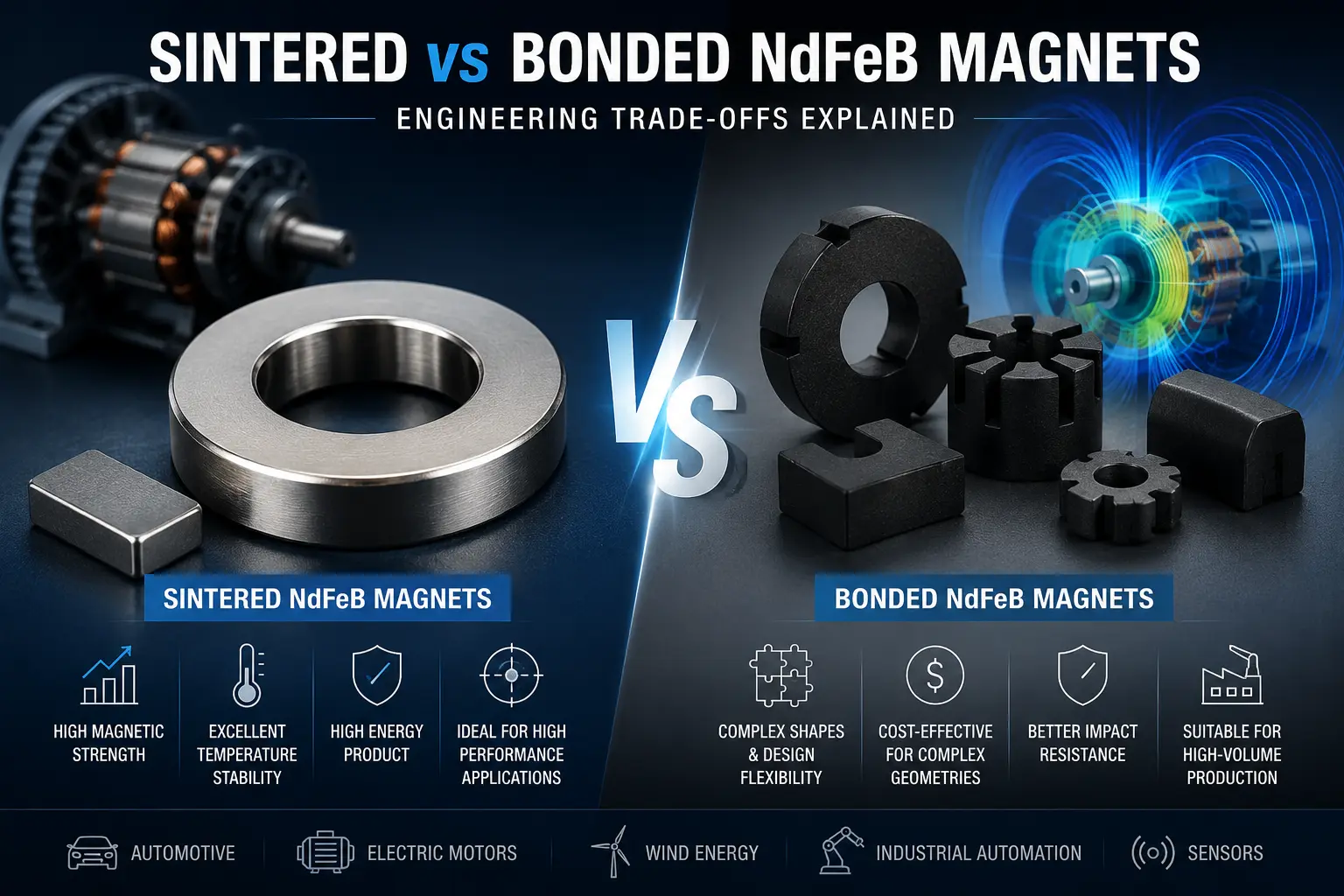
Neodymium Iron Boron (NdFeB) magnets are among the strongest permanent magnets available today and are widely used in electric motors, sensors, automotive systems, consumer electronics, and industrial automation. However, not all NdFeB magnets are manufactured in the same way. The two primary categories are sintered NdFeB magnets and bonded NdFeB magnets, each offering distinct advantages and limitations.
Understanding the engineering trade-offs between these magnet types is essential for selecting the most suitable solution for your application.
What Are Sintered NdFeB Magnets?
Sintered NdFeB magnets are produced by compacting and sintering rare earth magnetic powder under high temperature and pressure. This process creates a dense magnetic structure with exceptional magnetic performance.
Key characteristics include:
- Extremely high magnetic strength
- High energy product (BHmax)
- Excellent magnetic stability
- Suitable for demanding industrial applications
- Available in various grades such as N35, N42, N52, and high-temperature grades
Because of their superior magnetic properties, sintered NdFeB magnets are commonly used in electric vehicle motors, wind turbines, industrial motors, and magnetic assemblies requiring maximum performance.
What Are Bonded NdFeB Magnets?
Bonded NdFeB magnets are manufactured by mixing magnetic powder with a polymer binder and then molding the material into the desired shape through injection molding or compression molding.
Key characteristics include:
- Complex shapes can be produced directly
- Tight dimensional tolerances
- Lower manufacturing costs for intricate designs
- Better resistance to chipping and cracking
- Lower magnetic strength compared to sintered magnets
Bonded magnets are frequently found in automotive sensors, small electric motors, office equipment, and consumer electronics where design flexibility is more important than maximum magnetic power.
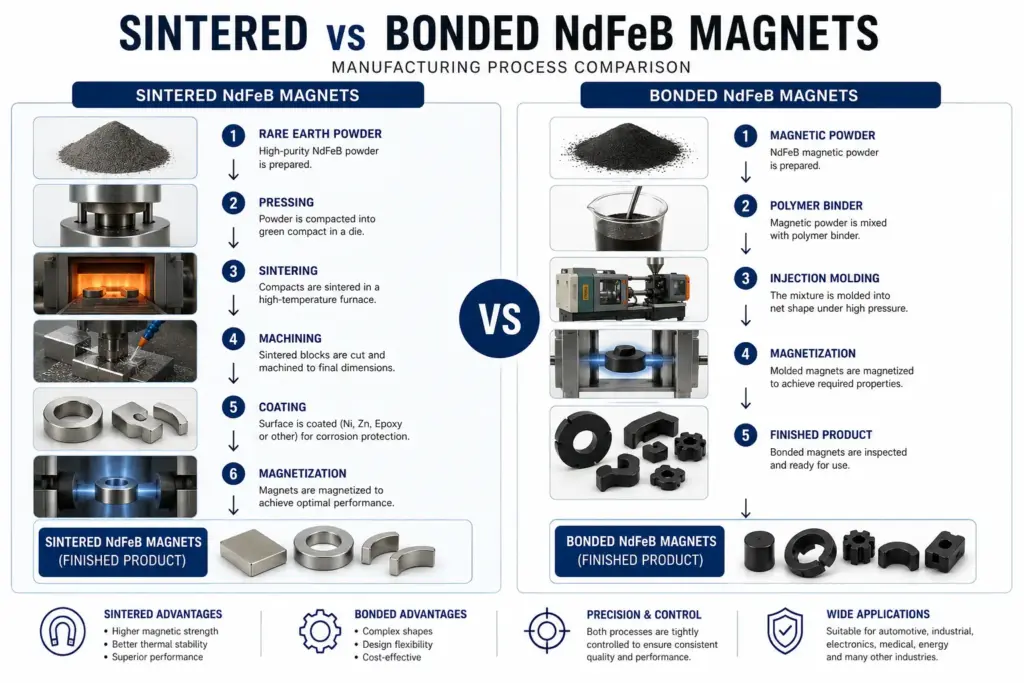
Performance Comparison
Magnetic Strength
Sintered NdFeB magnets offer significantly higher magnetic flux density and energy product than bonded magnets. In applications where space is limited and high magnetic output is required, sintered magnets are usually the preferred choice.
Design Flexibility
Bonded NdFeB magnets excel in design freedom. Complex geometries, thin-wall structures, and integrated components can often be molded in a single manufacturing process, reducing assembly costs.
Mechanical Properties
While sintered magnets are relatively brittle and may require protective coatings, bonded magnets possess greater impact resistance due to their polymer matrix.
Temperature Performance
High-temperature sintered grades can operate in demanding environments exceeding 180°C. Bonded magnets generally offer lower temperature resistance but provide stable performance in many standard applications.
Which Magnet Type Should You Choose?
The choice ultimately depends on application requirements.
Choose sintered NdFeB magnets when:
- Maximum magnetic strength is required
- High motor efficiency is critical
- Space constraints demand higher flux density
- Industrial or energy applications require long-term reliability
Choose bonded NdFeB magnets when:
- Complex geometries are needed
- Weight reduction is important
- High-volume production is required
- Cost-effective manufacturing is a priority
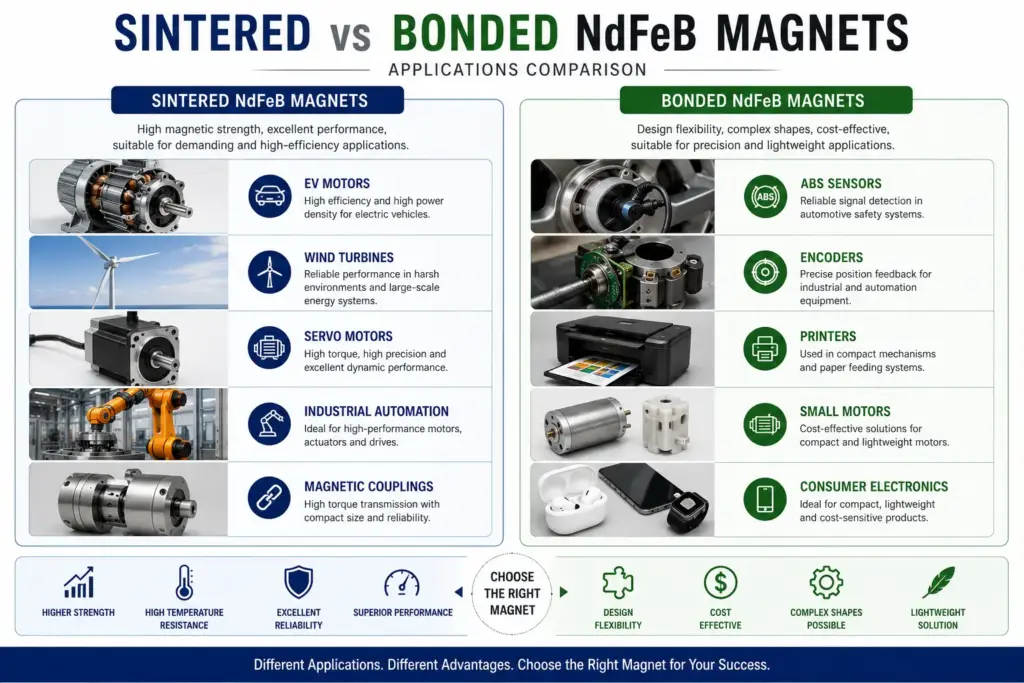
Conclusion
Both sintered and bonded NdFeB magnets play important roles in modern engineering. Sintered magnets deliver unmatched magnetic performance, while bonded magnets provide exceptional design flexibility and manufacturing efficiency. By carefully evaluating performance requirements, operating conditions, and production costs, engineers can select the optimal magnetic solution for their specific application.
At HSMagnet, we provide customized sintered NdFeB magnets, bonded magnetic solutions, and magnetic assemblies tailored to the needs of industrial, automotive, and energy-sector customers worldwide.
Leave a Reply