Category: Magnetic Applicaitons

  • The Role of Magnets in Green Power Generation

    The Role of Magnets in Green Power Generation

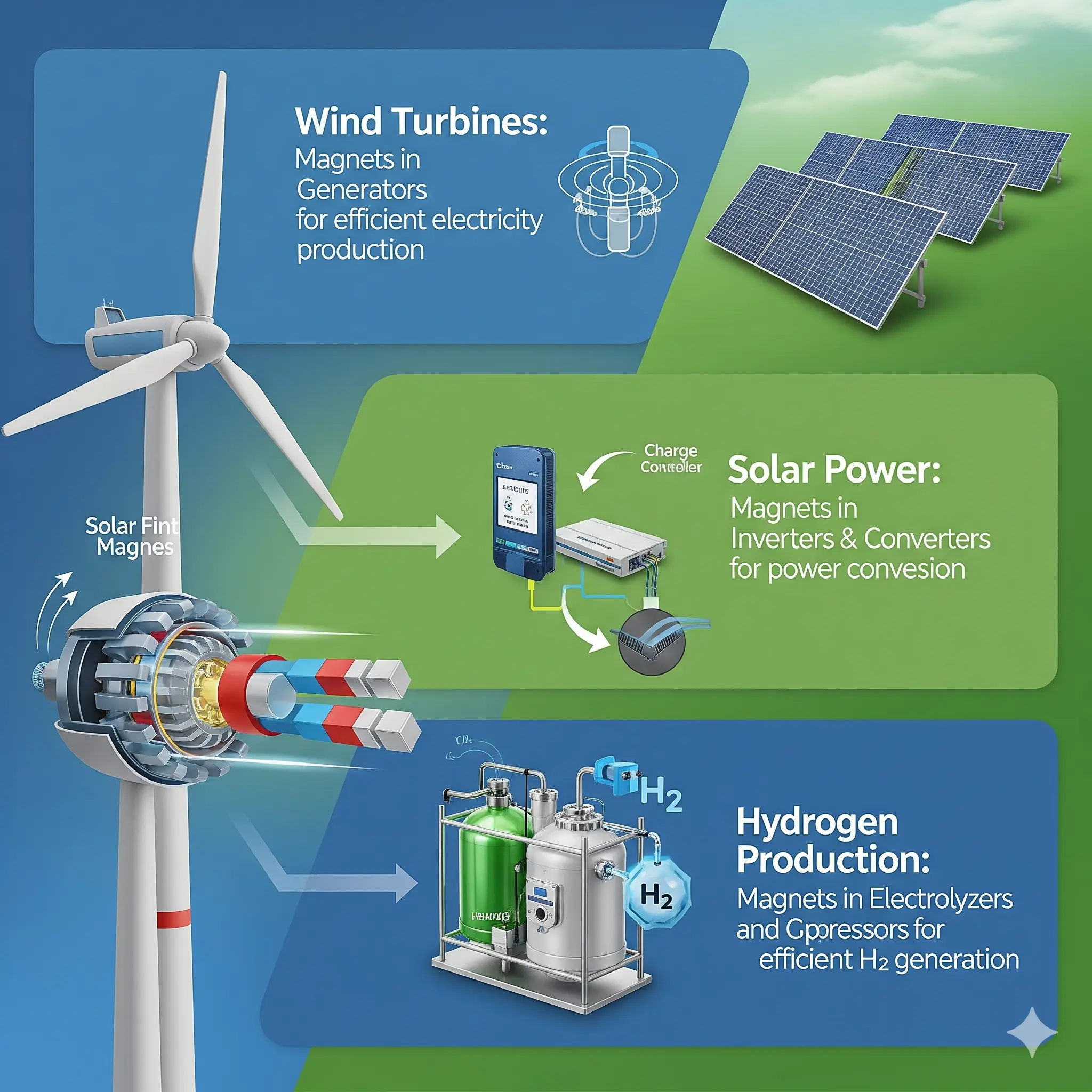
    With the rapid development of renewable energy, magnets—especially rare earth permanent magnets like NdFeB (neodymium iron boron) and SmCo—have become key components in many green power technologies. From wind turbines to solar inverters and hydrogen fuel cells, magnets help improve efficiency, reduce energy loss, and support the global transition to clean energy.

    Magnets in Wind Power Generation

    Permanent Magnet Direct Drive Wind Turbines

    Modern wind turbines increasingly use permanent magnet direct-drive or semi-direct-drive systems, where magnets replace traditional gearbox systems. Major benefits include:

    • Higher generation efficiency
    • Lower maintenance cost
    • Better performance in low wind speeds
    • Longer service life

    The permanent magnets provide a strong magnetic field, helping convert wind energy into electricity more efficiently.

    Converters and Control Systems

    Power converters in wind turbines use magnetic components like inductors and transformers, which rely on magnetic steel. High-quality magnetic materials improve conversion efficiency and ensure stable operation in variable wind conditions.
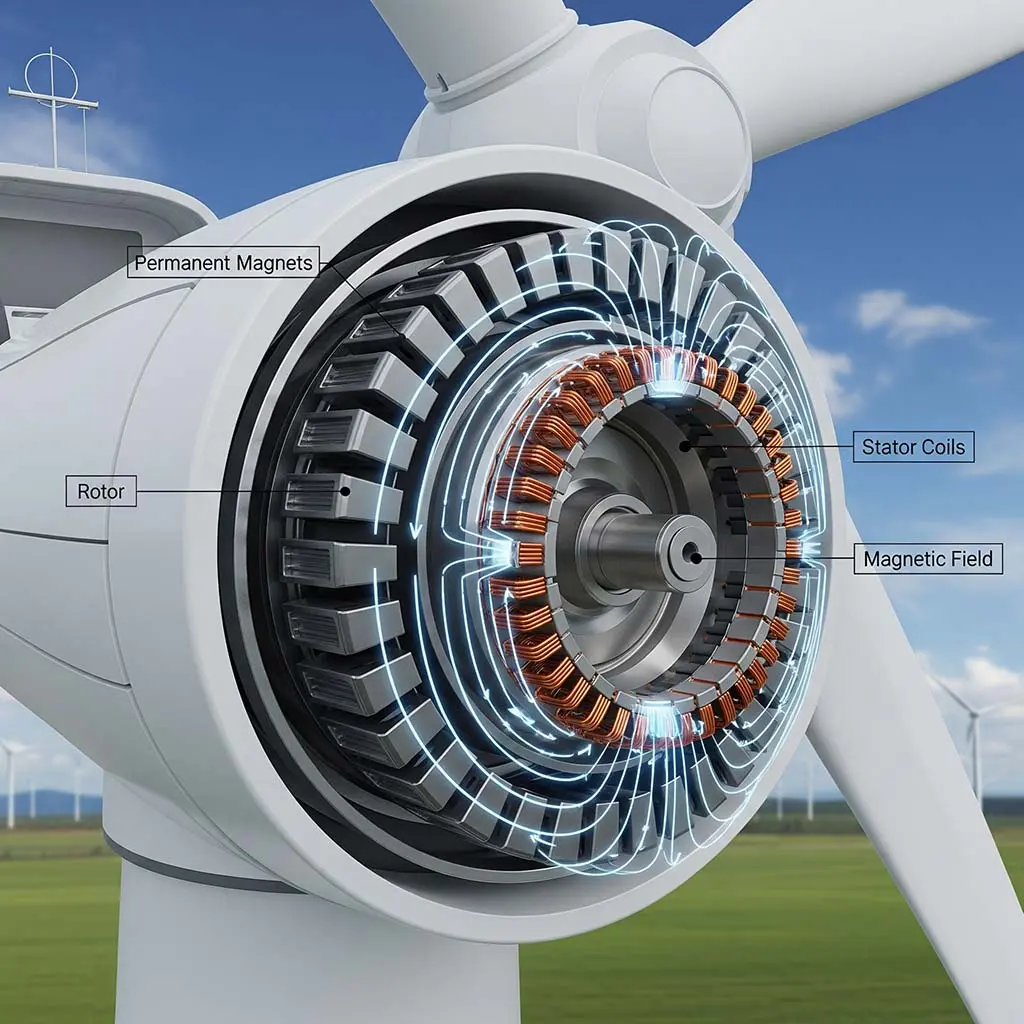
    the application of magnets in a wind turbine generator

    Magnets in Solar Photovoltaic Systems

    Inverters

    The solar inverter converts DC electricity from solar panels into usable AC electricity. Inductors and transformers in these inverters use magnetic steel. Using high-performance magnetic materials helps:

    • Increase power density
    • Reduce energy loss
    • Improve overall system efficiency

    Energy Storage Systems (ESS)
    In solar battery storage systems, magnets are used in:

    • Current sensors for monitoring battery flow
    • Position sensors in battery management systems (BMS)
      This ensures accurate control and safe operation of lithium battery packs.
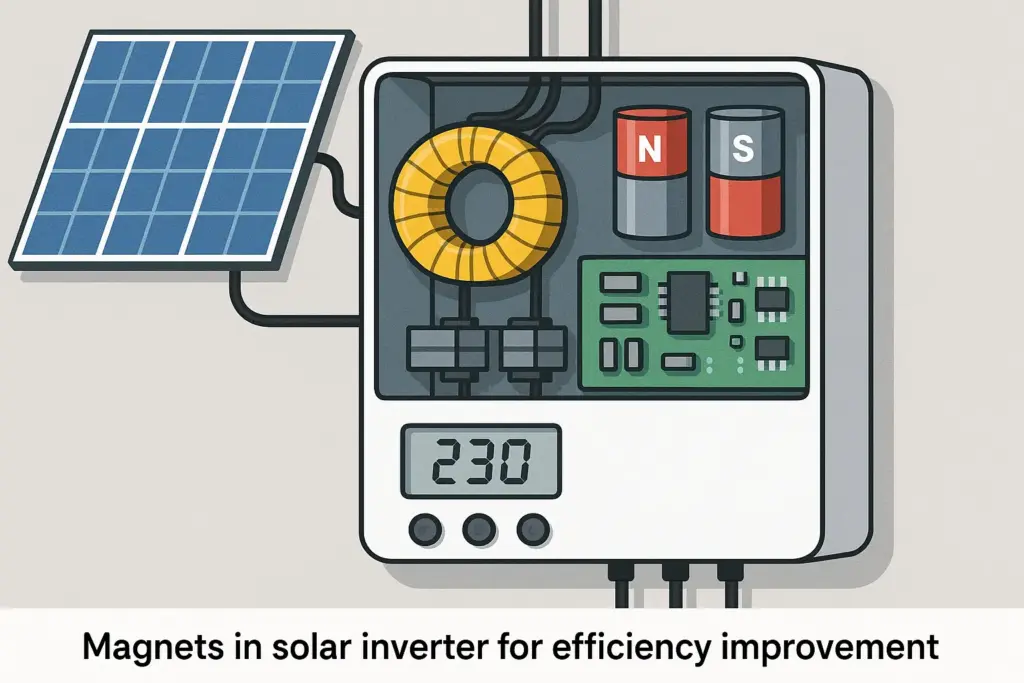
    Magnets in solar inverter for efficiency improvement

    Magnets in Hydrogen Fuel Cell Technology

    Hydrogen fuel cells depend on components that often contain magnetic alloys or use magnetic fields to control the fuel flow and monitor system operation. Magnets are utilized in:

    • Sensors
    • Electric pumps
    • Power conditioning devices

    Their presence helps enhance the performance and reliability of hydrogen-based clean energy solutions.

    New Energy Ships and Offshore Power

    In electric and hybrid marine vessels, especially those powered by renewable energy or battery systems, permanent magnet motors are used for propulsion. Benefits include:

    • High torque output
    • Lower noise (important for marine environments)
    • Improved energy conversion efficiency

    Conclusion

    Magnets are a foundation in many green energy technologies. Whether it’s wind turbines, solar PV, or hydrogen systems, magnetic materials make renewable energy generation more efficient, reliable, and scalable. As the world continues to pursue carbon neutrality, the demand for advanced magnetic materials will continue to grow in the renewable energy industry.
  • Choosing the Right Permanent Magnet Materials for Hall Sensors

    Choosing the Right Permanent Magnet Materials for Hall Sensors

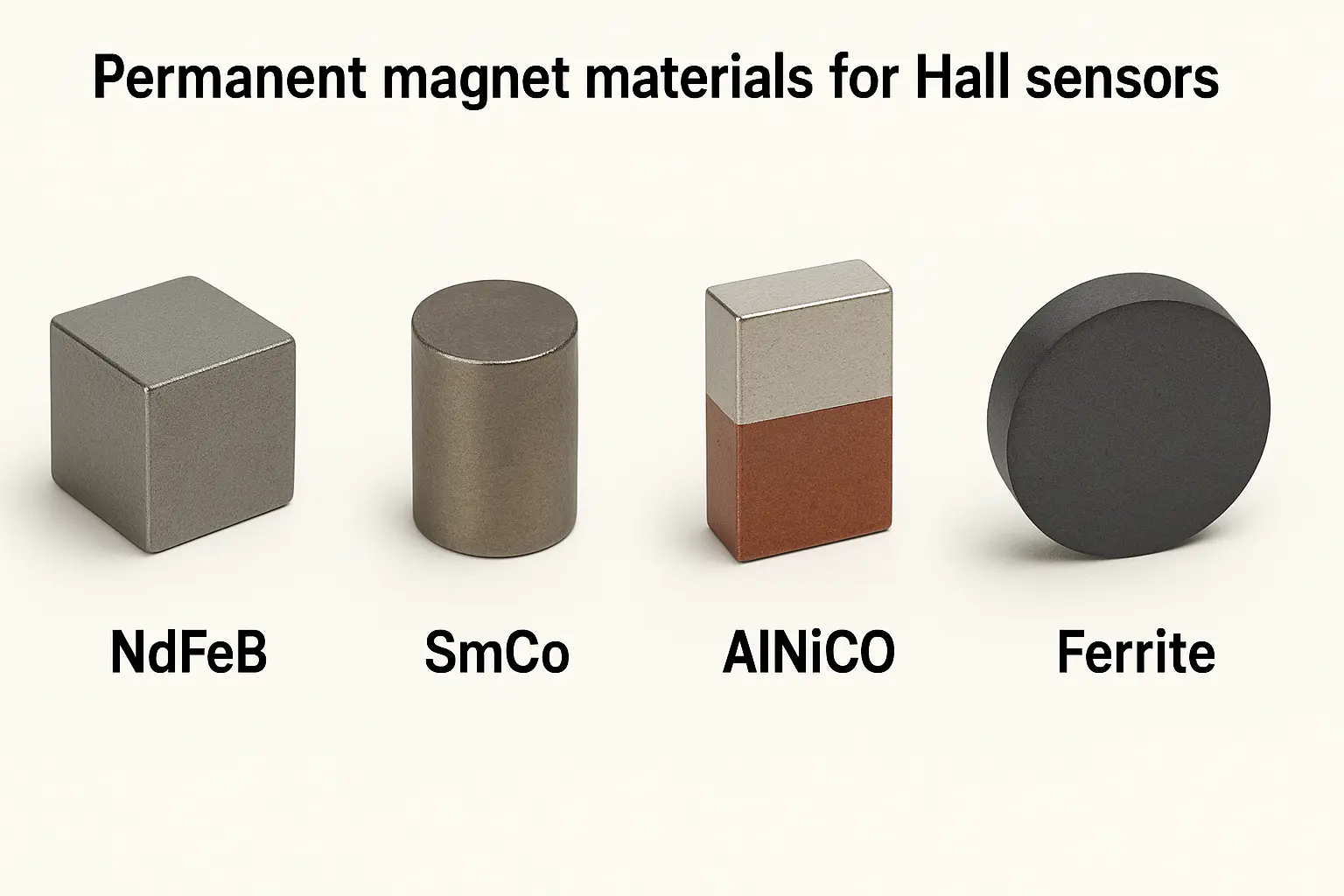
    At HS Magnet, a leading magnet manufacturer, we understand the critical role permanent magnets play in Hall sensor applications. Hall sensors, used for position detection, speed measurement, and current sensing, rely on a stable magnetic field to function effectively. Selecting the right permanent magnet material is key to optimizing sensor performance, reliability, and cost-efficiency. In this guide, we explore the most common permanent magnet materials—Neodymium Iron Boron (NdFeB), Samarium Cobalt (SmCo), Aluminum Nickel Cobalt (AlNiCo), and Ferrite—and their ideal applications in Hall sensors.

    Why Permanent Magnet Selection Matters for Hall Sensors

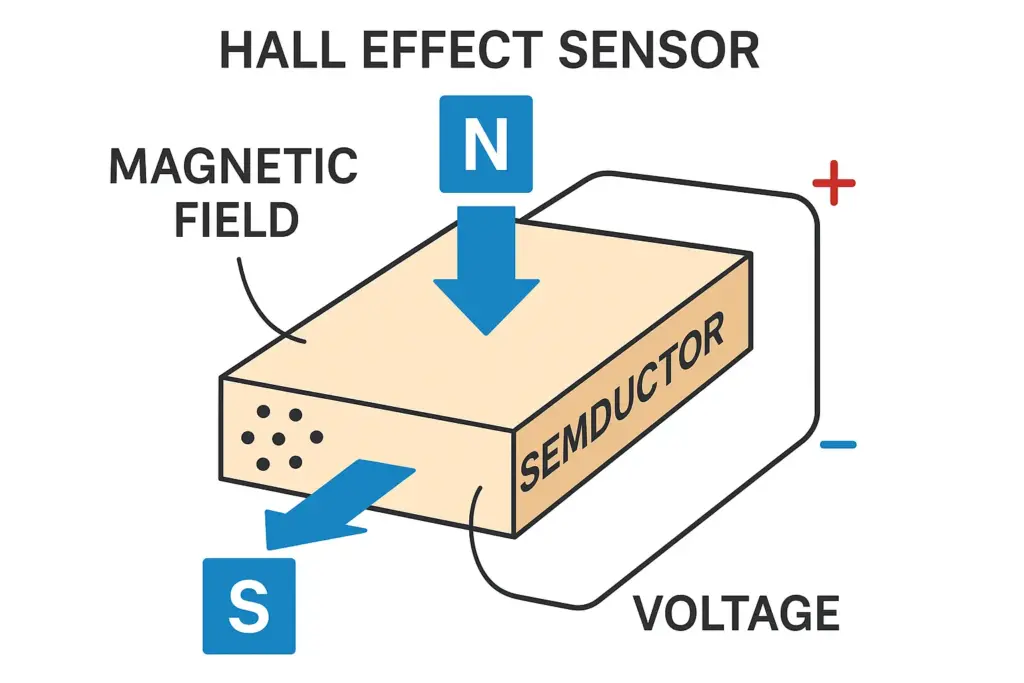
    Hall sensors operate based on the Hall effect, where a magnetic field generates a voltage that enables precise measurements. The choice of permanent magnet material directly impacts the sensor’s accuracy, durability, and suitability for specific environments. Factors like magnetic field strength, operating temperature, size constraints, and budget guide material selection. Let’s dive into the characteristics, advantages, and applications of each material.

    1. Neodymium Iron Boron (NdFeB) Magnets

    Features

    • Highest Magnetic Strength: NdFeB magnets offer the highest magnetic energy product, delivering powerful magnetic fields in compact sizes.
    • Ideal for Precision: Their high field strength supports high-precision applications in small spaces.

    Advantages

    • Provides a strong, stable magnetic field for accurate measurements.
    • Perfect for miniaturized, high-frequency, and high-precision sensors.

    Applications

    • Motor Speed Sensors: NdFeB magnets ensure accurate rotor speed detection in electric motors.
    • Angle and Position Sensors: Ideal for compact designs requiring precise angle or position tracking.
    • Automotive Electronics: Used in wheel speed sensors for reliable performance in demanding automotive systems.

    Why Choose NdFeB from HS Magnet?
    Our high-grade NdFeB magnets are engineered for maximum strength and durability, making them the top choice for cutting-edge Hall sensor applications.

    NdFeB magnets in motor speed Hall sensors for precision

    2. Samarium Cobalt (SmCo) Magnets

    Features

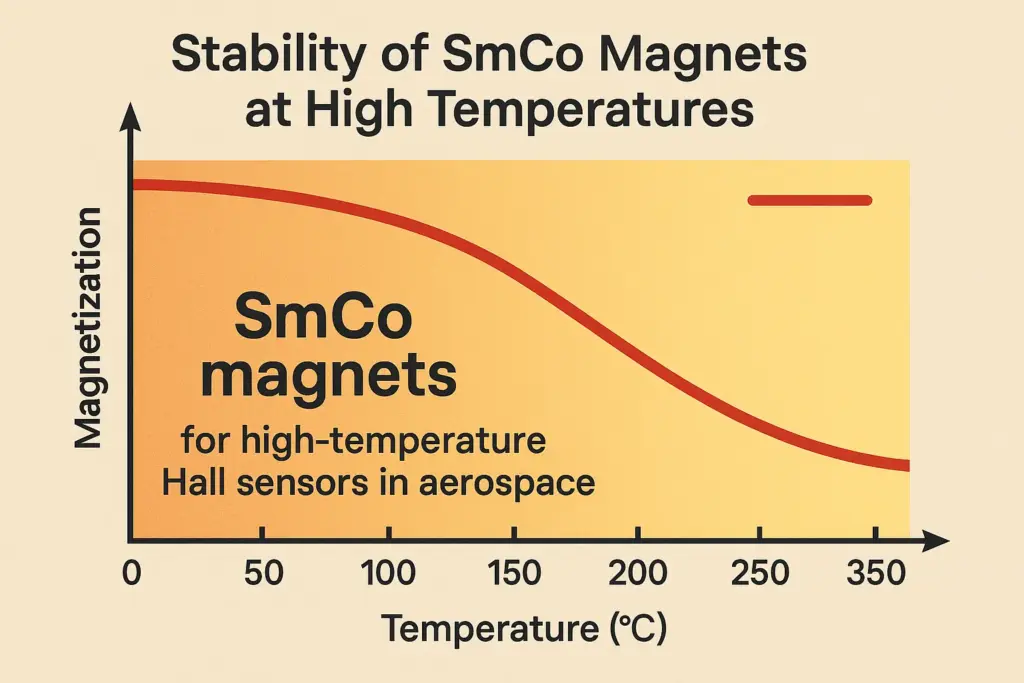
    • Superior High-Temperature Performance: SmCo magnets maintain stability in extreme heat, outperforming NdFeB in high-temperature environments.
    • Strong Magnetic Field: While not as powerful as NdFeB, SmCo offers excellent magnetic stability.

    Advantages

    • Exceptional performance in temperatures up to 300°C.
    • High corrosion resistance for long-term reliability.

    Applications

    • Automotive Engine Sensors: SmCo magnets deliver consistent performance in high-heat engine environments.
    • Aerospace and Military: Trusted for high-precision sensors in extreme conditions.

    Why Choose SmCo from HS Magnet?
    Our SmCo magnets are crafted for superior thermal stability and corrosion resistance, ensuring reliable performance in the toughest environments.

    SmCo magnets for high-temperature Hall sensors in aerospace

    3. Aluminum Nickel Cobalt (AlNiCo) Magnets

    Features

    • Stable Across Temperatures: AlNiCo magnets maintain magnetic consistency despite temperature fluctuations.
    • Moderate Magnetic Strength: Lower than NdFeB and SmCo but sufficient for many applications.

    Advantages

    • Excellent high-temperature stability, ideal for fluctuating conditions.
    • Cost-effective for budget-conscious projects.

    Applications

    • Home Appliances: Used in sensors for appliances like washing machines and refrigerators.
    • Low-to-Medium Field Applications: Suitable for position sensors in mechanical equipment.

    Why Choose AlNiCo from HS Magnet?
    Our AlNiCo magnets offer a cost-effective solution with reliable performance, perfect for applications requiring thermal stability.

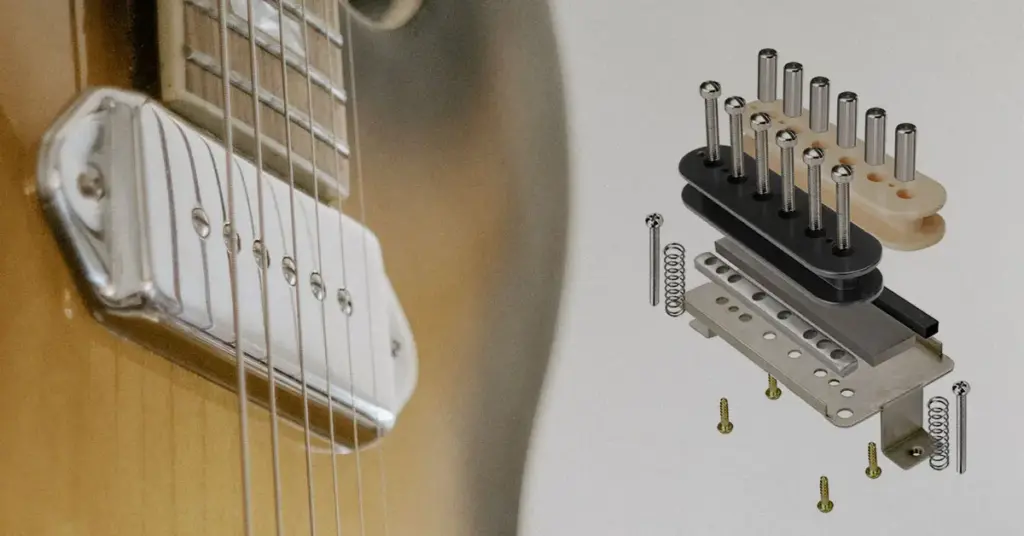
    Close-up of guitar pickup magnets showing alnico rods and bar sizes.

    4. Ferrite Magnets

    Features

    • Low Magnetic Strength: Ferrite magnets provide moderate magnetic fields but are highly cost-effective.
    • Good Electrical Insulation: Ideal for electrical environments requiring insulation.

    Advantages

    • Affordable, making them ideal for mass-produced sensors.
    • Excellent corrosion resistance for challenging environments.

    Applications

    • Low-Cost Hall Sensors: Used in low-precision position detection for home appliances and automation systems.
    • Automotive Sensors: Cost-effective solution for electrical systems with moderate performance needs.

    Why Choose Ferrite from HS Magnet?
    Our Ferrite magnets are designed for affordability and reliability, making them a go-to choice for cost-sensitive applications.

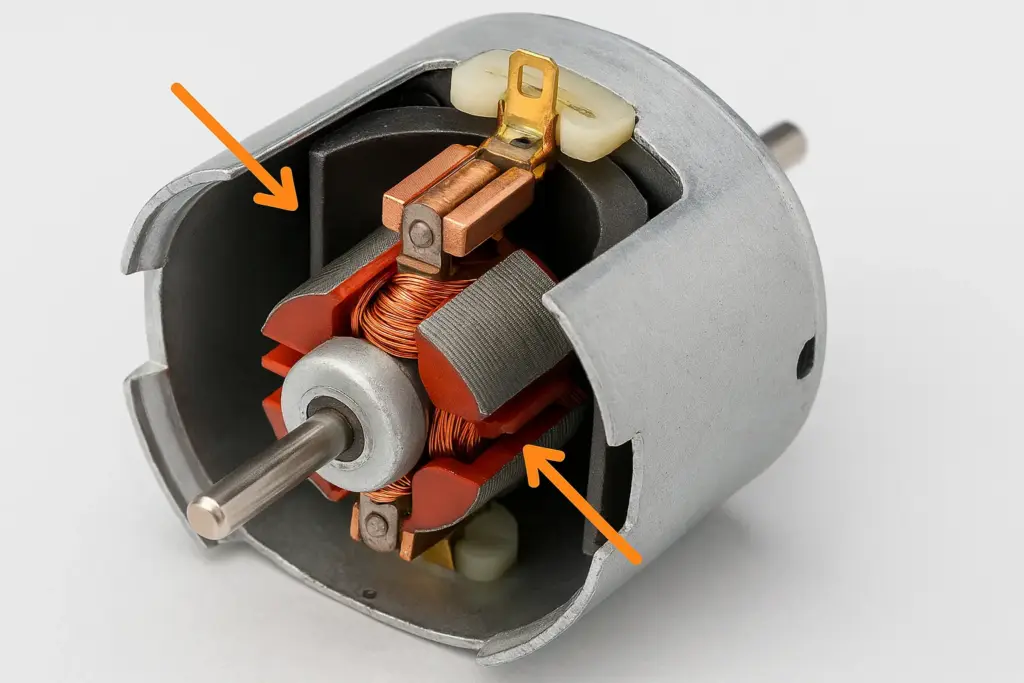
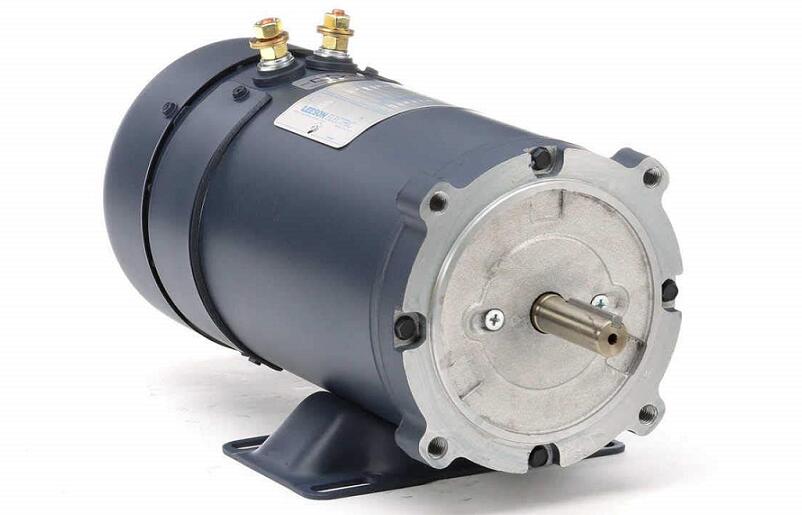
    Ferrite arc magnets in small DC motor for toys and hobby projects applications.

    Key Considerations for Choosing Permanent Magnet Materials

    To select the ideal magnet for your Hall sensor, consider the following factors:

    1. Magnetic Field Strength: High-precision, compact applications benefit from NdFeB’s superior strength, while Ferrite suits lower-strength needs.
    2. Operating Temperature: SmCo and AlNiCo excel in high-temperature environments, while NdFeB may require coatings or modifications for heat resistance.
    3. Cost Budget: Ferrite and AlNiCo are budget-friendly, while NdFeB and SmCo are premium options for high-performance applications.
    4. Size and Weight: NdFeB’s high strength-to-size ratio is ideal for space-constrained designs.

    Why Partner with HS Magnet?

    As a trusted magnet manufacturer, HS Magnet offers a wide range of NdFeB, SmCo, AlNiCo, and Ferrite magnets tailored for Hall sensor applications. Our magnets are precision-engineered to meet your specific requirements, ensuring optimal performance and durability. Whether you need compact, high-strength NdFeB magnets for automotive sensors or cost-effective Ferrite magnets for consumer electronics, we’ve got you covered.

  • Permanent Magnets in Smart Drones: Materials and Applications

    Permanent Magnets in Smart Drones: Materials and Applications

    Smart drones are evolving rapidly, from recreational use to industrial inspection, logistics, agriculture, and even defense. At the heart of these unmanned aerial systems (UAS), permanent magnets play a critical role. From powering motors to enabling precise navigation, magnets are indispensable in achieving lightweight design, high efficiency, and reliability.

    Key Applications of Magnets in Drones

    1. Drone Motors (Propulsion & Servo Motors)

    Motors are the largest consumer of permanent magnets in drones.

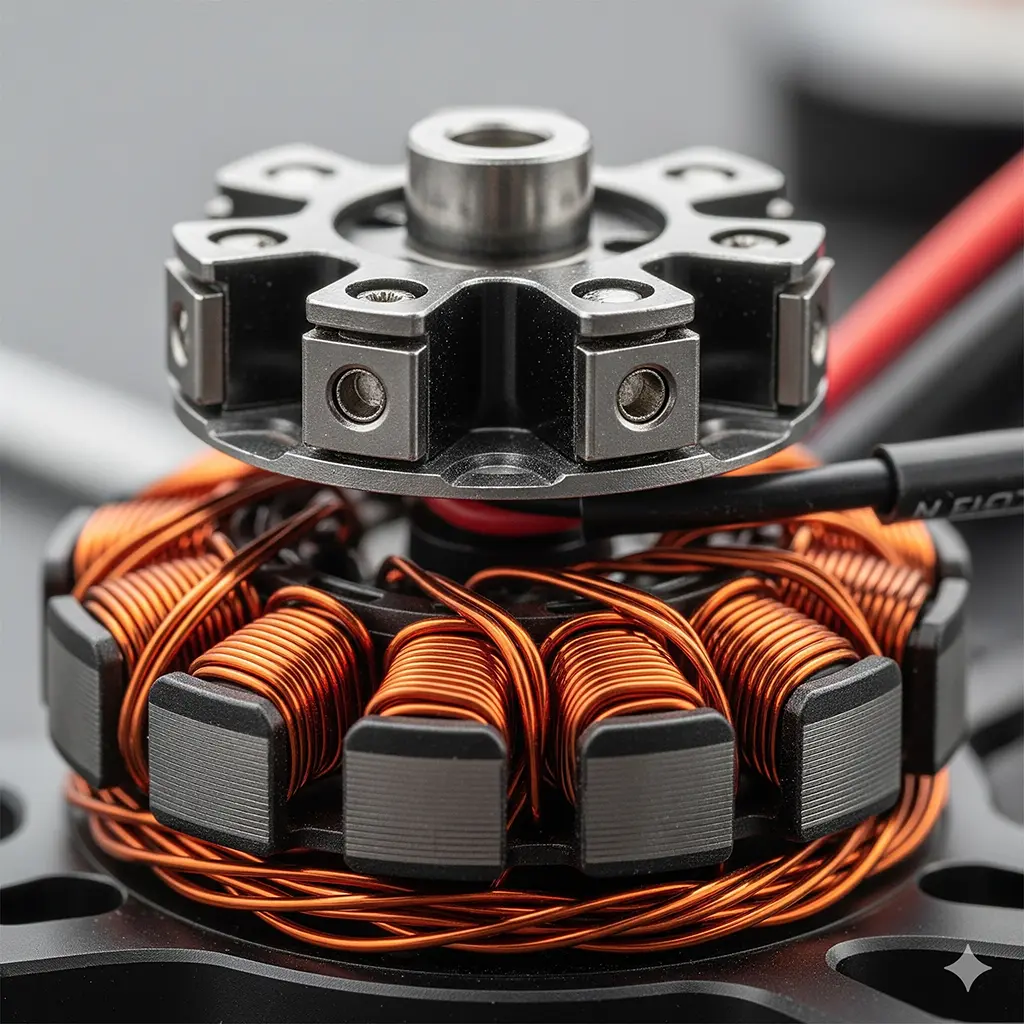
    • Neodymium Iron Boron (NdFeB) magnets are the preferred choice because of their high magnetic energy density, allowing powerful motors to be made small and lightweight—critical for extending flight time.
    • In high-end or military drones that face extreme environments, Samarium Cobalt (SmCo) magnets are sometimes used, as they offer better high-temperature stability and corrosion resistance.

    👉 Why it matters: Stronger magnets make motors more efficient, meaning longer battery life, greater thrust, and more stable flight.

    2. Sensors and Navigation Systems

    Magnets are also widely used in the sensing components of drones:

    • Magnetometers (electronic compasses) rely on magnetic sensing to help drones maintain accurate heading and navigation.
    • Hall effect sensors in motors and controllers use small permanent magnets (often NdFeB or ferrite) for detecting position and speed, enabling precise control of propellers.

    👉 Why it matters: Stable and accurate sensors are essential for GPS-assisted flight, obstacle avoidance, and autonomous operation.

    A three-axis camera gimbal on a drone, showing the motors and sensors that keep the camera stable.

    3. Gimbals and Stabilization Systems

    High-end drones use magnetic encoders and actuators in camera gimbals to ensure smooth video recording.

    • Here, NdFeB magnets are typically used in compact motorized gimbals for their high precision and responsiveness.

    👉 Why it matters: Without stable magnets, professional-grade aerial photography and mapping wouldn’t be possible.

    4. Other Functional Components

    • Magnetic couplings and connectors allow quick attachment of payloads, batteries, or modules.
    • Magnetic clamps may be used in folding drone arms for secure but lightweight locking mechanisms.
    A diagram illustrating the Hall effect sensor, showing a magnetic field passing through a semiconductor and generating a voltage.

    Choosing the Right Magnet Material for Drones

    • NdFeB (Neodymium magnets): Best choice for high-performance motors and compact systems. Delivers maximum power-to-weight ratio, but requires protective coatings (Ni, epoxy, PVD) to prevent corrosion.
    • SmCo (Samarium Cobalt): Used in high-temperature or harsh environments, especially in military or industrial drones. Expensive but highly stable.
    • Ferrite magnets: Found in low-cost drones or non-critical sensors; affordable and corrosion-resistant, but weaker.
    • AlNiCo magnets: Rarely used, but suitable for specific high-temperature sensors.

    Conclusion

    Permanent magnets are at the core of drone innovation. From the powerful motors that lift them into the sky, to the sensors that keep them stable and autonomous, magnets ensure that drones remain efficient, lightweight, and reliable.

    As drone technology advances, NdFeB magnets will continue to dominate mainstream designs, while SmCo magnets will support specialized, high-end applications. Understanding the right magnet material for each function is key to building smarter, safer, and more efficient drones.

  • Understanding Magnetic Levitation Trains: How Maglev Technology Works

    Understanding Magnetic Levitation Trains: How Maglev Technology Works

    In the world of high-speed transportation, magnetic levitation trains—commonly known as maglev trains—represent cutting-edge innovation. As a leading manufacturer of high-performance magnets, we’re excited to dive into how these trains operate and the crucial role permanent magnets play in their success. If you’re exploring magnetic applications or looking for reliable neodymium magnets for your projects, this guide will highlight why NdFeB magnets are the top choice.

    What is a Magnetic Levitation Train?

    A magnetic levitation train, or maglev train, is an advanced high-speed rail system that uses magnetic forces to levitate, propel, and guide the train without physical contact with the tracks. This frictionless design allows maglev trains to achieve incredible speeds—often exceeding 300 km/h (186 mph)—while offering a smooth, efficient ride.

    Unlike traditional trains that rely on wheels and rails, maglev systems eliminate wear and tear, reduce noise, and minimize energy loss. This technology is already in use in countries like Japan, China, and Germany, revolutionizing public transport and logistics.

    How Do Maglev Trains Work? Key Principles Explained

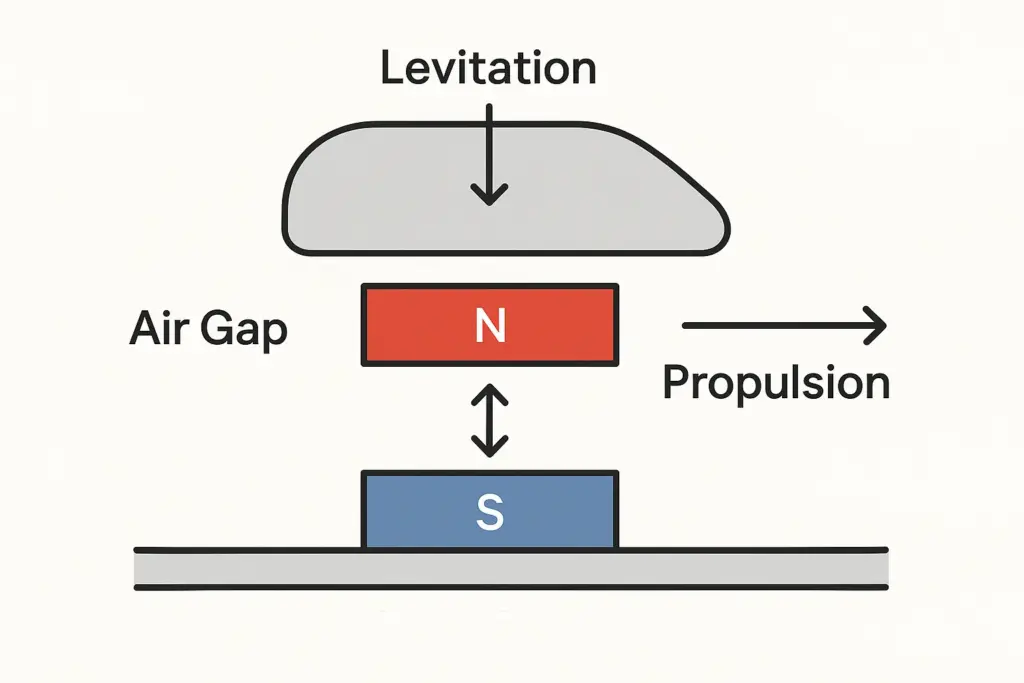
    Maglev trains operate on two main principles: levitation and propulsion. Both rely on powerful magnetic fields generated by electromagnets and permanent magnets integrated into the train and guideway (track).

    Levitation: Floating Above the Tracks

    Levitation is achieved through magnetic repulsion or attraction:

    • Electromagnetic Suspension (EMS): Uses attractive forces between electromagnets on the train and ferromagnetic materials on the guideway. The train “pulls” itself upward to maintain a stable gap.
    • Electrodynamic Suspension (EDS): Relies on repulsive forces from superconducting magnets or permanent magnets. When the train moves, induced currents create opposing magnetic fields, lifting the vehicle.

    Typically, the train hovers 1-10 cm (0.4-4 inches) above the guideway, eliminating friction for ultra-smooth travel. This requires magnets with exceptional strength and stability—qualities found in high-quality neodymium iron boron (NdFeB) magnets.

    Propulsion: Magnetic Power for High-Speed Movement

    Propulsion works like a linear motor:

    • Alternating magnetic fields along the guideway create a “traveling wave” that pushes or pulls the train forward.
    • By sequencing the polarity changes in the magnets, the system accelerates the train efficiently, similar to how magnets interact in a controlled pattern.

    This setup not only enables rapid acceleration but also regenerative braking, where energy is recaptured for reuse.

    Diagram showing magnetic levitation and propulsion principles in maglev trains

    Which Permanent Magnets Are Used in Maglev Trains?

    When it comes to permanent magnets in maglev trains, neodymium iron boron (NdFeB) magnets stand out as the primary choice. These rare-earth magnets are essential for generating the strong, consistent magnetic fields needed for reliable levitation and propulsion.

    As a specialized magnet manufacturer, we supply premium NdFeB magnets tailored for industrial applications like maglev systems. Our magnets ensure optimal performance in demanding environments, from transportation to renewable energy.

    Why Choose Neodymium Iron Boron (NdFeB) Magnets for Maglev Trains?

    NdFeB magnets, also known as neodymium magnets, offer unbeatable advantages that make them ideal for maglev technology. Here’s why they’re the go-to option:

    • Superior Magnetic Strength (High Energy Product): NdFeB magnets deliver the highest energy density among permanent magnets. This means they can produce powerful magnetic fields in a compact size, providing the lift and thrust required for heavy trains without adding unnecessary weight.
    • Excellent Resistance to Demagnetization (High Coercivity): These magnets maintain their magnetic properties even under extreme conditions, such as high temperatures or intense external fields. This ensures long-term stability and safety in maglev operations.
    • Cost-Effective Performance: Compared to other rare-earth alternatives like samarium cobalt (SmCo), NdFeB magnets offer a better balance of power and affordability, making them practical for large-scale projects.
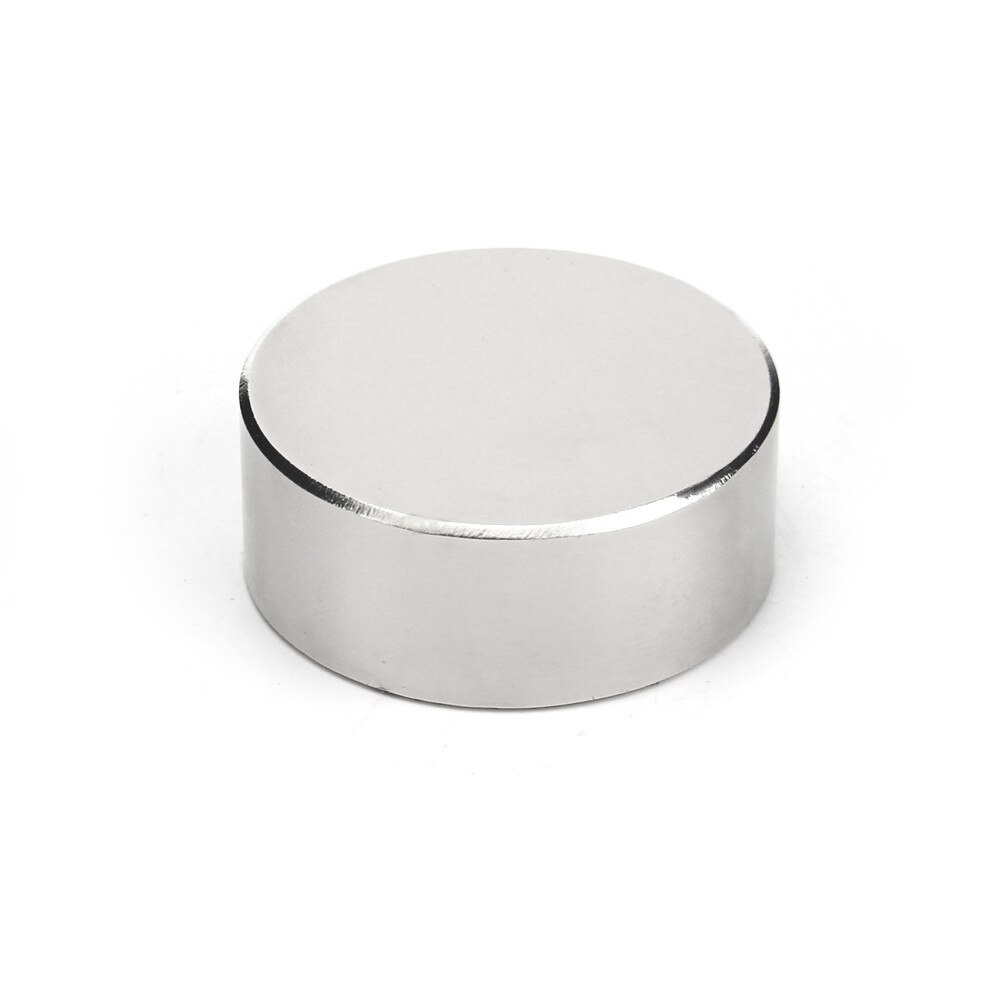
    NdFeB magnet

    At our company, we produce customized NdFeB magnets with various grades, coatings, and shapes to meet specific needs. Whether you’re developing maglev prototypes or other magnetic systems, our magnets guarantee reliability and efficiency.

    Applications Beyond Maglev: Where Else Can NdFeB Magnets Shine?

    Maglev trains are just one example of NdFeB’s versatility. These magnets are also widely used in:

    • Electric vehicles (EV motors)
    • Wind turbines and renewable energy systems
    • Medical devices (MRI machines)
    • Consumer electronics (speakers and hard drives)

    If your project involves high-strength magnets, explore our range of neodymium iron boron products designed for precision and durability.

    Ready to Power Your Project with NdFeB Magnets?

    Magnetic levitation trains demonstrate the transformative potential of advanced magnet technology. As experts in magnet manufacturing, we’re here to help you harness this power. Contact us today for a quote on custom NdFeB magnets, or browse our catalog to find the perfect solution for your magnetic applications.

    Keywords: magnetic levitation train, maglev train, neodymium magnets, NdFeB permanent magnets, magnetic propulsion, high-speed rail magnets

    For more insights on magnet tech and applications, subscribe to our newsletter or reach out at [email protected]. Let’s build the future together!

  • Applications of Multipole Magnets: Revolutionizing Industry, Medicine, and Science

    Applications of Multipole Magnets: Revolutionizing Industry, Medicine, and Science

    Multipole magnets, with their ability to generate complex and precise magnetic fields, are transforming industries, medical diagnostics, scientific research, and transportation. This article explores their diverse applications, highlighting their critical role in modern technology and innovation.

    Industrial Applications of Multipole Magnets

    Motor Manufacturing: Powering Efficiency and Precision

    Multipole magnets are essential in high-performance electric motors, driving advancements in electric vehicles (EVs) and robotics. For instance, Tesla’s cutting-edge EV motors leverage multipole permanent magnets to optimize magnetic field distribution, enabling efficient energy conversion and enhanced power output. This results in superior vehicle performance and extended driving range.

    In industrial robotics, multipole magnets are integral to joint motors, delivering precise torque for accurate and stable movements. This precision is vital for robots performing complex tasks in manufacturing, assembly, and automation, improving productivity and reliability.

    Magnetic Separation Technology: Enhancing Resource Recovery

    Multipole magnets are revolutionizing magnetic separation in industries like mining and recycling. In mining, multipole magnetic separators use non-uniform magnetic fields to isolate magnetic minerals, such as iron and manganese ore, from non-magnetic gangue. This technology boosts the efficiency of iron ore beneficiation, increasing concentrate grade and recovery rates.

    In scrap metal recycling, multipole magnets efficiently separate ferromagnetic metals from mixed waste, promoting resource recovery and reducing reliance on virgin materials. This supports sustainable practices and circular economies.

    Nondestructive Testing: Ensuring Safety and Quality

    Multipole magnets play a critical role in nondestructive testing (NDT) through magnetic particle inspection. By generating controlled magnetic fields, these magnets detect surface and near-surface defects like cracks and pores in metal components. In aerospace, for example, magnetic particle flaw detectors ensure the integrity of critical parts like engine blades and landing gear, enhancing safety and reliability.

    Multipole permanent magnets from HS Magnet are widely used in high-performance motors for EVs and robotics.

    Medical Applications of Multipole Magnets

    Magnetic Resonance Imaging (MRI): Precision in Diagnostics

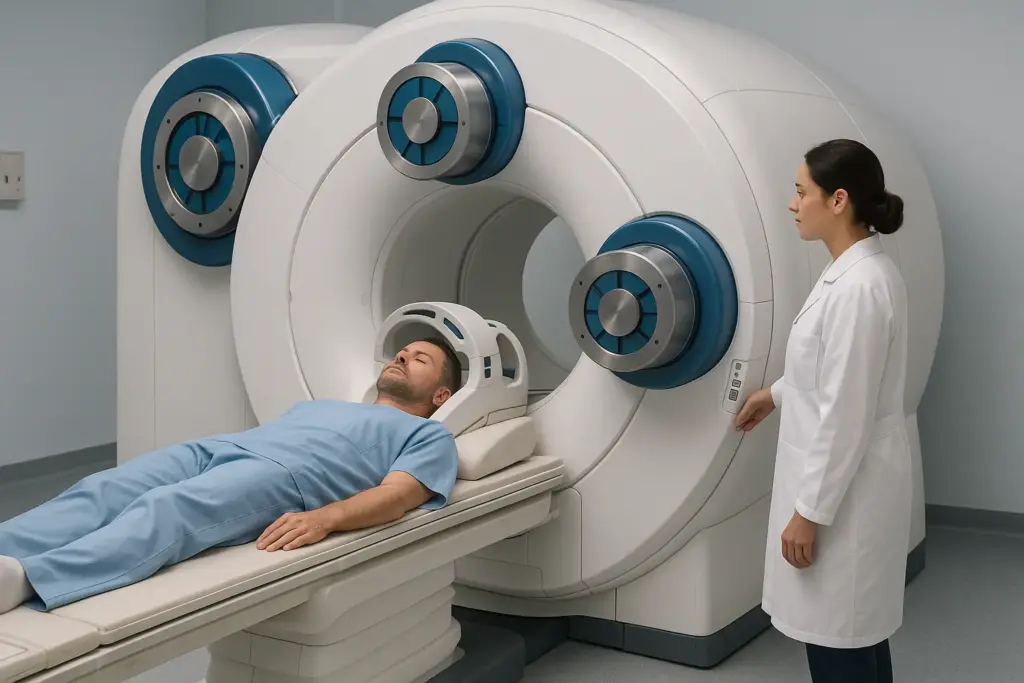
    Multipole magnets are at the heart of magnetic resonance imaging (MRI), a cornerstone of medical diagnostics. These magnets create uniform, stable magnetic fields for high-resolution imaging of internal organs and tissues. MRI is invaluable for diagnosing conditions in the brain, abdomen, and other areas, providing doctors with clear, accurate images to guide treatment.

    Magnetic Therapy: Exploring Health Benefits

    Magnetic therapy devices, such as mattresses and bracelets, use weak magnetic fields from multipole magnets to promote blood circulation and alleviate pain. While scientific evidence on efficacy varies, these products remain popular in alternative medicine markets, offering non-invasive therapy options.

    Multipole magnets in MRI machines providing precision diagnostics in modern healthcare

    Scientific Research Applications of Multipole Magnets

    Particle Accelerators: Unlocking the Universe’s Secrets

    In scientific research, multipole magnets are critical for controlling charged particle trajectories in particle accelerators like the Large Hadron Collider (LHC) at CERN. By precisely adjusting magnetic field strength and direction, these magnets guide particles at near-light speeds, enabling groundbreaking experiments that explore the fundamental nature of matter.

    Plasma Physics: Advancing Nuclear Fusion

    Multipole magnets are vital in plasma physics, particularly in nuclear fusion research. Devices like Tokamaks use multipole magnetic fields to confine high-temperature plasma, creating the conditions needed for controlled nuclear fusion. This technology holds immense potential for addressing global energy challenges with clean, sustainable power.

    Transportation Applications of Multipole Magnets

    Magnetic Levitation Trains: Redefining High-Speed Travel

    Magnetic levitation (maglev) trains rely on multipole magnets to achieve contactless suspension and propulsion. By leveraging magnetic field interactions between the train and track, maglev systems minimize friction, enabling ultra-high-speed travel. For example, Shanghai’s maglev train, reaching speeds of 430 km/h, showcases the potential of multipole magnets for efficient intercity transportation.

    High-speed maglev train using neodymium magnets for levitation and propulsion

    Conclusion

    Multipole magnets are a cornerstone of innovation across industries, from powering electric vehicles and robotics to advancing medical diagnostics and scientific discovery. Their ability to generate precise, controlled magnetic fields drives efficiency, safety, and sustainability in diverse applications. As technology evolves, the role of multipole magnets will continue to expand, shaping the future of industry, medicine, and transportation.

    Explore more about magnetic technologies and their applications on our website!

  • The Role of Samarium Cobalt Magnets in Magnetic Pumps: Why They’re Used, Advantages, Disadvantages, and Comparisons

    The Role of Samarium Cobalt Magnets in Magnetic Pumps: Why They’re Used, Advantages, Disadvantages, and Comparisons

    Magnetic pumps, also known as mag-drive pumps, are essential in industries like chemical processing, pharmaceuticals, and water treatment. These pumps operate without mechanical seals, using magnetic couplings to transfer torque from the motor to the impeller. This sealless design prevents leaks, making them ideal for handling hazardous, corrosive, or high-temperature fluids. At the heart of these couplings are powerful permanent magnets, and one standout material is Samarium Cobalt (SmCo). In this post, we’ll explore why SmCo magnets are used in magnetic pumps, their advantages and disadvantages, and how they stack up against other common magnetic materials like Neodymium-Iron-Boron (NdFeB), Ferrite, and Alnico.

    Why Are Samarium Cobalt Magnets Used in Magnetic Pumps?

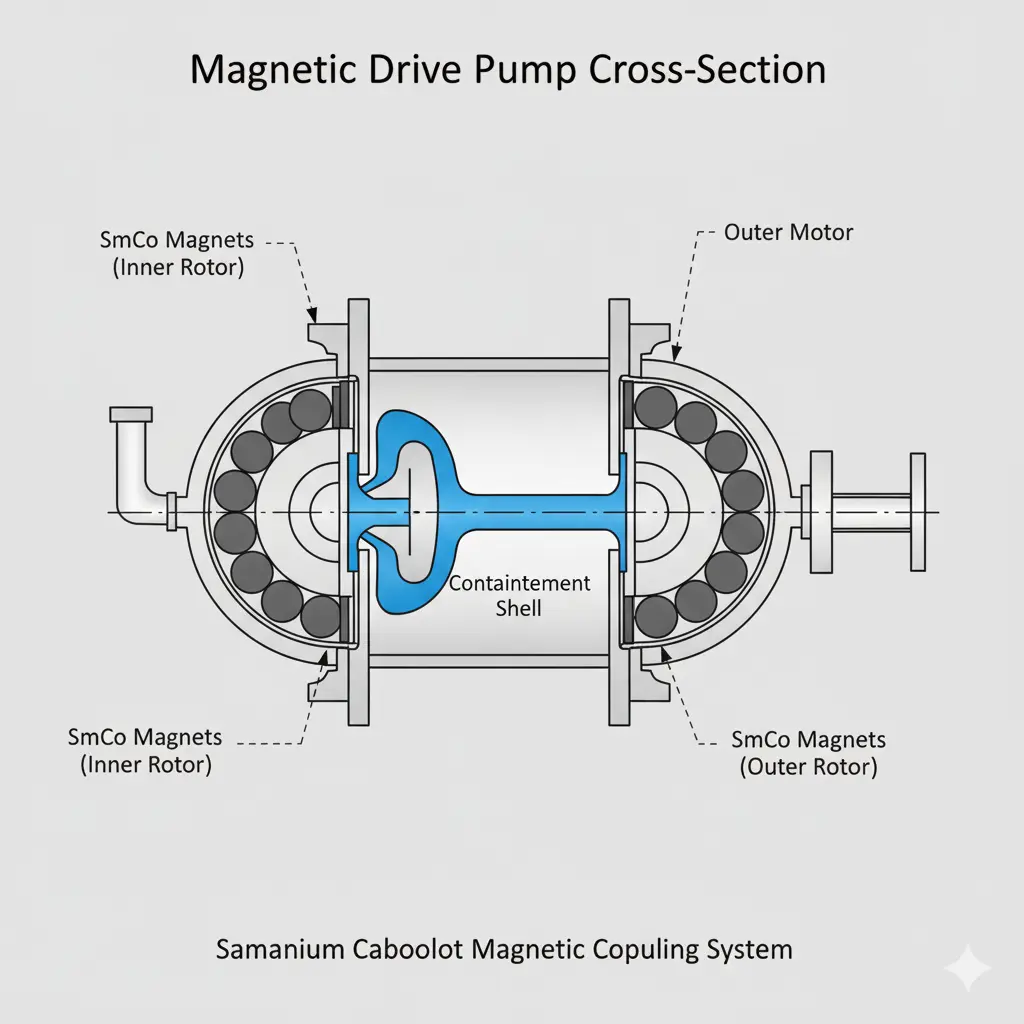
    Samarium Cobalt magnets are a type of rare-earth magnet composed primarily of samarium and cobalt, often with traces of iron and copper. In magnetic pumps, they form part of the magnetic coupling system, where an outer magnet (driven by the motor) interacts with an inner magnet (connected to the impeller) across a containment shell. This non-contact transfer eliminates the need for seals, reducing maintenance and the risk of contamination.

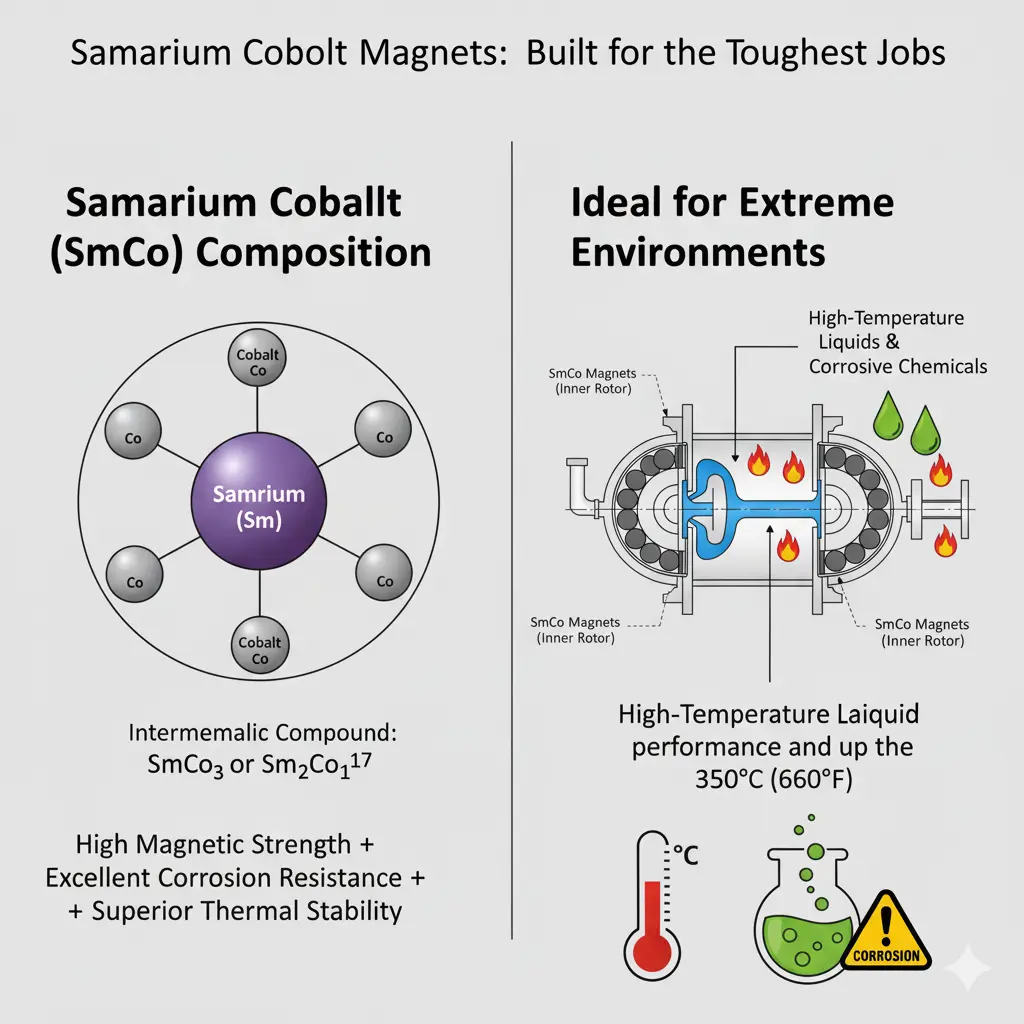
    SmCo magnets are particularly favored in mag-drive pumps for applications involving extreme conditions. They excel in environments with high temperatures (up to 350°C) and corrosive substances, where other magnets might fail due to demagnetization or degradation. For instance, in chemical plants pumping hot acids or in aerospace systems requiring reliability under thermal stress, SmCo provides stable magnetic performance without the need for additional protective coatings in many cases. Their high coercivity (resistance to demagnetization) ensures consistent torque transmission, even in compact designs where space is limited.

    Diagram of Samarium Cobalt magnet composition and use in high-temperature magnetic pumps

    Advantages of Samarium Cobalt Magnets in Magnetic Pumps

    SmCo magnets offer several key benefits that make them a go-to choice for demanding pump applications:

    • Superior Temperature Resistance: They maintain magnetic strength at temperatures far higher than most alternatives, making them suitable for hot fluid handling without performance loss.
    • Excellent Corrosion Resistance: Unlike some magnets that require coatings, SmCo inherently resists oxidation and chemical attack, ideal for corrosive environments in pumps.
    • High Magnetic Stability and Coercivity: They resist demagnetization from external fields or shocks, ensuring long-term reliability in industrial settings.
    • Compact and Lightweight Design: SmCo provides strong magnetic force relative to its size and weight, allowing for smaller, more efficient pump designs.

    These advantages translate to lower downtime, reduced maintenance costs, and enhanced safety in magnetic pump operations.

    Disadvantages of Samarium Cobalt Magnets in Magnetic Pumps

    While powerful, SmCo magnets aren’t without drawbacks:

    • High Cost: Due to the rarity of samarium and complex manufacturing, they are significantly more expensive than other options, which can increase the overall pump price.
    • Brittleness: SmCo is prone to chipping or cracking if mishandled during assembly or operation, requiring careful installation.
    • Slightly Lower Magnetic Strength: Compared to some rare-earth alternatives, SmCo has a marginally lower energy density, which might necessitate larger magnets for the same torque in certain designs.
    • Limited Availability: Supply chain issues with rare-earth elements can lead to procurement challenges.

    In magnetic pumps, these cons are often mitigated by the material’s longevity, but they may make SmCo less ideal for cost-sensitive or low-demand applications.

    Comparison with Other Magnetic Materials

    To understand where SmCo fits in, let’s compare it to other common permanent magnet materials used in magnetic pumps and couplings: Neodymium-Iron-Boron (NdFeB), Ferrite (Ceramic), and Alnico. The table below highlights key attributes based on magnetic properties, cost, and suitability for mag-drive pumps.

    MaterialMagnetic Strength (Energy Density)Temperature ResistanceCorrosion ResistanceCostAdvantages in Mag-Drive PumpsDisadvantages in Mag-Drive Pumps
    Samarium Cobalt (SmCo)High (22-32 MGOe)Excellent (up to 350°C)Excellent (inherent)HighStable in high-heat/corrosive fluids; high coercivity for reliable couplingBrittle; expensive for large-scale use
    Neodymium-Iron-Boron (NdFeB)Very High (up to 52 MGOe)Moderate (80-200°C)Poor (needs coating)ModerateStrongest torque in compact designs; cost-effective for standard tempsProne to corrosion/demagnetization in hot or harsh environments
    Ferrite (Ceramic)Low (3-5 MGOe)Good (up to 250°C)ExcellentLowCheap and corrosion-resistant for basic pumpsWeak strength requires larger sizes; lower efficiency
    AlnicoModerate (5-10 MGOe)Excellent (up to 450°C)GoodModerateHigh temp tolerance; easy to magnetizeLow coercivity leads to easy demagnetization; outdated for modern high-performance pumps

    From the comparison:

    • Vs. NdFeB: SmCo is preferred for high-temperature or corrosive mag-drive pumps, while NdFeB wins in strength and cost for ambient conditions. NdFeB is more common overall due to its power-to-cost ratio but often needs protective coatings.
    • Vs. Ferrite: SmCo offers far superior strength and stability, making it better for demanding pumps, though Ferrite is a budget-friendly alternative for less critical applications.
    • Vs. Alnico: Both handle high temps, but SmCo’s higher coercivity and strength make it more reliable for modern magnetic couplings; Alnico is rarely used today due to its lower performance.

    Ultimately, the choice depends on the pump’s operating environment—SmCo shines where reliability under stress is paramount.

    Samarium Cobalt magnets in a real-world mag-drive pump for industrial use

    Conclusion

    Samarium Cobalt magnets play a crucial role in enhancing the performance and safety of magnetic pumps, especially in challenging industrial settings. Their ability to withstand high temperatures and corrosion makes them indispensable, despite higher costs and brittleness. When compared to NdFeB, Ferrite, or Alnico, SmCo strikes a balance for applications where failure isn’t an option. If you’re designing or upgrading a mag-drive pump system, consider consulting with magnet experts to tailor the material to your needs. For more insights on advanced materials in pumping technology, stay tuned to our blog!

  • What is an Electropermanent Magnet (EPM)? A Comprehensive Guide

    What is an Electropermanent Magnet (EPM)? A Comprehensive Guide

    An electropermanent magnet (EPM) is a type of permanent magnet that can be switched on or off using a brief pulse of electric current. Unlike traditional electromagnets, which require continuous power to maintain a magnetic field, EPMs use permanent magnets to generate a stable magnetic field without ongoing energy consumption. This makes them highly efficient for applications like industrial lifting magnets and innovative self-building structures.

    In this guide, we’ll explore the definition, working principle, and applications of electropermanent magnets, highlighting their advantages over conventional magnetic systems.

    What is an Electropermanent Magnet?

    An electropermanent magnet consists of two key components:

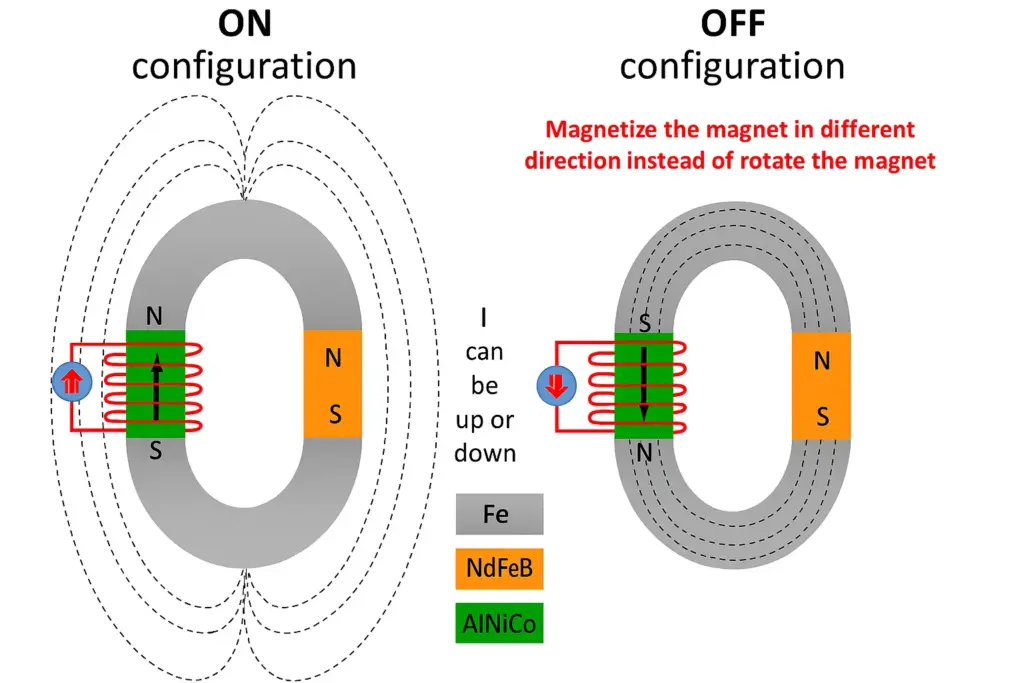
    • A hard magnetic material (high coercivity, e.g., NdFeB) that maintains a strong, stable magnetic field.
    • A soft magnetic material (low coercivity, e.g., AlNiCo) whose magnetization direction can be reversed with a current pulse.

    By controlling the magnetization of the soft material via a wire coil, the EPM can toggle its external magnetic field:

    • On State: When the hard and soft materials’ magnetizations align, the EPM produces a strong external magnetic field.
    • Off State: When their magnetizations oppose each other, the external magnetic field is nearly nonexistent.

    This unique ability to switch the magnetic field without continuous power distinguishes EPMs from electromagnets, offering energy efficiency and reliability.

    Comparison of electropermanent magnet in on and off states, showing magnetization alignment

    How Does an Electropermanent Magnet Work?

    The principle of an EPM is based on a magnetic latch configuration, typically involving:

    • Two permanent magnets (one hard, one soft).
    • Two soft magnetic plates (e.g., iron alloy) that concentrate magnetic flux.
    • A coil wound around the soft magnet to apply current pulses.

    EPM Operation Explained

    1. On Configuration:
      • Both magnets’ north poles are aligned (e.g., pointing up).
      • The magnetic flux flows through the soft magnetic plates, creating a strong external magnetic field, similar to a large magnet with distinct north and south poles.
      • This state is ideal for applications like lifting ferrous metals.
    2. Off Configuration:
      • The soft magnet’s magnetization is reversed using a current pulse, so its poles oppose the hard magnet’s.
      • The magnetic flux is confined within the soft magnetic plates, forming a closed circuit with minimal external magnetic field.
      • This allows the magnet to release objects without mechanical intervention.

    Magnetization Switching

    A current pulse through the coil generates a magnetic field stronger than the soft magnet’s intrinsic coercivity (e.g., 50 kA/m for AlNiCo vs. 1120 kA/m for NdFeB). This flips the soft magnet’s magnetization direction without affecting the hard magnet, enabling the EPM to toggle between on and off states.

    Advantages of Electropermanent Magnets

    • Energy Efficiency: EPMs only require a brief current pulse to switch states, unlike electromagnets that consume continuous power.
    • Reliability: The magnetic field is maintained by permanent magnets, ensuring stability without power sources.
    • Versatility: EPMs are ideal for applications requiring precise control, such as industrial lifting, robotics, and programmable magnets for self-assembling structures.

    Applications of Electropermanent Magnets

    1. Industrial Lifting Magnets:
      • EPMs made with rare earth magnets (e.g., NdFeB) are used to lift heavy ferrous objects. The magnet can be turned off to release the load, improving safety and efficiency.
      • Example: Magnetic Lifting Technologies (internal link to a related article).
    2. Self-Building Structures:
      • Programmable EPMs enable self-assembling systems, where components align and connect autonomously using controlled magnetic fields.
      • Example: Research into Programmable Magnetic Structures (internal link).
    3. Robotics and Automation:
      • EPMs are used in robotic grippers for precise handling of metallic objects without continuous power consumption.
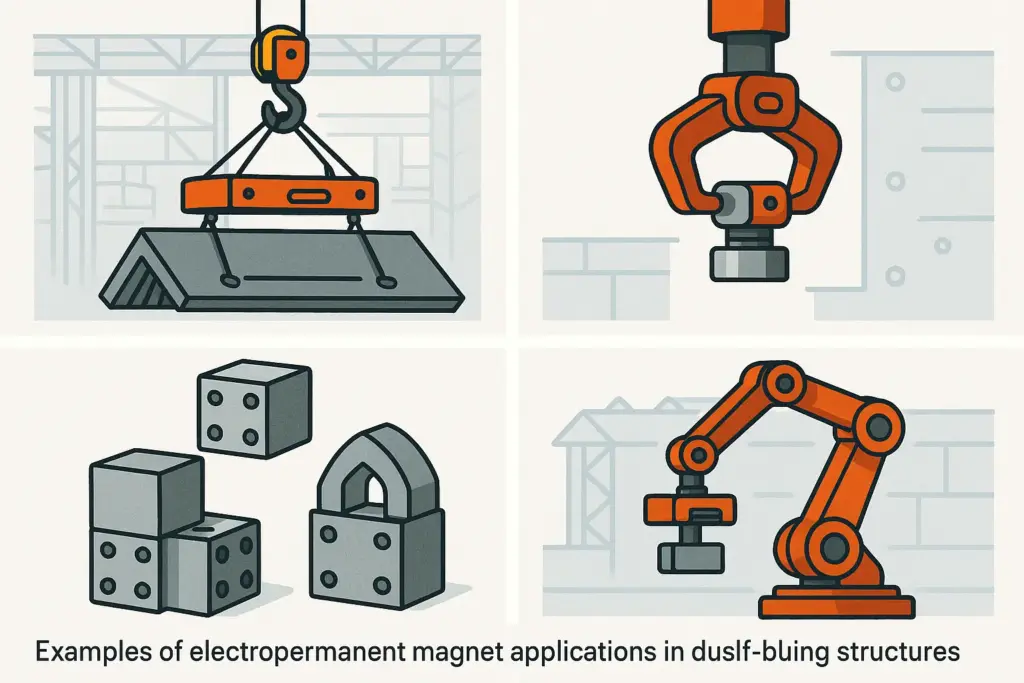
    Examples of electropermanent magnet applications in industrial lifting, robotics, and self-building structures

    Electropermanent Magnet vs. Electromagnet

    FeatureElectropermanent Magnet (EPM)Electromagnet
    Power ConsumptionPulse-based (minimal)Continuous
    Magnetic Field SourcePermanent magnetsElectric current
    ApplicationsLifting, robotics, self-assemblyBroad, less efficient
    Energy EfficiencyHighLow

    Conclusion

    Electropermanent magnets (EPMs) offer a revolutionary approach to magnetic technology, combining the strength of permanent magnets with the control of electromagnets. Their ability to toggle magnetic fields with minimal energy makes them ideal for industrial, robotic, and innovative applications like self-building structures. By understanding the principles and advantages of EPMs, industries can leverage this technology for greater efficiency and precision.

    Explore more about Magnetic Technologies and their applications at HS magnet.

  • How to Safely Administer Cow Magnets: Preventing Hardware Disease in Cattle

    How to Safely Administer Cow Magnets: Preventing Hardware Disease in Cattle

    In the world of cattle farming, maintaining herd health is paramount for productivity and profitability. One common yet preventable issue is hardware disease, a condition where cows ingest metal objects like nails, wires, or staples, leading to serious internal injuries. As a leading manufacturer of high-quality cow magnets, we’re often asked about the best practices for using these essential tools—especially inspired by popular questions on platforms like Quora. In this comprehensive guide, we’ll explore how to feed cow magnets safely, their benefits for cattle health, and why they’re a must-have for any dairy or beef operation. Whether you’re a seasoned farmer or new to livestock management, this step-by-step approach will help you protect your herd effectively.

    What Are Cow Magnets and Why Do They Matter?

    Cow magnets are specialized veterinary devices designed to safeguard cattle from hardware disease, also known as traumatic reticuloperitonitis. These cylindrical magnets, typically made from durable materials like alnico (an alloy of aluminum, nickel, and cobalt) or ferrite, are about 2-3 inches long and settle in the cow’s reticulum—one of the four stomach compartments. Once in place, they attract and trap ferrous metal objects that cows might accidentally swallow while grazing or eating feed.

    Hardware disease occurs when sharp metal debris penetrates the stomach lining, causing infections, reduced appetite, weight loss, decreased milk production, and even death if untreated. Studies show it can affect up to 10% of cattle in some areas, making prevention crucial. By using cow magnets, farmers can significantly reduce these risks, leading to healthier animals and better farm efficiency.

    At our company, we produce premium cow magnets engineered for maximum magnetic strength and longevity. Our alnico and ferrite options ensure reliable performance, helping your herd stay protected for life.

    The Benefits of Using Cow Magnets for Cattle Health

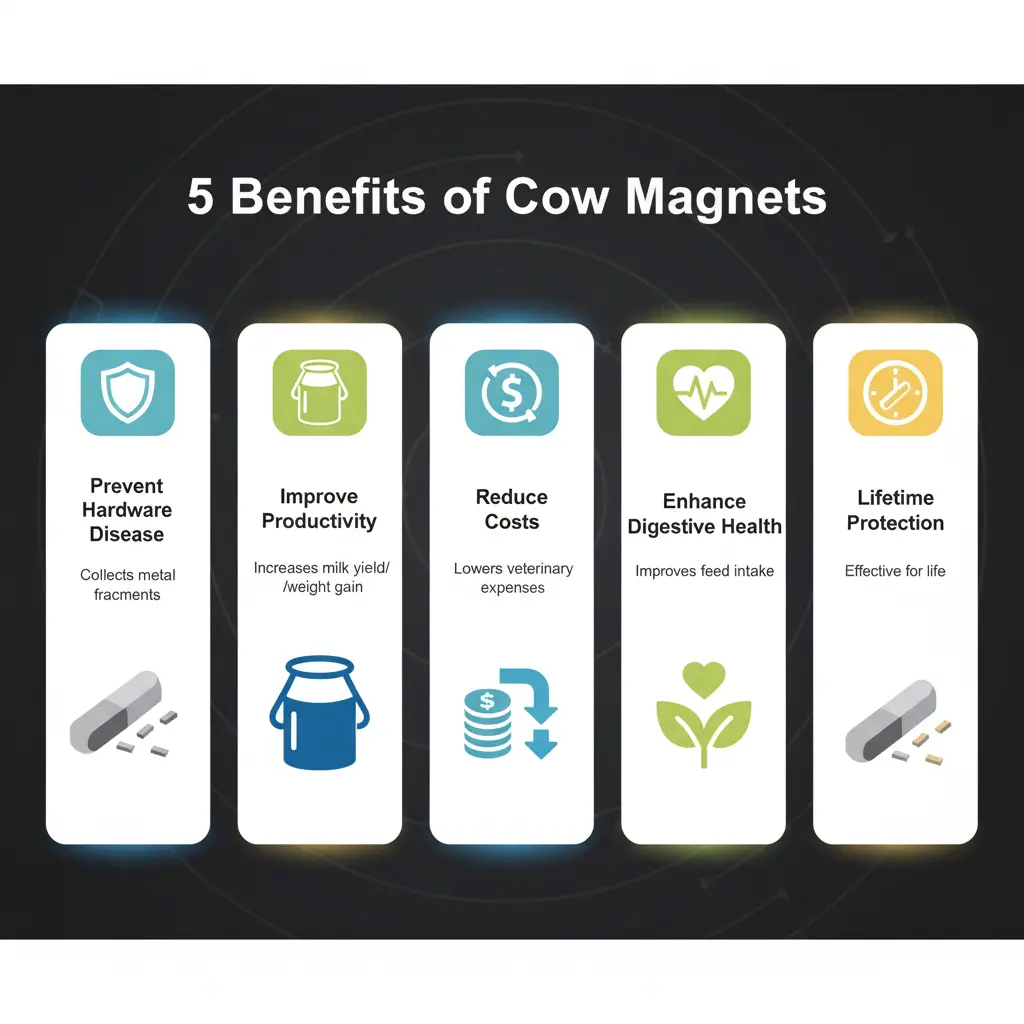
    Benefits of cow magnets for cattle health Infographic on preventing hardware disease and improving productivity.

    Incorporating cow magnets into your herd management routine offers numerous advantages:

    • Prevention of Hardware Disease: The magnet acts as a magnetic shield, collecting metal fragments in the reticulum and preventing them from causing perforations or infections.
    • Improved Productivity: Healthy cows mean higher milk yields for dairy operations and better weight gain for beef cattle. Reduced veterinary visits also cut costs.
    • Long-Term Protection: One magnet lasts the cow’s entire lifetime, making it a cost-effective solution.
    • Enhanced Digestive Health: By minimizing complications from ingested metals, magnets support better feed intake and overall well-being.
    • Peace of Mind for Farmers: Knowing your herd is protected allows you to focus on other aspects of farm management.

    Our cow magnets are veterinarian-approved and have helped countless farmers avoid the pitfalls of hardware disease. They’re a simple investment with substantial returns in herd health and farm sustainability.

    Step-by-Step Guide: How to Administer Cow Magnets Safely

    Step-by-step guide to safely administering cow magnets Flowchart for preventing hardware disease in cattle.

    Administering cow magnets, often referred to as “feeding” them, is a straightforward process but requires care to ensure safety for both the animal and the handler. Always consult a veterinarian before starting, especially if you’re new to the procedure. Here’s how to do it right:

    1. Prepare the Cow

    • Fast the cow for 18-24 hours beforehand. This empties the stomach, making it easier for the magnet to settle in the reticulum without complications.
    • Administer to calves around 6-12 months old, ideally the entire herd at once for maximum effectiveness.
    • Restrain the cow securely in a chute or head gate to minimize stress and movement.

    2. Gather Your Tools

    • Use a bolusing gun (also called a balling gun) specifically designed for cattle. This tool safely delivers the magnet down the throat.
    • Select a high-quality cow magnet from a reputable manufacturer like ours—ensure it’s smooth, rounded, and encased in protective material to prevent injury during swallowing.

    3. The Administration Process

    • Insert the magnet into the bolusing gun.
    • Open the cow’s mouth gently and position the gun at the back of the tongue.
    • Push the plunger to release the magnet, allowing the cow to swallow it naturally. It will travel down the esophagus to the reticulum.
    • Monitor the cow for a few minutes post-administration to ensure no immediate distress.

    4. Post-Administration Care

    • Provide water and resume normal feeding after the procedure.
    • Check for signs of discomfort, though cows typically experience none.
    • Avoid giving a second magnet, as it could cause internal pinching.

    For best results, combine magnet use with good feed management, such as running feed through magnets or avoiding metal-contaminated pastures.

    Safety Tips and Common Mistakes to Avoid

    Safety tips for cow magnets Do's and Don'ts to avoid mistakes in hardware disease prevention.

    Safety is key when handling cow magnets to protect both your herd and yourself:

    • Work with a Vet: Professional guidance ensures proper technique and addresses any herd-specific needs.
    • Use the Right Equipment: Never force the magnet without a bolusing gun to avoid choking or injury.
    • One Magnet Per Cow: Multiple magnets can align and cause harm—stick to one lifetime dose.
    • Monitor for Hardware Disease Symptoms: Watch for reduced appetite, fever, or lethargy, and act quickly if suspected.
    • Store Magnets Properly: Keep them away from children and other animals, as they’re strong and could be hazardous if mishandled.

    By following these guidelines, you’ll minimize risks and maximize the protective benefits of cow magnets.

    Why Choose Our Cow Magnets?

    As a trusted manufacturer, we specialize in producing top-tier cow magnets that outperform standard options. Our products feature enhanced magnetic strength for better metal attraction, durable coatings for longevity, and designs vetted by veterinarians. Whether you need alnico for superior power or ferrite for affordability, our range caters to all farm sizes. Investing in our magnets means investing in your herd’s future—proven to reduce hardware disease incidence dramatically.

    Conclusion: Protect Your Herd Today

    Feeding cow magnets is a proven, simple strategy to enhance cattle health and safety, directly addressing concerns like those raised on Quora. By preventing hardware disease, you ensure your cows thrive, boosting your farm’s success. Ready to safeguard your herd? Explore our selection of cow magnets on our website or contact us for personalized advice. Your cattle’s well-being starts with one small step—make it today!

  • Magnetic Therapy: Benefits, Types, and How It Works

    Magnetic Therapy: Benefits, Types, and How It Works

    Magnetic therapy is a form of alternative medicine that uses magnets to help relieve pain and support overall wellness. It has gained popularity as a complementary treatment for conditions such as arthritis, chronic back pain, headaches, and other musculoskeletal issues. While scientific evidence is still evolving, many users and practitioners report noticeable improvements in comfort, mobility, and quality of life.

    (more…)
  • Working Principle of a Speaker: How Magnets Create Sound

    Working Principle of a Speaker: How Magnets Create Sound

    A speaker is a fascinating device that converts electrical signals into audible sound waves, enriching our daily audio experiences—whether through phones, TVs, or professional sound systems. To understand how a speaker works, it’s helpful to look at both the working principle and the key components that bring sound to life.

    Working Principle of a Speaker

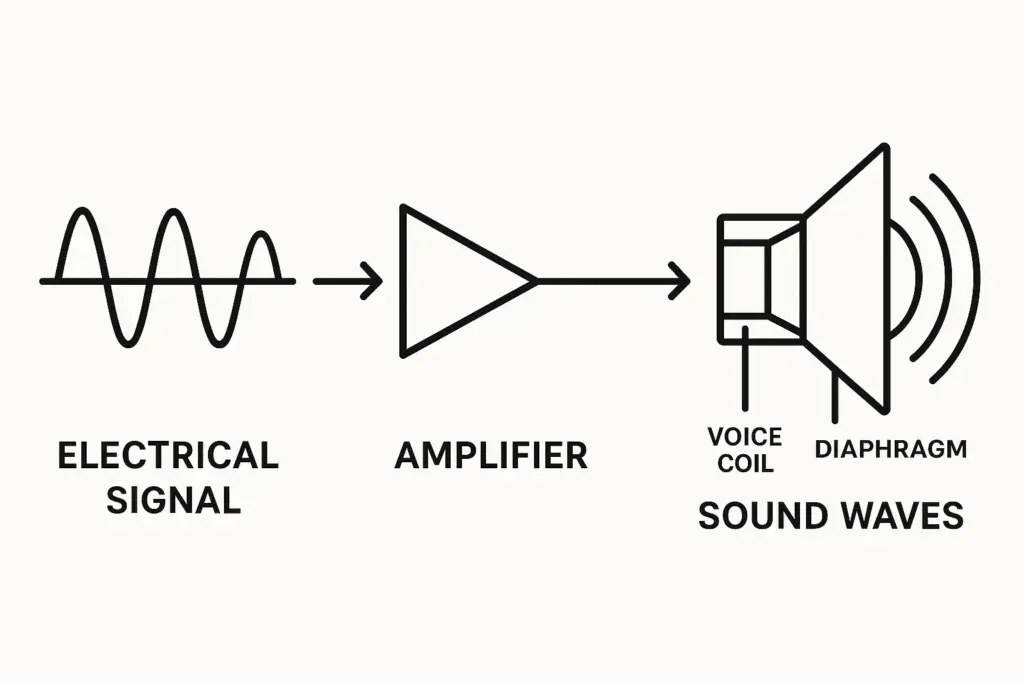
    At its core, a speaker operates on the principle of electromagnetism. Here’s how it works step by step:

    1. Electrical audio signals pass through the voice coil—a wire coil suspended inside a magnetic field created by a permanent magnet.
    2. When current flows through the coil, it generates an electromagnetic force that interacts with the magnet’s field.
    3. This interaction causes the coil to move back and forth rapidly.
    4. The coil is attached to a cone (or diaphragm), which vibrates as the coil moves.
    5. These vibrations push and pull the surrounding air, creating sound waves that replicate the original audio signal.

    In short, the speaker transforms electricity into mechanical vibrations, and then into the sound waves we hear.

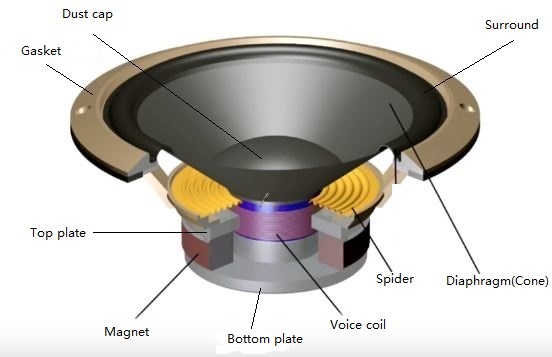
    Exploded view of a speaker with all key components (voice coil, diaphragm, magnet, suspension) clearly labeled.

    Main Components of a Speaker

    A speaker is made up of several systems and supporting parts. Each has a unique role in sound production:

    1. Magnetic Circuit System

    • Includes: top plate, T-yoke, permanent magnet, and frame.
    • Magnets used: commonly Alnico magnets or Ferrite magnets (Y30, Y35 grades).
    • Function: provides a stable magnetic field for the voice coil to interact with, enabling efficient sound conversion.

    2. Vibration System

    • Voice Coil: converts electrical signals into mechanical motion.
    • Cone (Diaphragm): usually made of paper or composite materials, vibrates to push air and create sound waves.
    • Suspension System: includes the spider and surround, which center and support the coil, ensuring smooth and controlled movement.

    3. Auxiliary Components

    • Basket Frame: supports and holds all parts together, providing structure.
    • Dust Cap/Dome: keeps dust and debris away from internal parts while influencing acoustic response.
    • Lead Wires: connect the voice coil to the speaker terminals, transmitting the electrical signal.

    Functions of Each Component at a Glance

    • Voice Coil: Converts electric signals into motion.
    • Cone/Diaphragm: Moves air to produce sound waves.
    • Magnet & Circuit: Provides the magnetic field needed for motion.
    • Suspension System: Controls stability and precision of movement.
    • Basket Frame: Ensures structural integrity.
    • Dust Cap: Protects internal components and affects sound response.
    Flowchart illustrating the conversion of electrical signals (waveform) to voice coil motion, diaphragm vibration, and finally audible sound waves.

    Conclusion

    The working principle of a speaker beautifully demonstrates the power of electromagnetism—transforming invisible electrical signals into the sounds we enjoy every day. From the voice coil to the magnetic circuit system, every part plays an essential role in sound quality.

    At HS Magnets, we have over 20 years of expertise in manufacturing magnets such as Alnico and Ferrite magnets, widely used in speaker applications. If you are looking for high-quality magnets or accessories for speakers, feel free to browse our website or contact us at [email protected].