
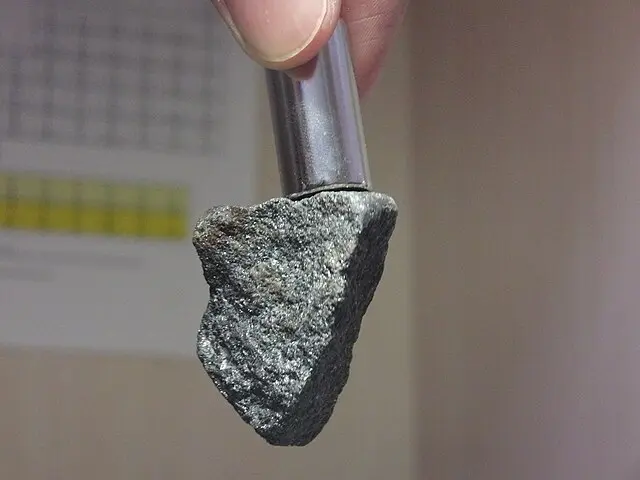
Magnets interact with materials based on their atomic structure and magnetic domain behavior. At a strategic level, the key determinant is whether the material contains elements that support aligned magnetic domains, enabling strong attraction. Understanding these fundamentals helps businesses make data-driven decisions when selecting materials for industrial, commercial, or consumer-facing applications.
Ferromagnetic Materials
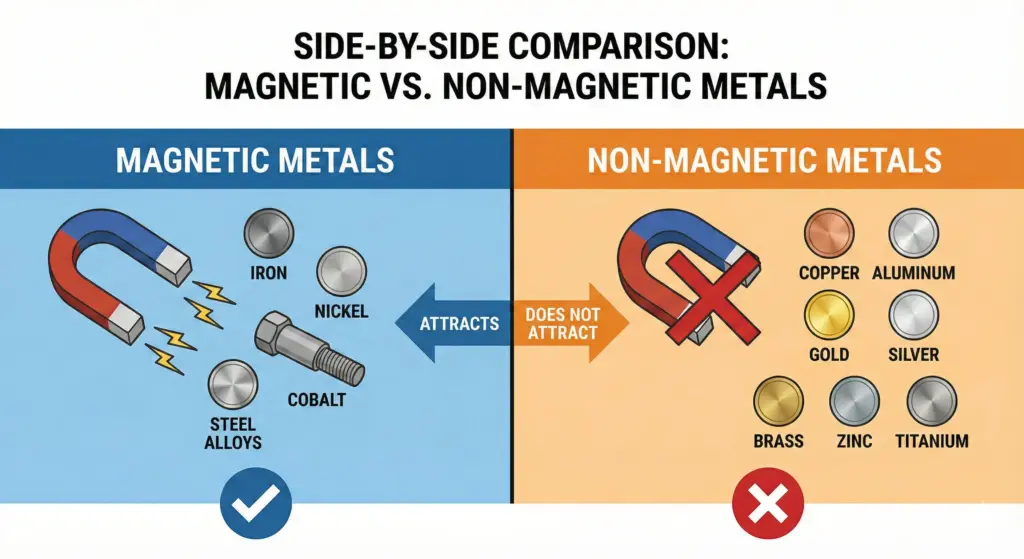
Ferromagnetic materials are the primary category that magnets adhere to consistently. These materials have unpaired electrons and magnetic domains that align easily when exposed to an external magnetic field, delivering strong and stable attraction.
Common Ferromagnetic Examples
- Iron: The most magnet-responsive metal and widely used across manufacturing and engineering.
- Steel: An alloy of iron; carbon steels are highly magnetic, while stainless steels vary based on composition.
- Nickel: Offers moderate magnetism and is often used in plating and electronic components.
- Cobalt: Known for strong magnetic properties and essential in high-performance alloys and magnets.
Ferromagnetic materials deliver predictable bonding strength, which is why they dominate in industrial fixtures, magnetic assemblies, motors, and consumer products.
Variability Within Steel Grades
Not all steels respond equally to magnets.
- Austenitic stainless steels (e.g., 304, 316) are generally non-magnetic due to their crystal structure.
- Ferritic and martensitic stainless steels (e.g., 430, 410) are magnetic and support strong adhesion.
This variability underscores the importance of material-grade verification in production planning and quality assurance workflows.
Paramagnetic Materials
Paramagnetic materials demonstrate very weak attraction. This effect is so minimal that magnets will not “stick”—instead, these materials are only faintly attracted in the presence of a strong magnetic field.
Typical examples include:
- Aluminum
- Magnesium
- Titanium
- Molybdenum
Operationally, these materials are treated as non-magnetic in practical applications.
Diamagnetic Materials
Diamagnetic materials are repelled by magnetic fields. The effect is extremely weak, meaning magnets will not stick under any normal circumstance.
Examples include:
- Copper
- Gold
- Silver
- Bismuth
- Graphite
From a material-engineering perspective, diamagnetism is not leveraged for adhesion but may be considered where magnetic neutrality is desired, such as in sensitive electronic or scientific environments.
Non-Metallic Objects
Most non-metallic materials do not interact with magnets, including:
- Plastic
- Wood
- Rubber
- Glass
- Ceramics
While magnets do not stick to these surfaces, they are commonly used as substrates or housings in magnetic product design.
Coatings, Plating, and Surface Treatments
Magnets stick to objects based on core material, not surface coating.
For example:
- Gold-plated iron → Magnetic
- Nickel-plated steel → Magnetic
- Copper-coated aluminum → Not magnetic
Evaluating the base structure is crucial when assessing compatibility for magnetic fixtures or assemblies.
Practical Applications
Understanding what magnets stick to unlocks value across multiple sectors:
- Manufacturing: Selecting compatible metals for magnetic tools or automation systems.
- Consumer Goods: Designing magnetic closures, mounts, or accessories.
- Electronics: Ensuring proper interaction between magnets and shielding components.
- Construction: Using magnetic fasteners and alignment tools for operational efficiency.
This material-level insight enables precise engineering decisions and performance optimization.
Leave a Reply