

A horseshoe magnet is a permanent magnet bent into a U-shaped configuration, strategically engineered to bring its two poles—north and south—closer together. This geometry creates a concentrated magnetic field between the poles, enabling higher magnetic strength and greater holding force. In modern industrial and scientific applications, this compact yet powerful design supports precision tasks where controlled magnetic fields are essential.
Why the U-Shape Matters
The distinctive U-shape is not merely aesthetic; it is the core driver of performance. By positioning the poles near one another, the magnetic circuit becomes shorter and more efficient. This leads to a dense, focused magnetic field that minimizes flux leakage. As a result, horseshoe magnets deliver stronger attraction than traditional bar magnets of equivalent material and size. From an engineering perspective, this design optimizes energy utilization within the magnetic domain.
How Magnetic Field Concentration Works
In a permanent magnet, microscopic magnetic domains align when the material is magnetized. In a horseshoe magnet, these domains produce field lines that exit the north pole and curve directly toward the south pole. Because the path between the poles is shorter and the air gap is smaller, the magnetic flux density increases significantly. This phenomenon enables a horseshoe magnet to lift heavier ferromagnetic objects and maintain magnetic performance even in constrained environments.
Functional Advantages in Industrial Settings
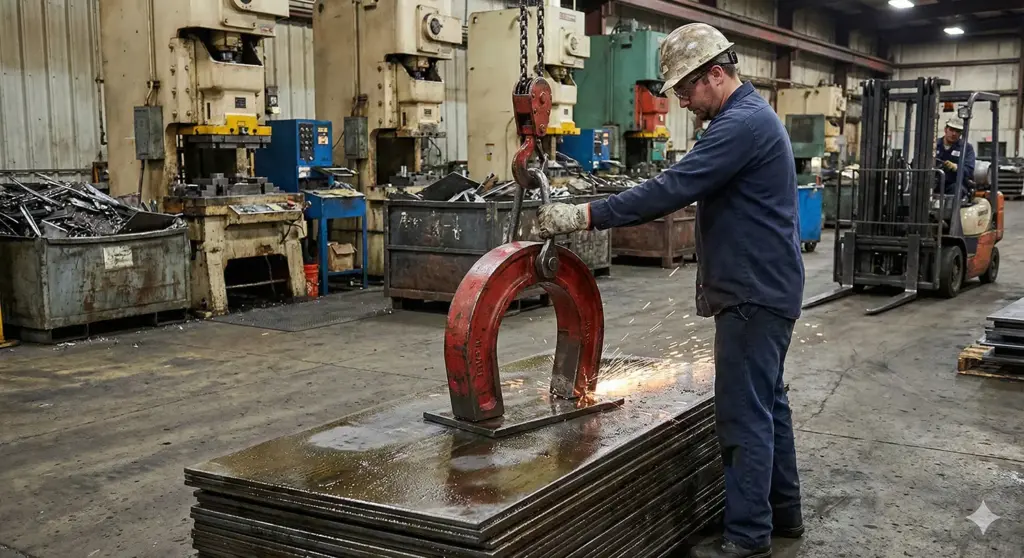
Horseshoe magnets are deployed in scenarios where concentrated pull force and reliability are mission-critical. Manufacturing operations use them for lifting, sorting, and positioning metal components. Laboratory environments leverage their strong, localized fields for experimental setups requiring stable magnetic conditions. Their predictable flux profile also enhances measurement accuracy in magnetic instrumentation.
Role in Educational and Demonstrative Applications
In academic contexts, horseshoe magnets remain a preferred tool for visualizing magnetic fields. Their shape clearly demonstrates how magnetic lines of force travel between poles. Students and trainees can observe field interactions, magnetic attraction, and repulsion with a higher degree of clarity compared to bar or disc magnets.
Limitations and Engineering Considerations
Although highly effective, the design does have constraints. Exposure to high temperatures, mechanical shock, or opposing magnetic fields can weaken magnetization over time. Additionally, most horseshoe magnets are manufactured from steel or AlNiCo, materials that offer stability but may not achieve the extreme field strength of rare-earth magnets. As industries pursue performance optimization, next-generation horseshoe-style assemblies may incorporate NdFeB materials with protective coatings to enhance durability.
Forward-Looking Applications
With the increasing adoption of automation and robotics, concentrated magnetic fields will play a strategic role in advanced gripping systems, magnetic sensing modules, and precision handling equipment. Horseshoe magnet principles also underpin hybrid magnet structures used in electromagnetic actuators and magnetic clamping systems, supporting greater operational efficiency across sectors.
Leave a Reply