
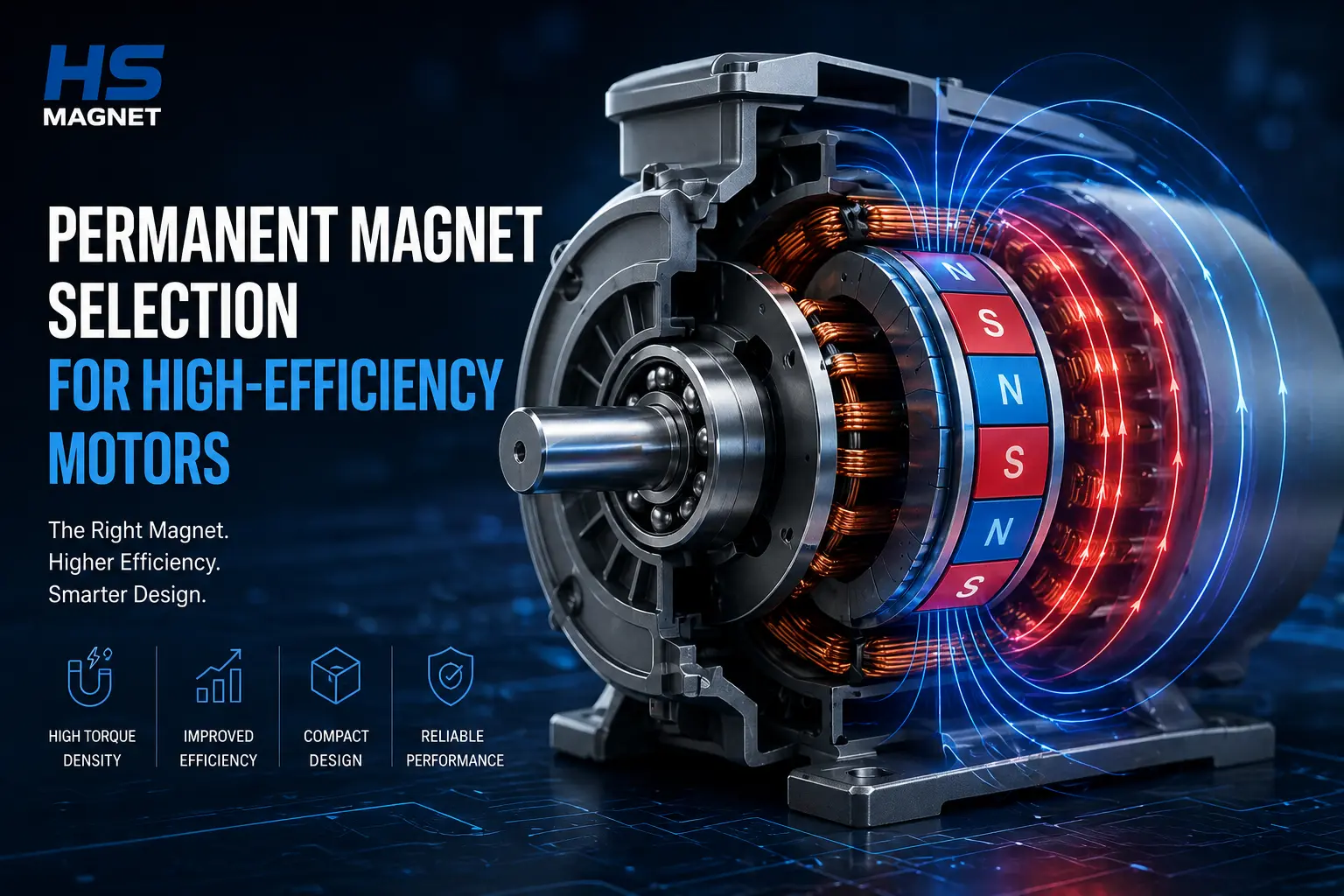
Electric motor efficiency is no longer a marginal optimization—it is a core competitive lever across EVs, industrial automation, HVAC systems, and precision equipment. At the center of this performance equation lies the permanent magnet. Selecting the right magnet type directly impacts torque density, thermal stability, lifecycle cost, and supply chain resilience.
This guide provides a structured framework for choosing the optimal permanent magnet for high-efficiency motor designs, with a focus on practical engineering trade-offs and procurement strategy.
Why Magnet Selection Matters in Motor Efficiency
Permanent magnets define the magnetic flux available in the air gap, which directly influences torque output and energy conversion efficiency. The right material enables:
- Higher power density (smaller motors with equal or greater output)
- Reduced copper losses due to improved magnetic coupling
- Stable performance across temperature ranges
- Lower total cost of ownership through durability and efficiency gains
However, no single magnet type dominates across all applications. Selection must balance performance, environment, and cost constraints.
Overview of Main Permanent Magnet Types
NdFeB (Neodymium Iron Boron)
NdFeB magnets are the industry standard for high-performance electric motors, especially in electric vehicles and high-end industrial systems.
Key characteristics:
- Extremely high energy product (BHmax)
- Excellent torque density
- Compact motor design capability
Limitations:
- Susceptible to corrosion (requires coating)
- Performance degradation at high temperatures (unless using high-grade variants with Dy/Tb additives)
- Price volatility due to rare earth supply chain
Best-fit applications:
- EV traction motors
- Robotics and automation
- High-efficiency compressors
SmCo (Samarium Cobalt)
SmCo magnets offer superior thermal stability and corrosion resistance, making them suitable for extreme environments.
Key characteristics:
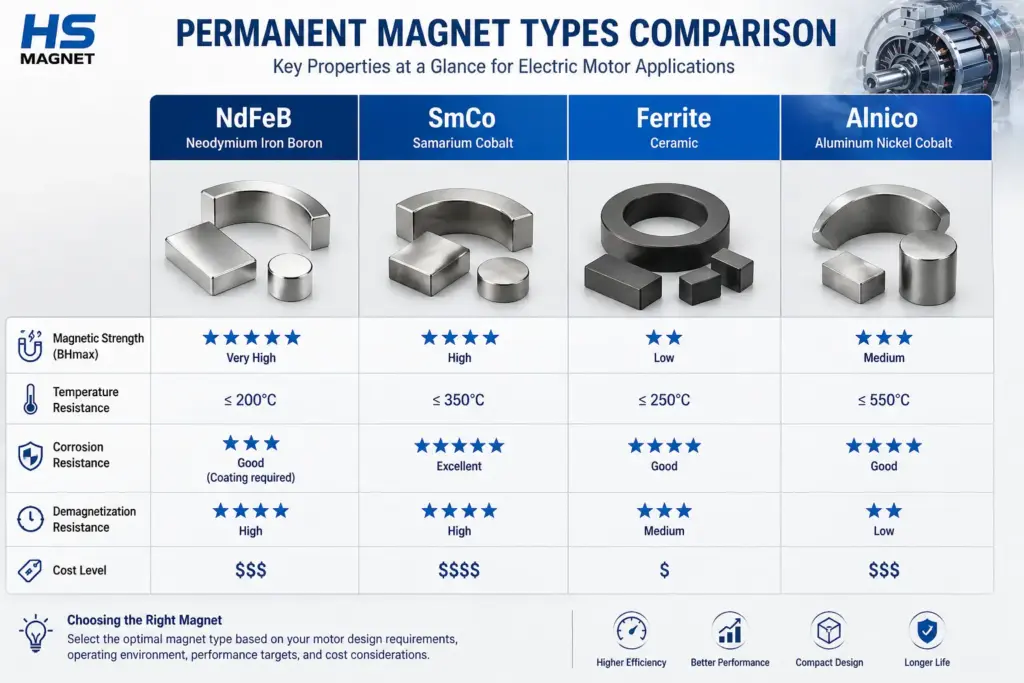
- Excellent high-temperature performance (up to 350°C)
- Strong resistance to oxidation and corrosion
- Stable magnetic properties over time
Limitations:
- Higher cost than NdFeB
- Lower magnetic strength compared to NdFeB
Best-fit applications:
- Aerospace motors
- Military and defense systems
- High-temperature industrial equipment
Ferrite (Ceramic Magnets)
Ferrite magnets are the most cost-effective solution and are widely used in mass-market applications.
Key characteristics:
- Low cost and abundant raw materials
- Good corrosion resistance
- Stable performance in moderate environments
Limitations:
- Low energy density
- Larger motor size required for equivalent output
Best-fit applications:
- Household appliances
- Pumps and fans
- Low-cost automotive systems
Alnico (Aluminum Nickel Cobalt)
Alnico magnets are known for their excellent temperature stability and low demagnetization risk.
Key characteristics:
- Outstanding temperature resistance
- High remanence
- Excellent stability in fluctuating fields
Limitations:
- Low coercivity (prone to demagnetization in compact motor designs)
- Relatively high cost compared to ferrite
Best-fit applications:
- Sensors and instrumentation
- Specialized motor designs with stable magnetic circuits
Key Selection Criteria for High-Efficiency Motor Design
1. Magnetic Performance (BHmax & Coercivity)
Higher energy product enables greater torque density. For compact, high-performance motors, NdFeB is typically the optimal choice. However, coercivity must also match the demagnetization risk in the motor design.
2. Operating Temperature Range
Thermal conditions significantly impact magnet performance:
- NdFeB: Typically up to 150–200°C (higher with special grades)
- SmCo: Up to 350°C
- Ferrite: Up to 250°C
For high-temperature environments, SmCo often provides the most reliable performance despite higher cost.
3. Corrosion Resistance & Coating Requirements
NdFeB magnets require protective coatings such as Ni-Cu-Ni, epoxy, or Parylene. In humid or chemically aggressive environments, coating selection becomes a critical design decision.
Ferrite and SmCo offer better intrinsic corrosion resistance, reducing long-term maintenance risks.
4. Cost vs Performance Optimization
A strategic cost-performance analysis should include:
- Initial material cost
- Motor size reduction benefits
- Efficiency gains over lifecycle
- Supply chain stability
In many cases, NdFeB delivers the lowest total cost of ownership despite higher upfront cost.
5. Supply Chain and Sustainability Considerations
Rare earth materials (Nd, Dy, Tb) introduce geopolitical and pricing risks. Forward-looking OEMs are:
- Exploring ferrite-based motor redesigns
- Reducing heavy rare earth dependency
- Partnering with reliable magnet manufacturers for stable sourcing
Application-Based Selection Recommendations
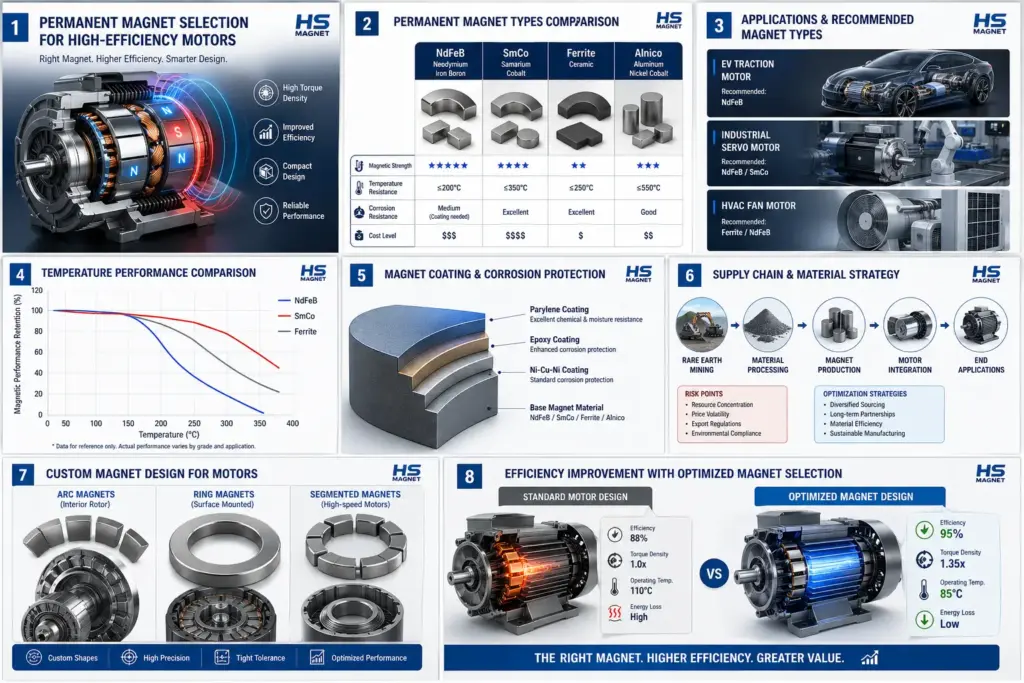
| Application | Recommended Magnet | Key Rationale |
|---|---|---|
| Electric Vehicles (EVs) | NdFeB | Maximum efficiency and compact size |
| Industrial Servo Motors | NdFeB / SmCo | Performance vs temperature trade-off |
| HVAC Systems | Ferrite / NdFeB | Cost-sensitive with moderate efficiency needs |
| Aerospace Systems | SmCo | High-temperature reliability |
| Consumer Appliances | Ferrite | Cost optimization |
Design Optimization Tips
- Use finite element analysis (FEA): Optimize magnet shape and placement for maximum flux efficiency
- Consider hybrid magnet systems: Combine ferrite and NdFeB to balance cost and performance
- Optimize magnet grade selection: Avoid over-specification to reduce unnecessary cost
- Integrate thermal management early: Magnet performance is highly temperature-dependent
Why Partner with HS Magnet
At HS Magnet, we support motor manufacturers with application-driven magnet solutions:
- Full range of NdFeB, SmCo, Ferrite, and Alnico magnets
- Custom magnet geometries for motor optimization
- Advanced coating solutions for durability
- Stable supply chain and quality assurance for global B2B clients
Whether you are designing next-generation EV motors or optimizing industrial systems, our engineering team helps you achieve the right balance of efficiency, reliability, and cost.
Conclusion
Permanent magnet selection is a strategic engineering decision that directly impacts motor efficiency, product competitiveness, and long-term profitability. By aligning material properties with application requirements and supply chain realities, manufacturers can unlock significant performance gains.
For high-efficiency motor design, the optimal choice is rarely about selecting the “strongest” magnet—it’s about selecting the right magnet for the system.
Leave a Reply