
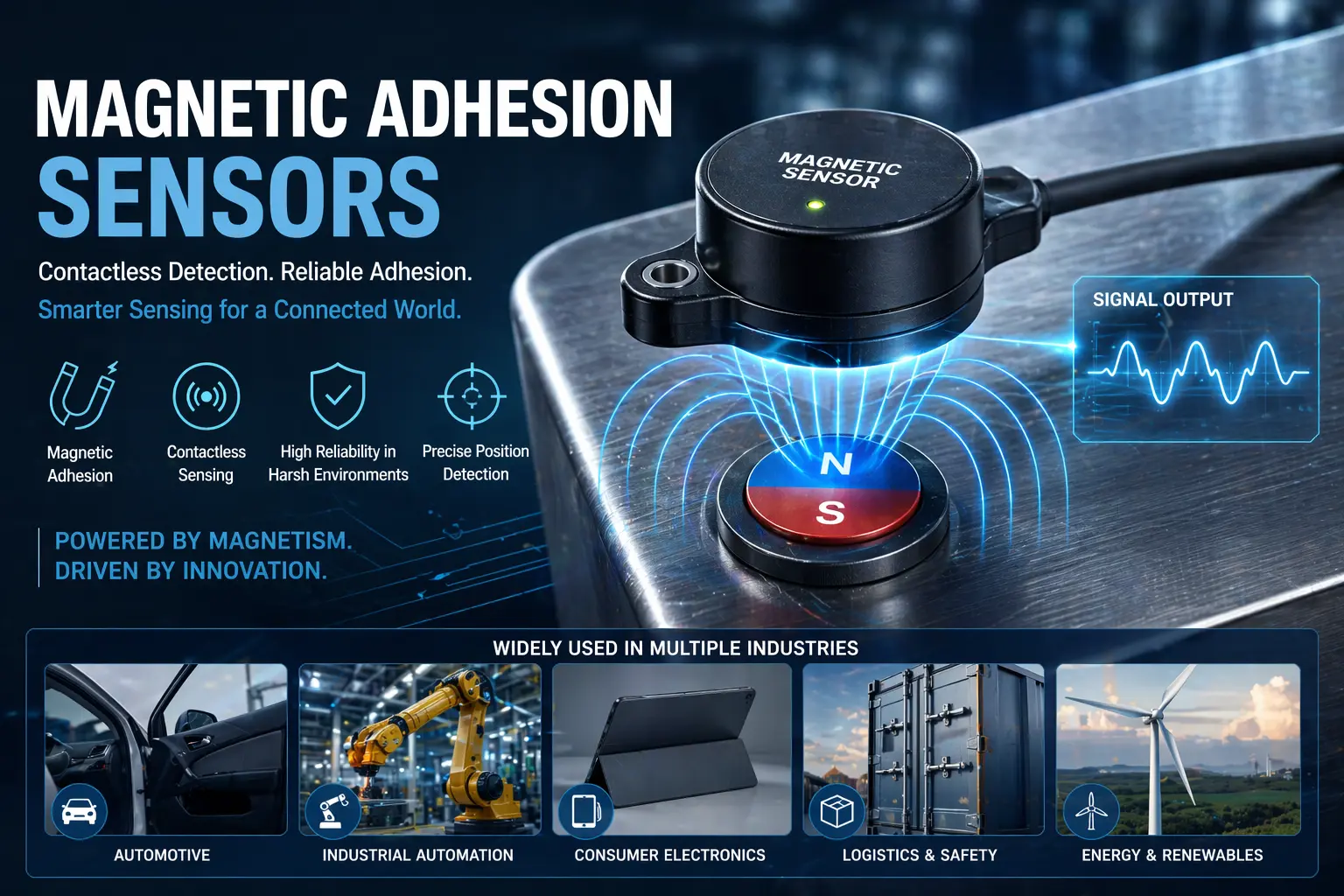
Magnetic adhesion sensors are emerging as a high-reliability solution for contactless detection, attachment verification, and position monitoring across multiple industries. By leveraging controlled magnetic fields and sensing elements such as Hall-effect or magnetoresistive chips, these sensors deliver stable performance in environments where traditional mechanical or optical sensing fails.
This article outlines the working principles, system architecture, and real-world deployment scenarios of magnetic adhesion sensors, with a focus on scalability and industrial applicability.
What Is a Magnetic Adhesion Sensor?
A magnetic adhesion sensor is a system that detects the presence, position, or attachment state of an object using magnetic force and field variation. Unlike conventional proximity sensors, it integrates both magnetic attraction (adhesion) and field sensing, enabling dual functionality:
- Physical stabilization or positioning via magnetic force
- Signal generation via magnetic field detection
This combination is particularly valuable in dynamic or vibration-prone environments.
Core Working Principle
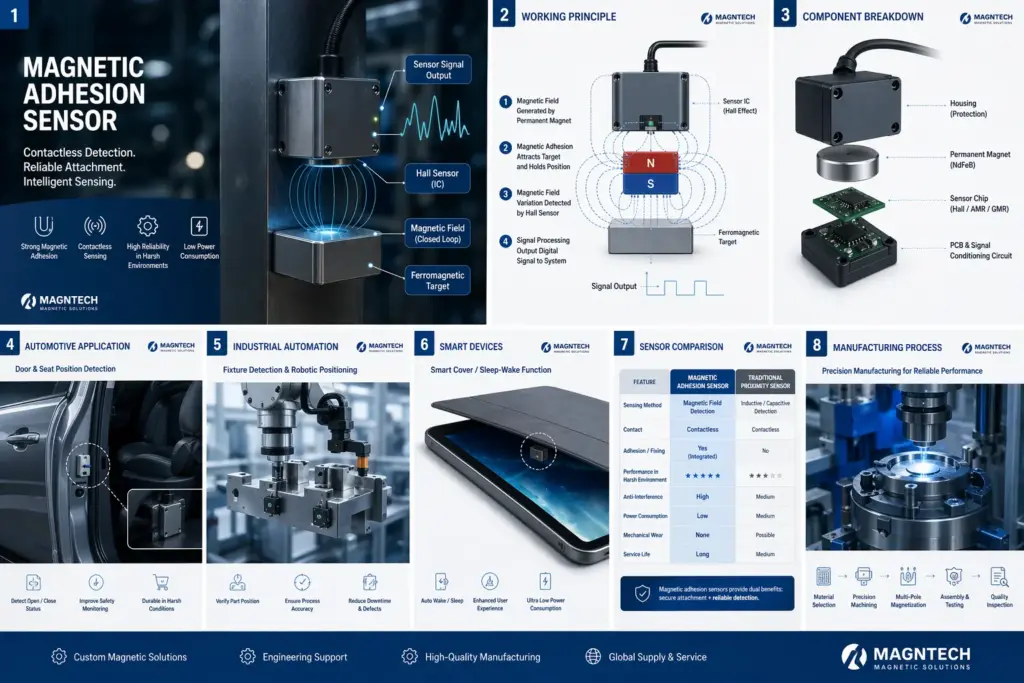
At a system level, magnetic adhesion sensors operate based on magnetic field interaction and signal conversion.
1. Magnetic Field Generation
A permanent magnet (such as NdFeB or ferrite) generates a stable magnetic field. The geometry—ring, block, or arc—determines the field distribution.
2. Adhesion Mechanism
When a ferromagnetic target (e.g., steel component) enters the magnetic field, it is attracted and held in position. This creates a predictable and repeatable spatial relationship.
3. Field Variation Detection
A sensing element—commonly a Hall-effect sensor or AMR/GMR sensor—detects changes in magnetic flux density as the target moves, attaches, or detaches.
4. Signal Processing
The detected analog signal is converted into a digital output, enabling integration with control systems such as PLCs, ECUs, or IoT platforms.
Key Components in System Design
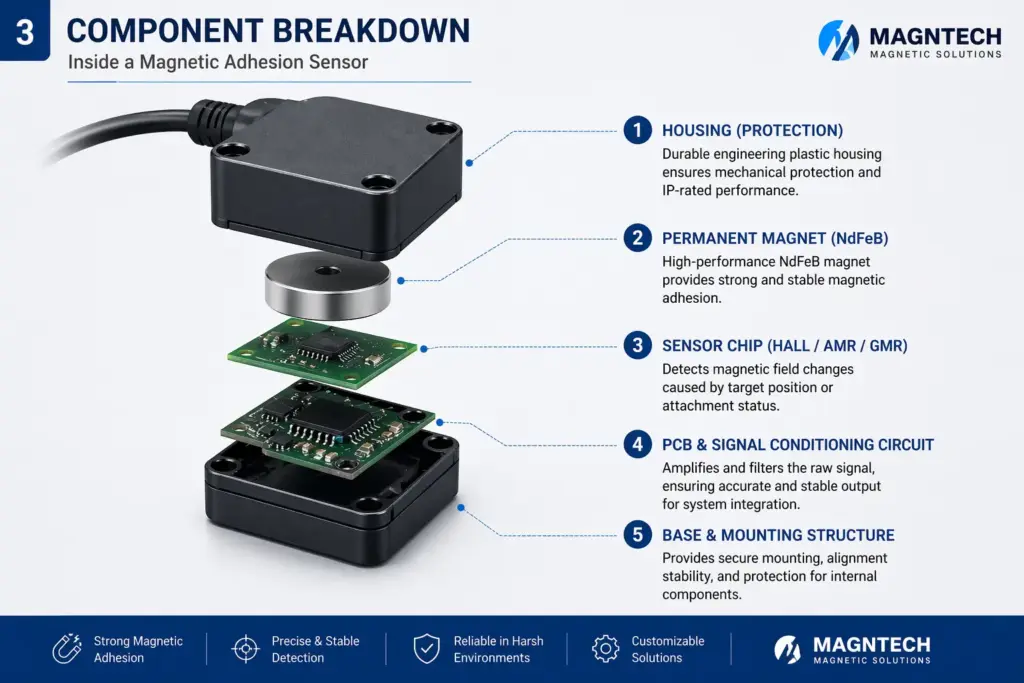
- Permanent Magnet: Defines field strength and adhesion force
- Sensor Chip: Converts magnetic flux into electrical signals
- Housing Structure: Ensures alignment and environmental protection
- Signal Conditioning Circuit: Amplifies and filters sensor output
From an engineering perspective, magnet selection and field uniformity are critical to ensuring consistent sensor performance.
Strategic Advantages
1. Contactless Operation
No mechanical wear, leading to longer lifecycle and reduced maintenance costs.
2. High Reliability in Harsh Environments
Magnetic sensing is unaffected by dust, oil, moisture, or light conditions—ideal for industrial applications.
3. Dual Functionality (Fixing + Sensing)
Combines mechanical positioning and sensing into a single system, reducing component count.
4. Energy Efficiency
Permanent magnets require no continuous power supply, lowering system energy consumption.
Limitations and Engineering Challenges
- Sensitivity to external magnetic interference
- Performance dependency on material properties of the target
- Precision limitations compared to optical or laser sensors in ultra-fine measurements
Mitigation strategies include magnetic shielding, calibration algorithms, and optimized magnet geometry.
Industry Applications and Case Studies
1. Automotive Industry: Door and Seat Position Detection
Magnetic adhesion sensors are widely used in electric vehicles for detecting door closure status and seat positioning. The magnetic element ensures stable alignment, while the sensor provides real-time feedback to the vehicle ECU.
Value Proposition:
- Improved safety monitoring
- Reduced mechanical failure risk
2. Industrial Automation: Fixture Detection and Robotics
In automated production lines, magnetic adhesion sensors are used to verify whether a workpiece is correctly positioned or attached to a fixture.
Example Use Case:
Robotic arms equipped with magnetic grippers use embedded sensors to confirm successful pick-and-place operations.
Business Impact:
- Increased production accuracy
- Reduced defect rates
3. Consumer Electronics: Smart Covers and Accessories
Devices such as tablets and wearables use magnetic adhesion sensors to detect cover attachment (e.g., sleep/wake function).
Strategic Benefit:
- Enhanced user experience
- Low power consumption design
4. Logistics and Warehousing: Container and Door Monitoring
Magnetic sensors are deployed in smart logistics systems to detect whether containers or doors are securely closed.
Operational Advantage:
- Real-time monitoring
- Integration with IoT tracking systems
5. Renewable Energy: Wind Turbine Maintenance
Magnetic adhesion sensors are used in inspection robots that climb steel structures using magnetic force. Sensors ensure proper adhesion and positioning during operation.
Outcome:
- Improved safety for maintenance operations
- Reduced manual inspection costs
Design Considerations for Engineers
When implementing magnetic adhesion sensors, decision-makers should evaluate:
- Magnet Material (NdFeB vs Ferrite): trade-off between strength and cost
- Air Gap Distance: directly impacts sensing accuracy
- Temperature Stability: critical for automotive and outdoor applications
- Shielding Requirements: to minimize electromagnetic interference
A well-optimized design balances magnetic force, sensing precision, and system cost.
Future Development Trends
1. Integration with Smart Systems
Magnetic sensors are increasingly integrated with IoT platforms, enabling predictive maintenance and real-time diagnostics.
2. Miniaturization
Advances in materials and sensor ICs are enabling compact designs for wearable and micro-device applications.
3. Advanced Magnetization Techniques
Custom multi-pole magnetization enhances sensing resolution and system flexibility.
4. AI-Driven Signal Processing
Machine learning algorithms are being used to improve signal interpretation and reduce noise interference.
Conclusion
Magnetic adhesion sensors represent a robust, scalable solution for modern sensing challenges. Their ability to combine mechanical fixation with precise detection positions them as a key technology in next-generation industrial and smart systems.
For manufacturers and system integrators, investing in optimized magnet design and sensor integration will be essential to achieving competitive advantage in increasingly automated and data-driven environments.
As a professional magnet manufacturer, we provide customized magnetic components and engineering support to help you develop high-performance magnetic sensor solutions tailored to your application needs.
Leave a Reply