
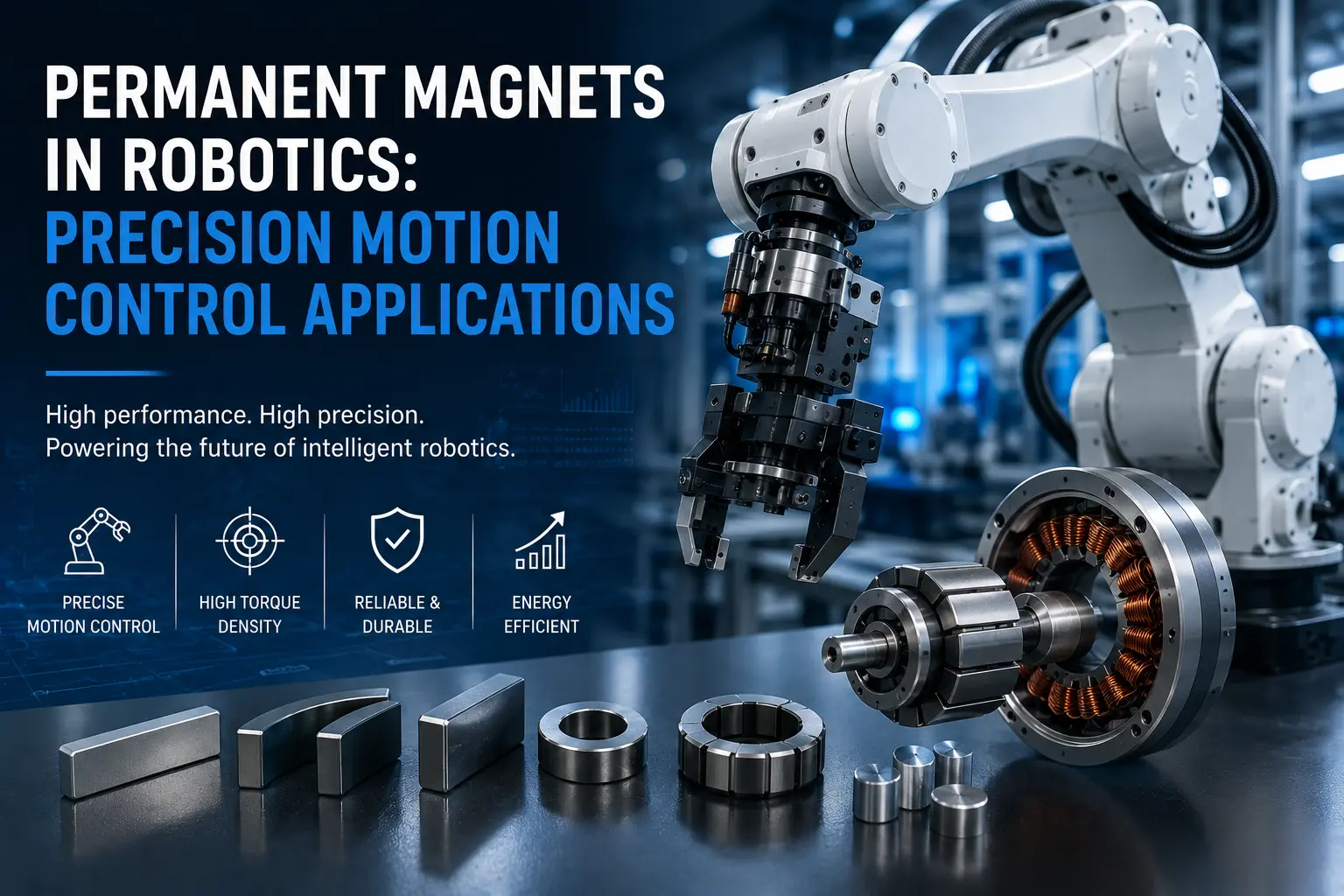
Permanent magnets play an important role in modern robotics, enabling compact motors, precise positioning systems, magnetic sensors, and efficient actuators. As industrial robots become faster, lighter, and more accurate, the performance of their magnetic components directly affects motion control, energy efficiency, and system reliability.
From robotic arms and collaborative robots to automated guided vehicles (AGVs), permanent magnets provide the magnetic force and torque required for precise and repeatable movement.
Table of Contents
- Why Permanent Magnets Matter in Robotics
- NdFeB Magnets for Robotic Motors
- Permanent Magnets for Servo Motors
- Magnetization Direction and Motor Performance
- Permanent Magnets in Robotic Sensors
- SmCo Magnets for High-Temperature Robotics
- Custom Magnetic Solutions for Robotics
- Choosing the Right Permanent Magnet
- Conclusion
Why Permanent Magnets Matter in Robotics
Robotic systems require motors and actuators that can deliver high torque, fast response, and accurate positioning within a compact footprint. Permanent magnet materials are particularly suitable because they generate a continuous magnetic field without requiring an external power source to maintain magnetization.
In permanent magnet motors, the interaction between the magnetic field of the permanent magnets and the electromagnetic field generated by the stator produces rotational torque. This enables high power density and efficient motion control.
For robotics manufacturers, key advantages include:
- High torque density
- Compact motor design
- Fast dynamic response
- High energy efficiency
- Precise position control
- Low maintenance requirements
NdFeB Magnets for Robotic Motors
Neodymium Iron Boron (NdFeB) magnets are widely used in robotic servo motors because of their high magnetic energy density. Their strong magnetic performance allows engineers to design smaller and lighter motors without sacrificing torque output.
This is particularly valuable for robotic arms, where reducing actuator weight can improve acceleration, payload efficiency, and overall energy consumption.
Different NdFeB grades can be selected according to the application’s magnetic and thermal requirements. High-coercivity and high-temperature grades are often considered for motors exposed to elevated operating temperatures or demanding electromagnetic conditions.
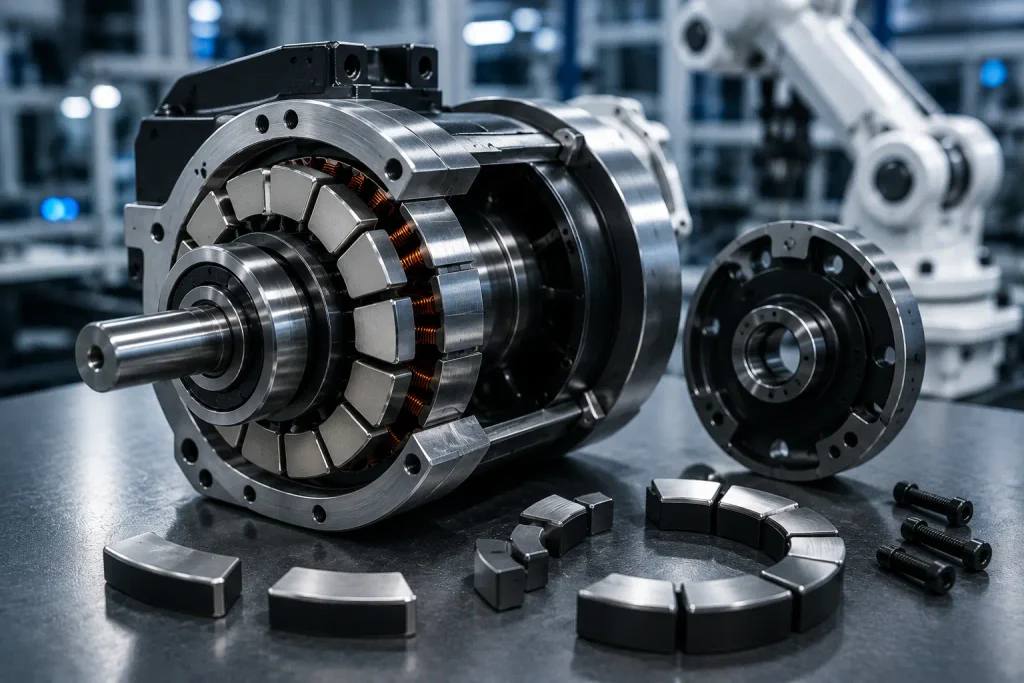
Permanent Magnets for Servo Motors
Servo motors are fundamental to precision robotics. They must respond quickly to control signals while maintaining accurate position, speed, and torque.
Permanent magnets contribute to servo motor performance by providing a stable rotor magnetic field. Combined with position feedback from encoders or magnetic sensors, the motor controller can continuously adjust current and rotor position.
This closed-loop architecture enables robots to perform precise operations such as:
- Pick-and-place
- Welding
- Assembly
- Dispensing
- Semiconductor handling
- Precision machining
The quality and positioning accuracy of the magnets can therefore have a direct impact on motor consistency.
Magnetization Direction and Motor Performance
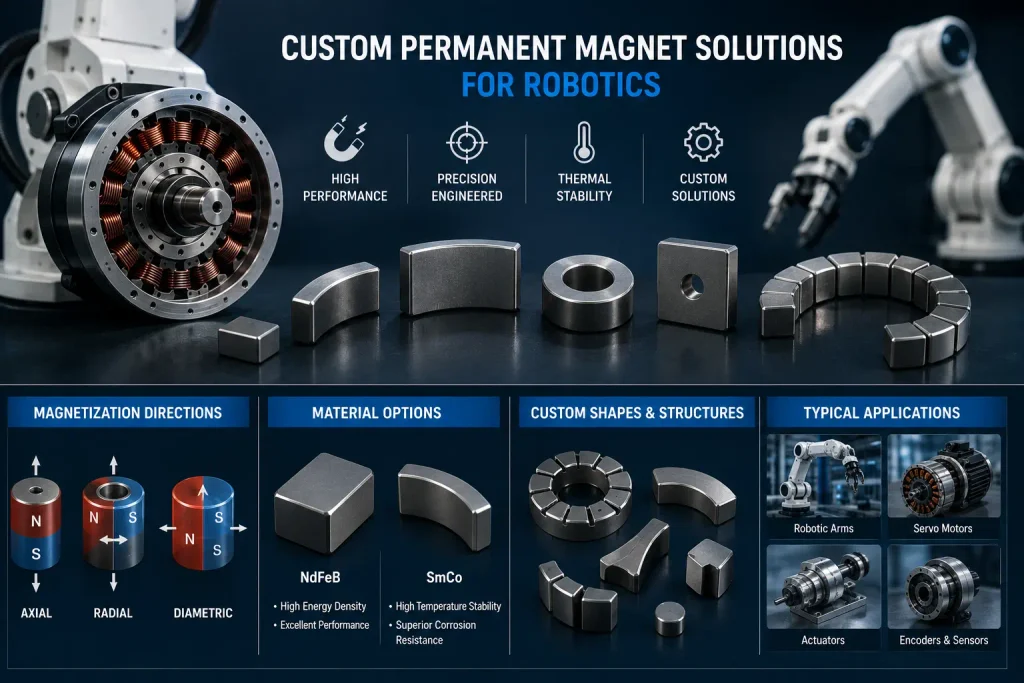
Magnetization direction is an important consideration when designing magnets for robotic motors. Depending on the rotor structure, magnets may require axial, radial, diametric, or customized magnetization.
Correct magnetization ensures that the magnetic flux is distributed as intended throughout the motor’s magnetic circuit.
For complex motor designs, engineers can use magnetic circuit simulation to optimize:
- Magnetic flux distribution
- Torque output
- Cogging torque
- Back EMF
- Thermal performance
- Motor efficiency
Early simulation and prototype testing can help identify the optimal magnet geometry and grade before mass production.
Permanent Magnets in Robotic Sensors
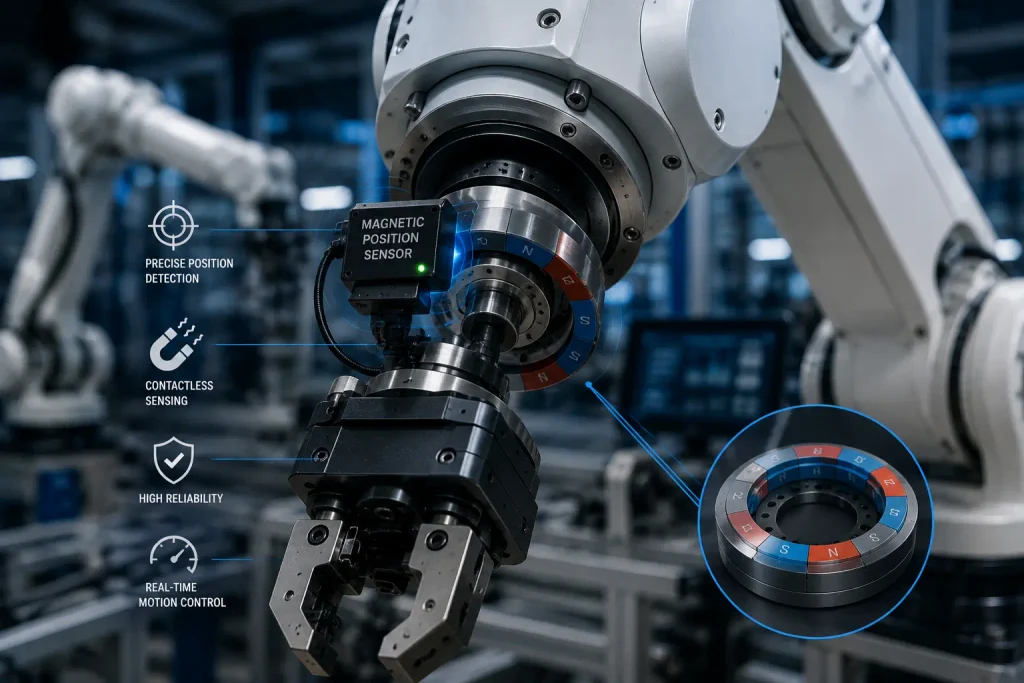
Permanent magnets are not limited to motors. They are also used in position and proximity sensing systems.
Magnetic sensors can detect changes in magnetic fields to determine the position or movement of robotic components. This provides a contactless method of measuring motion, reducing mechanical wear.
Applications include:
- Joint position detection
- Linear position sensing
- End-effector position monitoring
- Rotary encoders
- Proximity detection
For these applications, magnet size, magnetic field strength, pole configuration, and dimensional tolerances must be carefully controlled.
SmCo Magnets for High-Temperature Robotics
While NdFeB is often selected for its high magnetic strength, Samarium Cobalt (SmCo) magnets can be advantageous in high-temperature robotic applications.
SmCo offers excellent temperature stability and strong resistance to demagnetization. It can therefore be considered for robotic systems operating near heat-generating equipment or in demanding industrial environments.
Material selection should always consider the actual operating temperature, required magnetic performance, mechanical design, and cost target.
Custom Magnetic Solutions for Robotics
Robotic applications rarely have identical requirements. A standard magnet may not provide the required geometry, magnetization pattern, dimensional tolerance, or thermal performance.
Custom permanent magnets and magnetic assemblies allow manufacturers to optimize the component around the complete motor or actuator design.
A customized solution may involve:
- Special magnet shapes
- Customized magnetization
- High-temperature grades
- Protective coatings
- Precision machining
- Segmented rotor magnets
- Integrated magnetic assemblies
Working with an experienced magnet manufacturer during the design stage can also help optimize material usage and reduce manufacturing risks.
Choosing the Right Permanent Magnet
When selecting magnets for robotic motion control, engineers should evaluate more than maximum magnetic strength.
Important parameters include:
Magnetic grade: Determines energy density, coercivity, and temperature performance.
Operating temperature: The magnet must maintain sufficient performance throughout the complete temperature range.
Magnetization direction: Must match the motor or sensing system’s magnetic circuit.
Dimensional tolerance: Precise geometry and positioning are critical for consistent motor performance.
Surface protection: Coatings may be required for corrosion resistance and environmental durability.
Mechanical retention: High-speed rotors require reliable methods to prevent magnet movement during operation.
Conclusion
Permanent magnets are fundamental components in modern robotic motion control systems. Their high magnetic energy density enables compact servo motors, efficient actuators, and precise sensing solutions that support the increasing performance requirements of industrial automation.
NdFeB magnets are particularly suitable for high-performance robotic motors, while SmCo provides an attractive option for applications requiring greater thermal stability. By optimizing magnet grade, geometry, magnetization direction, and assembly design, robotics manufacturers can achieve improved torque density, positioning accuracy, efficiency, and reliability.
For OEM robotics applications, partnering with an experienced permanent magnet manufacturer can help ensure that the magnetic solution is optimized for both technical performance and long-term production requirements.

Leave a Reply