
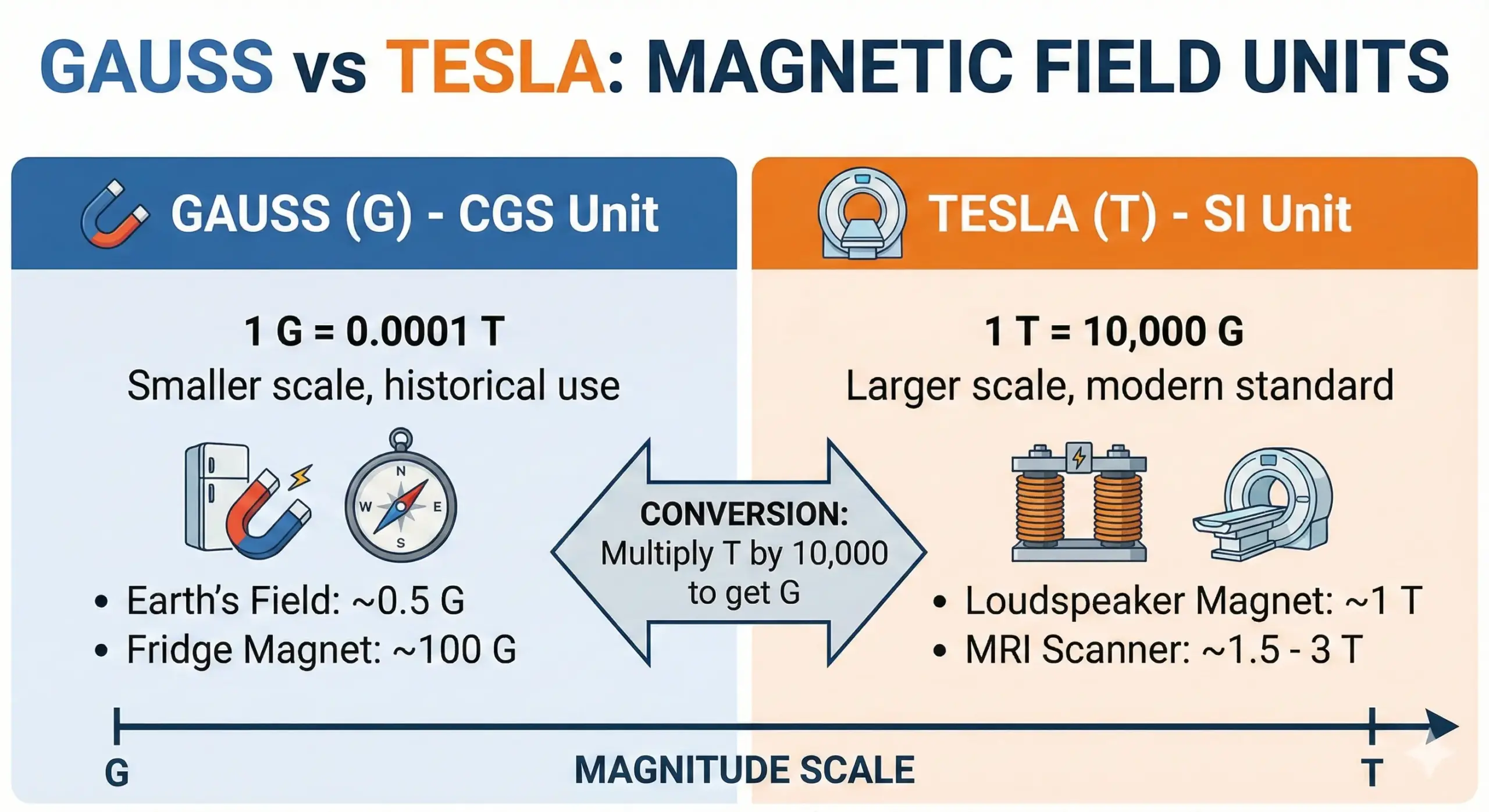
Global industries relying on permanent magnets — including EV motors, medical devices, renewable energy systems, and industrial automation — must quantify magnetic field strength accurately. Two primary units are used worldwide: Gauss (G) and Tesla (T). Both describe magnetic field intensity, but they originate from different measurement systems and align with different engineering standards.
For professionals specifying magnet performance, compliance, and safety, a clear understanding of these units is essential to making informed procurement and design decisions.
The Difference Between Gauss and Tesla
Gauss and Tesla measure magnetic flux density, denoted as B. The difference lies in the unit systems they belong to:
| Unit | Symbol | System | Scale | Usage |
|---|---|---|---|---|
| Tesla | T | SI (International System) | Large | Engineering, motor design, industrial standards |
| Gauss | G | CGS (Centimeter-Gram-Second system) | Small | Legacy science, magnet QC testing |
Core Conversion:
1 Tesla = 10,000 Gauss
or
1 Gauss = 0.0001 Tesla
Tesla is now the globally preferred scientific and industrial unit due to SI standardization, while Gauss remains common in magnet distribution and product marketing.
When to Use Tesla vs. Gauss in Industry
Different sectors rely on one unit more than the other based on precision and application scale:
| Industry Application | Preferred Unit | Rationale |
|---|---|---|
| Electric motors, wind turbines | Tesla | Handles high-strength magnetic fields |
| MRI medical systems | Tesla | System operates in multi-Tesla ranges |
| Consumer magnets (NdFeB, ferrite) | Gauss | Easier to communicate surface field |
| Magnetic sensors & QC checks | Gauss | Portable meters typically read Gauss |
| R&D laboratories | Tesla | Standardized scientific measurement |
In many modern supply chains, teams use Tesla for performance modeling and Gauss for surface field validation during inspection.
How Magnetic Field Strength Is Measured
Magnetic flux density is commonly measured using:
- Gaussmeters / Teslameters
- Hall effect sensors
- Flux mapping systems for QC
- Automated magnet inspection equipment
For permanent magnet suppliers and OEMs, consistent measurement ensures:
- Compliance with procurement specifications
- Magnetic uniformity in production batches
- Reliability in torque, force, and energy output

Why Advanced Manufacturing Is Moving Toward Tesla
Future-proof engineering strategies demand standardization. Tesla delivers:
- Alignment with SI-based global industrial standards
- Clear modeling compatibility in motor and sensor design
- Higher accuracy in fields >1,000 Gauss
- Improved international communication between partners
Enterprises operating in defense, aviation, clean energy, and robotics increasingly rely on Tesla-based performance criteria in contracts and certifications.
Practical Example: NdFeB Magnet Surface Field
A typical N52 neodymium magnet has a surface field around:
14,000 Gauss ≈ 1.4 Tesla
Even small permanent magnets operate in multi-kilogauss ranges — one reason Tesla continues to gain adoption in high-tech sectors.
Key Takeaways for Strategic Procurement
- Gauss and Tesla measure the same physical property: magnetic flux density
- Tesla is 10,000× larger than Gauss and serves as the modern standard
- Industrial innovation is increasingly Tesla-driven
- Gauss remains useful for surface readings and retail communication
Organizations that transition to Tesla-aligned specifications see improved cross-border collaboration, more accurate performance forecasting, and reduced downstream quality risks.
Leave a Reply