
Importing magnets in 2025 requires more than just checking technical specs. With the latest export controls on heavy rare earth elements (effective October 2025), a single mistake in material selection or documentation can lead to 3-month delays or customs seizures.
This guide breaks down the process into four core steps to ensure your shipment arrives on time and compliant.
Step 1: Material Selection — Avoid Licensing Traps
To streamline your import, it is crucial to identify whether your required magnet grade falls under the ‘Dual-Use Item’ export control list. While not all magnets containing Dysprosium (Dy) or Terbium (Tb) are restricted, high-performance grades (typically High-Hcj) often trigger the requirement for an export license, which can add 2–3 months to the lead time.
| Magnet Type | Export License Required? | Best For… | Our Support |
| Standard NdFeB (No Dy/Tb) | No (Only ICP Report needed) | Consumer electronics, standard motors, general applications. | We provide ICP Test Reports to validate the material composition and confirm exemption from export licensing. |
| High-Temp NdFeB (Contains Dy/Tb) | Yes (Dual-Use Item License) | High-performance motors, aerospace, extreme environments. | We initiate the 3-month application process for you and track weekly progress. |
| Samarium Cobalt (SmCo) | Yes (Dual-Use Item License) | High-temp and highly corrosive environments. | We manage all technical documentation and end-user verification. |
| Ferrite / AlNiCo | No | Low-cost sensors, toys, educational tools. | Fast-track shipping with basic commercial documentation. |
Pro Tip: Unless your application absolutely requires high-temperature stability, prioritize Non-Dy/Tb NdFeB. You will save at least 2 months in lead time.
Step 2: The Licensing Process (For Regulated Items)
If your magnets require heavy rare earths, the “Dual-Use Item Export License” is mandatory.
- Start Early (90-Day Rule): Official approval by the Ministry of Commerce typically takes 45 working days. Including document preparation, start the process at least 3 months before your required ship date.
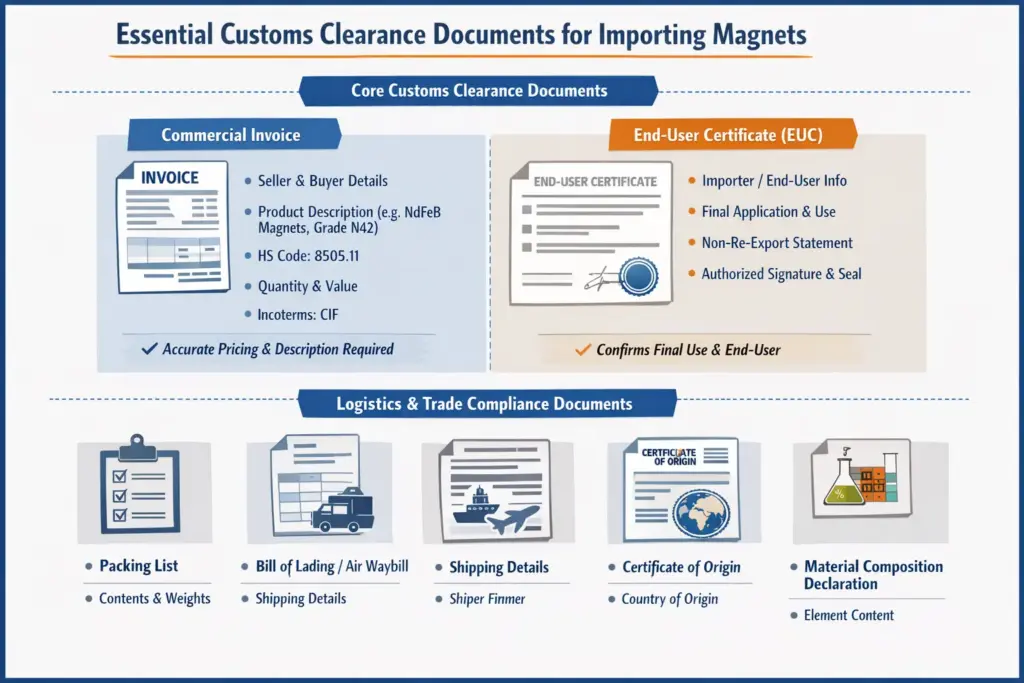
- The “End-User Certificate” (EUC): This is the most scrutinized document. It must clearly state the specific application (e.g., “MRI Medical Device” rather than just “Industrial Use”) and include a non-military use commitment.
- Batch Optimization: We recommend consolidating multiple small orders into one large licensed shipment to reduce repetitive paperwork and administrative fees.
Step 3: Essential Documentation & Consistency Check
Customs officials look for “perfect consistency.” If the weight on the Packing List differs from the ICP Report by even a small margin, the cargo may be flagged.
Required Document Checklist:
- Commercial Invoice & Packing List: Must include the correct HS Code (typically 8505.11).
- ICP Test Report: A chemical composition analysis from a certified lab.
- Technical Specifications: Includes product drawings and physical property data (Grade, Br, Hcj, etc.).
- SDS (Safety Data Sheet): Must be updated to the latest GHS standards (replacing the outdated MSDS format).
- End-User Statement: Signed and stamped by the final user of the magnets.
Step 4: Shipping Compliance — Magnetism & UN2807
Magnets are considered “Dangerous Goods” in air freight if not properly shielded. Handling this incorrectly results in rejected shipments or heavy fines.
1. The Magnetic Inspection Standards (IATA DGR)
- Non-Restricted: If the magnetic field strength at 2.1m from the package is < 0.159 A/m (0.002 gauss), it can be shipped as general cargo.
- Restricted (UN2807 Class 9): If the field is > 0.159 A/m at 2.1m, but < 0.418 A/m (0.00525 gauss) at 4.6m, it must be declared as UN2807.
- Prohibited: If it exceeds 0.418 A/m at 4.6m, air transport is generally forbidden.
2. Shielded Packaging
We use specialized iron-lined boxes and “magnetic shielding” layouts to ensure the external field remains within “Non-Restricted” limits whenever possible.
3. Professional Certification
For all air shipments, we provide a Magnetic Inspection Report from an IATA-authorized agency (such as DGM) to ensure the airline accepts the cargo without delay.
Summary for a Smooth Import
- Check the Chemistry: Avoid Dy/Tb if you want to ship within weeks rather than months.
- Verify the UN Number: Ensure your freight forwarder uses UN2807 for magnets (never confuse this with UN3090, which is for Lithium Batteries).
- Detail the End-Use: Be specific in your usage descriptions to avoid “Dual-Use” red flags.
Importing magnets from China does not have to be complex.
With structured planning, regulatory awareness, and end-to-end support, the process becomes predictable, compliant, and efficient.
From magnet selection and licensing to documentation, logistics, and customs clearance, HSMAGNET remain actively involved at every stage—so your shipment arrives on time, without disruptions to production.


Leave a Reply