

For engineers and product designers, magnets are not off-the-shelf accessories—they are performance-critical components that influence efficiency, safety, cost structure, and long-term reliability. An incorrect magnet choice can trigger redesigns, supply delays, compliance issues, and hidden lifecycle costs.
This guide is designed as a decision framework, not a catalog overview. Its objective is simple: help technical decision-makers specify the right magnet the first time and move efficiently toward qualified B2B supplier engagement.
Table of Contents
- Why Magnet Selection Is a Strategic Engineering Decision
- Step 1: Clearly Define Functional Requirements
- Step 2: Select the Right Magnet Material
- Step 3: Evaluate Operating Environment
- Step 4: Choose the Correct Coating and Surface Treatment
- Step 5: Optimize Size, Shape, and Tolerances
- Step 6: Account for Supply Chain and Compliance Risk
- Step 7: Prototype, Test, and Validate Early
- Common Mistakes Engineers and Designers Should Avoid
- When to Engage a Magnet Manufacturer
- Conclusion: From Specification to Strategic Partnership
Why Magnet Selection Is a Strategic Engineering Decision
In B2B product development, magnets affect more than holding force or field strength. They directly impact:
- System efficiency and energy consumption
- Mechanical design constraints and assembly complexity
- Environmental durability and failure risk
- Supply chain resilience and compliance exposure
Treating magnet sourcing as an early-stage engineering decision—rather than a late procurement task—reduces downstream risk and accelerates time to market.
Step 1: Clearly Define Functional Requirements
Before evaluating materials or grades, define the functional role of the magnet within the system.
Key parameters to specify:
- Required magnetic force or torque
- Static vs dynamic magnetic loading
- Direction and shape of the magnetic field
- Acceptable performance tolerances over time
Clear functional definitions allow suppliers to propose optimized solutions rather than generic components.
Step 2: Select the Right Magnet Material
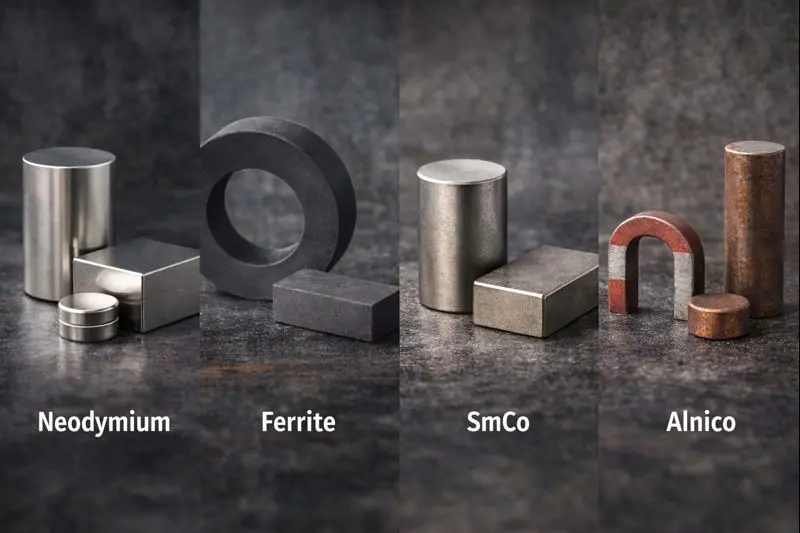
Neodymium (NdFeB) Magnets
Best for compact, high-performance designs.
- Highest magnetic strength per volume
- Enables miniaturization and lightweight systems
- Requires coating for corrosion resistance
Common uses: motors, actuators, automation, electronics
Samarium Cobalt (SmCo) Magnets
Optimized for extreme environments.
- Excellent thermal stability
- Strong corrosion resistance
- Higher cost, typically lower volumes
Common uses: aerospace, medical, high-temperature systems
Ferrite (Ceramic) Magnets
Cost-effective and stable.
- Low material cost
- Excellent corrosion resistance
- Larger size required for equivalent strength
Common uses: speakers, appliances, separators
Alnico Magnets
Stable magnetic characteristics.
- Good high-temperature performance
- Lower coercivity than modern magnets
Common uses: sensors, instruments
Material choice should align with system-level priorities, not just magnetic strength.
Step 3: Evaluate Operating Environment
Environmental conditions are a primary cause of magnet failure when overlooked.
Critical factors include:
- Maximum and continuous operating temperature
- Exposure to humidity, water, or chemicals
- Mechanical shock, vibration, or wear
In harsh environments, material grade, coating selection, and mechanical protection must be considered together.
Step 4: Choose the Correct Coating and Surface Treatment
For many magnets—especially NdFeB—coatings are mandatory, not optional.
Common options:
- Nickel (Ni-Cu-Ni): general industrial use
- Epoxy: humid, outdoor, or chemical environments
- Zinc: cost-sensitive, low-risk applications
- Polymer / Parylene: medical and electronics
A coating mismatch often results in corrosion, flaking, and premature field failures.
Step 5: Optimize Size, Shape, and Tolerances
Magnet geometry directly affects performance and manufacturability.
Consider:
- Shape optimization to reduce material usage
- Tolerance requirements vs production cost
- Assembly method and alignment sensitivity
Experienced suppliers can suggest geometry adjustments that improve performance while lowering total cost.
Step 6: Account for Supply Chain and Compliance Risk
In B2B and OEM environments, magnet selection must account for more than technical fit.
Evaluate suppliers based on:
- Material traceability and quality certifications
- Supply stability and lead time consistency
- Export control and regulatory compliance
- Engineering support and customization capability
A technically perfect magnet is still a liability if supply continuity is uncertain.
Step 7: Prototype, Test, and Validate Early
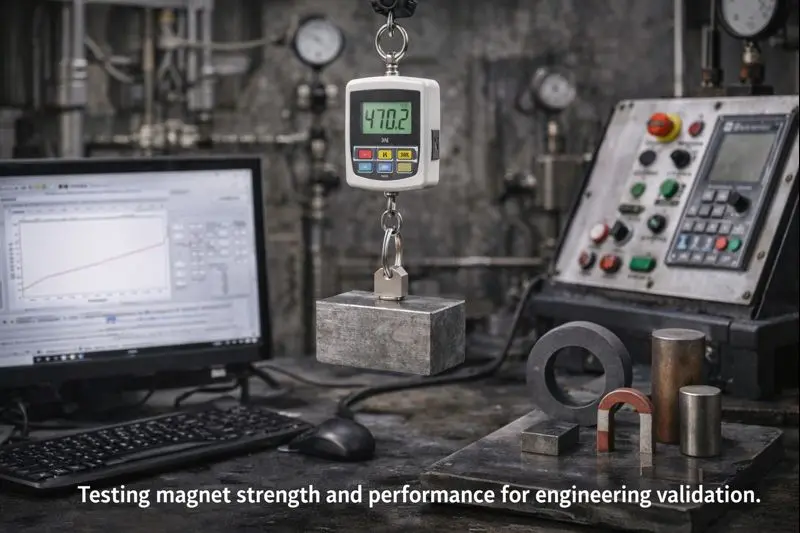
Before locking specifications:
- Test magnets under real operating conditions
- Validate thermal, corrosion, and mechanical limits
- Confirm consistency across pilot and production batches
Early validation minimizes redesign risk and avoids late-stage delays.
Common Mistakes Engineers and Designers Should Avoid
- Over-specifying magnet strength and inflating cost
- Ignoring environmental exposure until failure occurs
- Treating magnets as interchangeable commodities
- Selecting suppliers based on unit price alone
Avoiding these pitfalls significantly improves project outcomes.
When to Engage a Magnet Manufacturer
The optimal time to engage a professional magnet manufacturer is before final design freeze.
Early collaboration enables:
- Application-specific material and grade selection
- Design optimization to reduce cost and risk
- Faster prototyping and smoother scale-up
For B2B projects, direct technical dialogue consistently outperforms transactional sourcing.
Conclusion: From Specification to Strategic Partnership
Magnets are small components with outsized impact. For engineers and product designers, choosing the right magnet requires balancing performance, durability, cost, and supply chain resilience.
Organizations that approach magnet sourcing strategically—supported by qualified manufacturers—achieve faster development cycles, lower lifecycle costs, and more reliable products.
If your project demands performance certainty and long-term supply stability, engaging directly with an experienced magnet manufacturer is the most efficient next step.
Leave a Reply