
1. Introduction
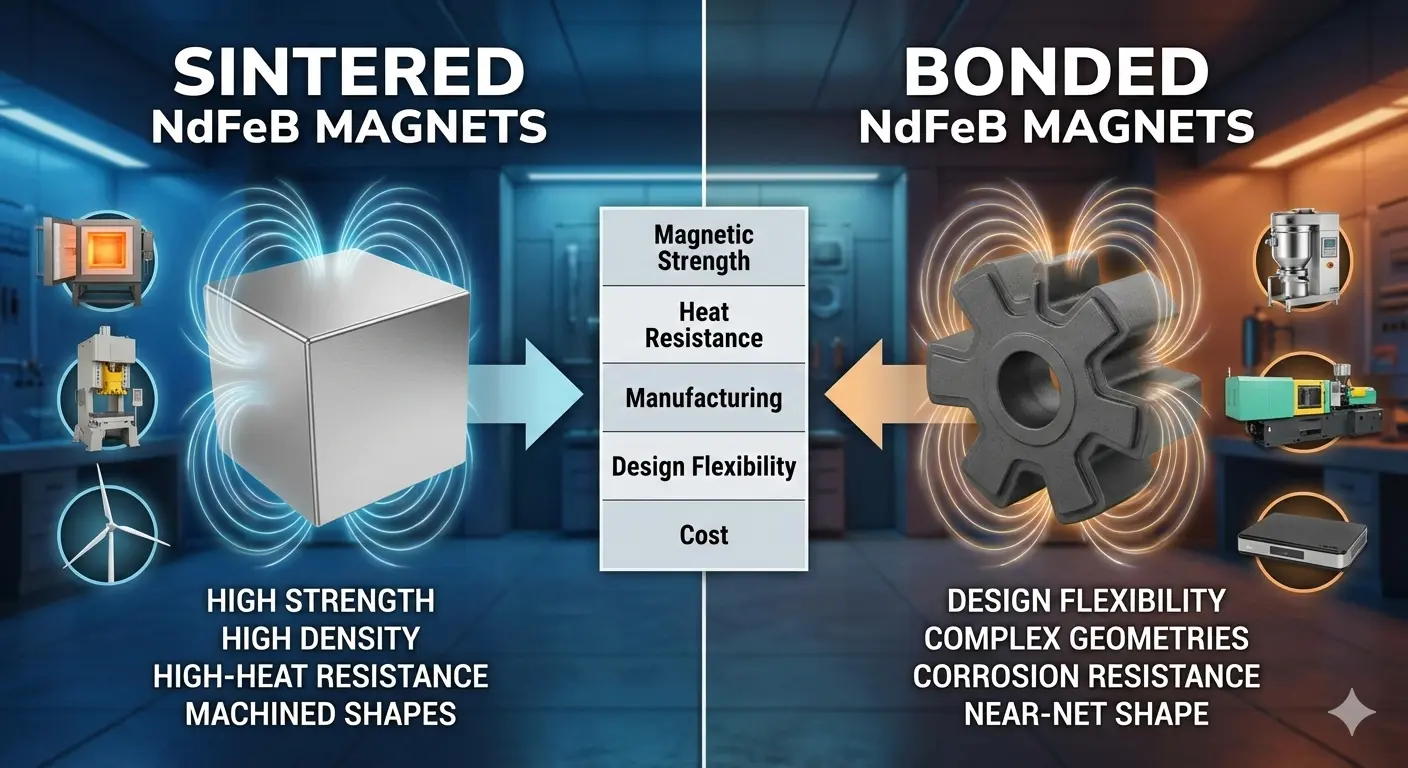
Since their introduction in the 1980s, Neodymium-Iron-Boron (NdFeB) magnets have become the strongest type of permanent magnets available, often called the “King of Magnets.”
Depending on the production process, NdFeB magnets can be classified into two major categories:
👉 Sintered NdFeB and Bonded NdFeB.
Although both share the same main magnetic phase (Nd₂Fe₁₄B), they differ significantly in manufacturing process, microstructure, magnetic performance, and application fields.
This article provides a detailed comparison to help engineers and designers choose the right material for their needs.
2. Manufacturing Process Comparison
| Item | Sintered NdFeB | Bonded NdFeB |
|---|---|---|
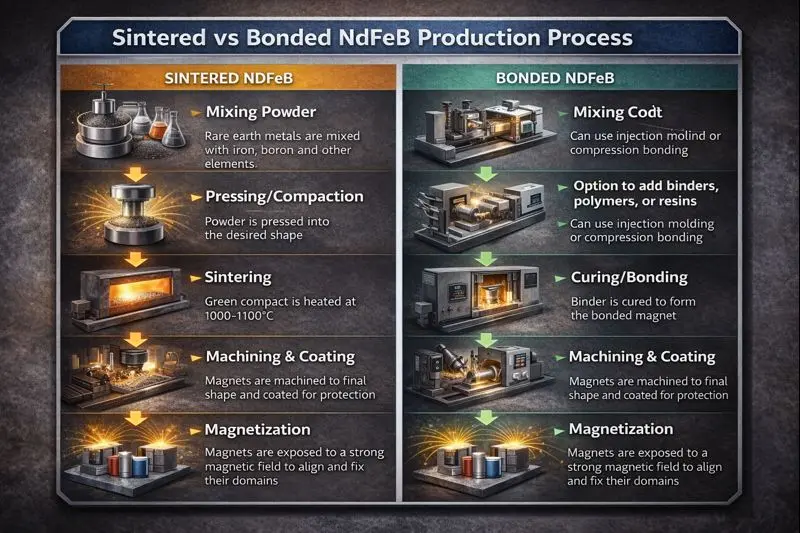
| Process Flow | Pulverizing → Pressing → Sintering → Machining → Coating | Powder + Binder Mixing → Injection/Compression Molding → Curing |
| Bond Type | Metallic atomic bonding | Polymer bonding |
| Shape Freedom | Low (requires post-machining) | High (net-shape molding possible) |
| Density | ~7.4 g/cm³ | ~6.0 g/cm³ |
| Magnetic Strength Loss | Minimal | Moderate |
| Cost | Higher | Lower |
3. Magnetic Performance Comparison
| Parameter | Sintered NdFeB | Bonded NdFeB |
|---|---|---|
| Remanence (Br, T) | 1.1–1.4 | 0.6–0.9 |
| Coercivity (Hcj, kA/m) | 800–2000 | 500–900 |
| Maximum Energy Product (BHmax, kJ/m³) | 200–400 | 70–120 |
| Temperature Coefficient (αBr, %/°C) | -0.11 | -0.12 ~ -0.15 |
| Operating Temperature (°C) | ≤ 200 (up to 230°C with special grades) | ≤ 150 |
| Density (g/cm³) | ~7.4 | ~6.0 |
| Machinability | Poor | Excellent |
| Corrosion Resistance | Requires coating (Ni, Zn, Epoxy) | Good (protected by polymer binder) |
💡 Observation:
Sintered NdFeB provides maximum magnetic energy density, while bonded NdFeB offers greater shape flexibility and better corrosion resistance.
4. Microstructural Differences
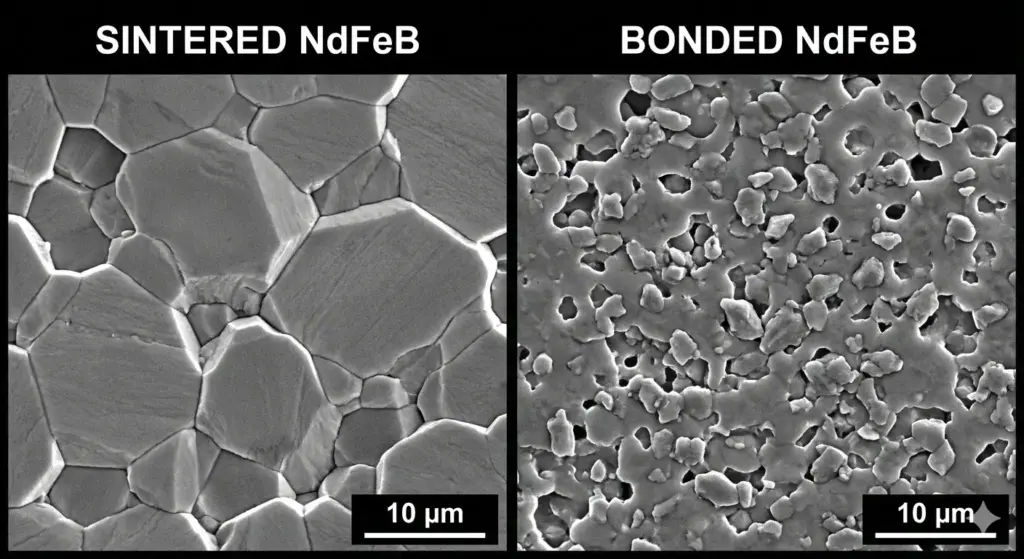
- Sintered NdFeB:
Formed through high-temperature sintering, creating strong inter-grain metallic bonds and exchange coupling.
The microstructure shows aligned grains with high magnetic anisotropy, ideal for maximum performance. - Bonded NdFeB:
Consists of isolated NdFeB powder particles embedded in a non-magnetic polymer binder.
The grains are magnetically decoupled, resulting in lower magnetic strength but isotropic properties—allowing multi-directional magnetization and complex shapes.
5. Application Comparison
| Application Area | Recommended Magnet Type | Key Advantage |
|---|---|---|
| High-power Motors (EVs, Servo, Wind Turbines) | Sintered NdFeB | Highest energy product and temperature stability |
| Precision Micro Motors (HDDs, Optical Drives) | Sintered NdFeB | High remanence and dimensional stability |
| Sensors, Meters, and Office Devices | Bonded NdFeB | Flexible design and isotropic magnetization |
| Automotive Systems (Seats, Fans, Windows) | Bonded NdFeB | Corrosion resistance and cost-effective mass production |
| Medical Equipment and Consumer Devices | Bonded NdFeB | Lightweight and safer material properties |
6. Cost and Lifecycle Analysis
| Factor | Sintered NdFeB | Bonded NdFeB |
|---|---|---|
| Raw Material Cost | High (higher rare-earth content) | Moderate |
| Manufacturing Cost | High (multiple processing steps) | Lower (injection or compression molding) |
| Service Life | Long, stable performance | Moderate, easier demagnetization |
| Recyclability | Re-sintering possible | Difficult due to polymer binder |
💬 Summary:
- Sintered NdFeB → Best for maximum performance and high-temperature operation.
- Bonded NdFeB → Ideal for complex shapes, mass production, and cost optimization.
7. Conclusion
Both sintered and bonded NdFeB magnets are derived from the same Nd₂Fe₁₄B base material, but their bonding structure, magnetic performance, and engineering use cases differ greatly.
- Sintered NdFeB: high magnetic strength, excellent for EVs, wind turbines, and precision motors.
- Bonded NdFeB: versatile, customizable, and suitable for compact, low-power, or cost-sensitive designs.
Choosing the right magnet type ensures optimal balance between performance, reliability, and cost efficiency.
📞 Contact HSMagnet
HSMagnet specializes in both Sintered and Bonded NdFeB technologies, offering:
- Custom magnet design and manufacturing
- Magnetic circuit and assembly solutions
- High-temperature and corrosion-resistant grades
Leave a Reply