
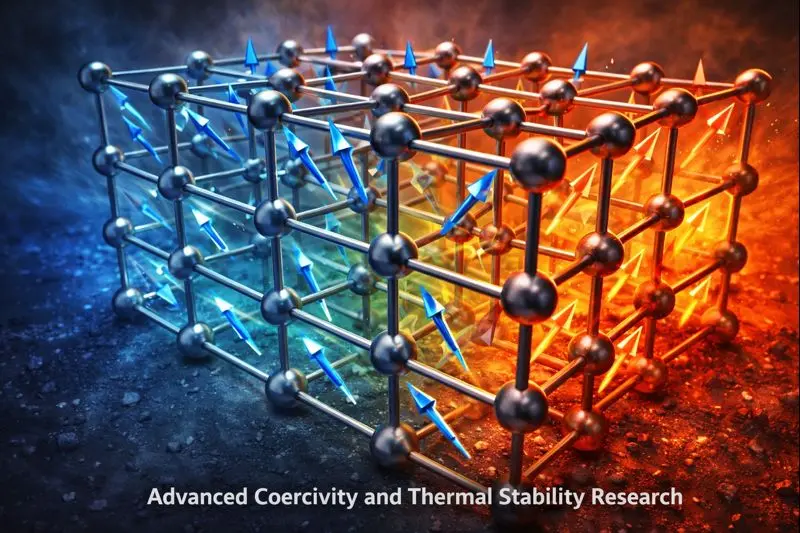
High-temperature operating conditions represent one of the most critical challenges in modern magnet engineering. From electric vehicles and wind turbines to aerospace systems and industrial automation, magnetic components are increasingly required to maintain performance under thermal stress.
In this context, stability and coercivity become decisive factors in determining whether a magnetic material can deliver long-term reliability and predictable performance in demanding environments.
Why High-Temperature Stability Matters
Magnetic materials are highly sensitive to temperature. As thermal energy increases, magnetic domains become more active, and the alignment responsible for magnetization can weaken.
In high-value industrial applications, temperature-induced degradation can lead to:
- Reduced magnetic flux output
- Loss of torque or efficiency in motors
- Increased demagnetization risk
- Shortened service life of permanent magnet systems
Therefore, thermal stability is not just a material property—it is a strategic design requirement.
Understanding Coercivity in Magnetic Materials
Coercivity refers to a magnet’s resistance to demagnetization. It defines how much reverse magnetic field is required to reduce magnetization to zero.
In high-temperature environments, coercivity is particularly important because elevated temperatures lower the energy barrier that keeps magnetic domains aligned.
A magnet with insufficient coercivity may experience irreversible demagnetization even if the temperature remains below its Curie point.
Temperature Effects on Magnetic Performance
Reduction in Remanence
As temperature rises, the remanent magnetization decreases. This results in a lower magnetic field strength and reduced functional output in devices.
Decline in Coercivity
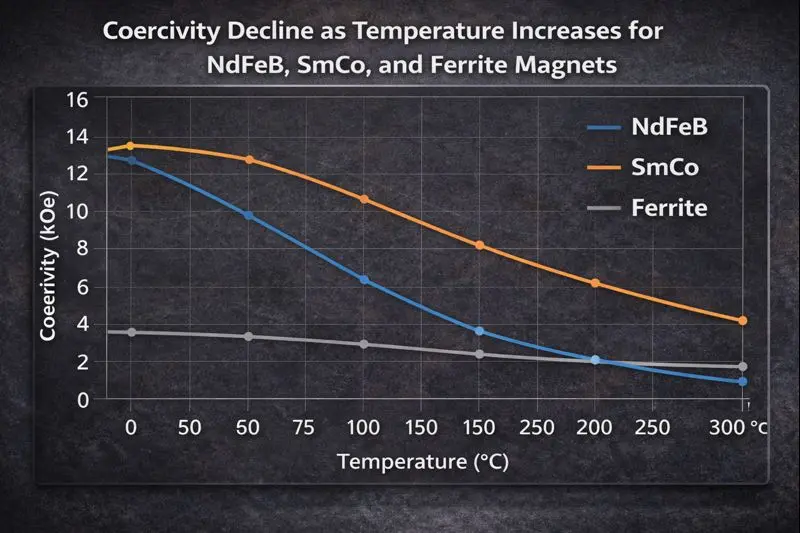
Coercivity typically drops significantly with temperature. This makes magnets more vulnerable to external demagnetizing fields, mechanical vibration, and thermal cycling.
Approaching the Curie Temperature
At the Curie temperature, the material loses ferromagnetism entirely and becomes paramagnetic. While most industrial systems operate well below this limit, partial losses occur long before reaching Curie temperature.
Key Magnetic Materials for High-Temperature Applications
NdFeB Magnets
Neodymium magnets provide the highest energy density but are highly temperature-sensitive. High-coercivity grades and heavy rare earth doping (Dy, Tb) are often required for stability above 150°C.
SmCo Magnets
Samarium cobalt magnets offer superior thermal stability and corrosion resistance, maintaining performance up to 250–350°C. They are widely used in aerospace and defense applications.
Ferrite Magnets
Ferrite Magnets have lower magnetic strength but excellent thermal stability and cost efficiency. They are suitable for applications where temperature resistance outweighs compact power density.
Strategies to Improve High-Temperature Stability
Material Engineering
Optimizing grain boundaries, alloy composition, and coercivity-enhancing additives improves resistance to thermal demagnetization.
Coatings and Protection
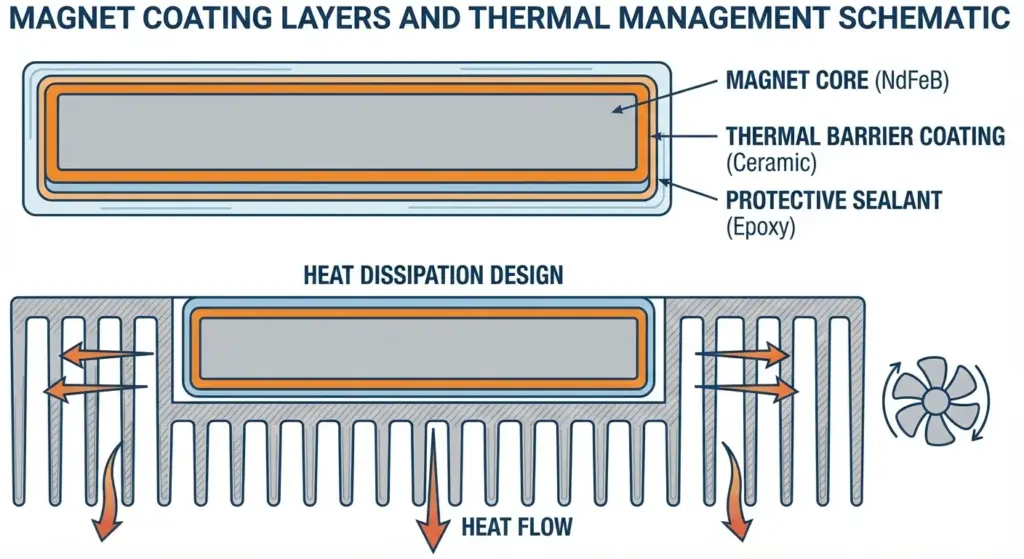
High temperatures accelerate oxidation and corrosion, especially in NdFeB magnets. Protective coatings such as epoxy, nickel, or specialized thermal layers extend service life.
Thermal Design Integration
Effective heat dissipation, insulation, and system-level thermal management reduce magnet exposure to peak temperatures.
Industrial Outlook and Future Trends
The demand for magnets capable of stable performance in extreme environments is accelerating. Key drivers include:
- Electrification of transportation
- High-efficiency industrial motors
- Renewable energy generation
- Miniaturized high-power electronics
Future innovation will focus on reducing dependence on heavy rare earth elements while maintaining high coercivity and thermal reliability.
Conclusion
Stability and coercivity are central to the successful deployment of magnetic materials in high-temperature environments. Understanding how temperature impacts remanence, coercivity, and long-term durability allows engineers and manufacturers to select the right magnet grade, improve system resilience, and ensure operational reliability.
As industries push toward higher efficiency and harsher operating conditions, high-temperature magnetic performance will remain a key competitive advantage in advanced manufacturing and energy technologies.
Leave a Reply