
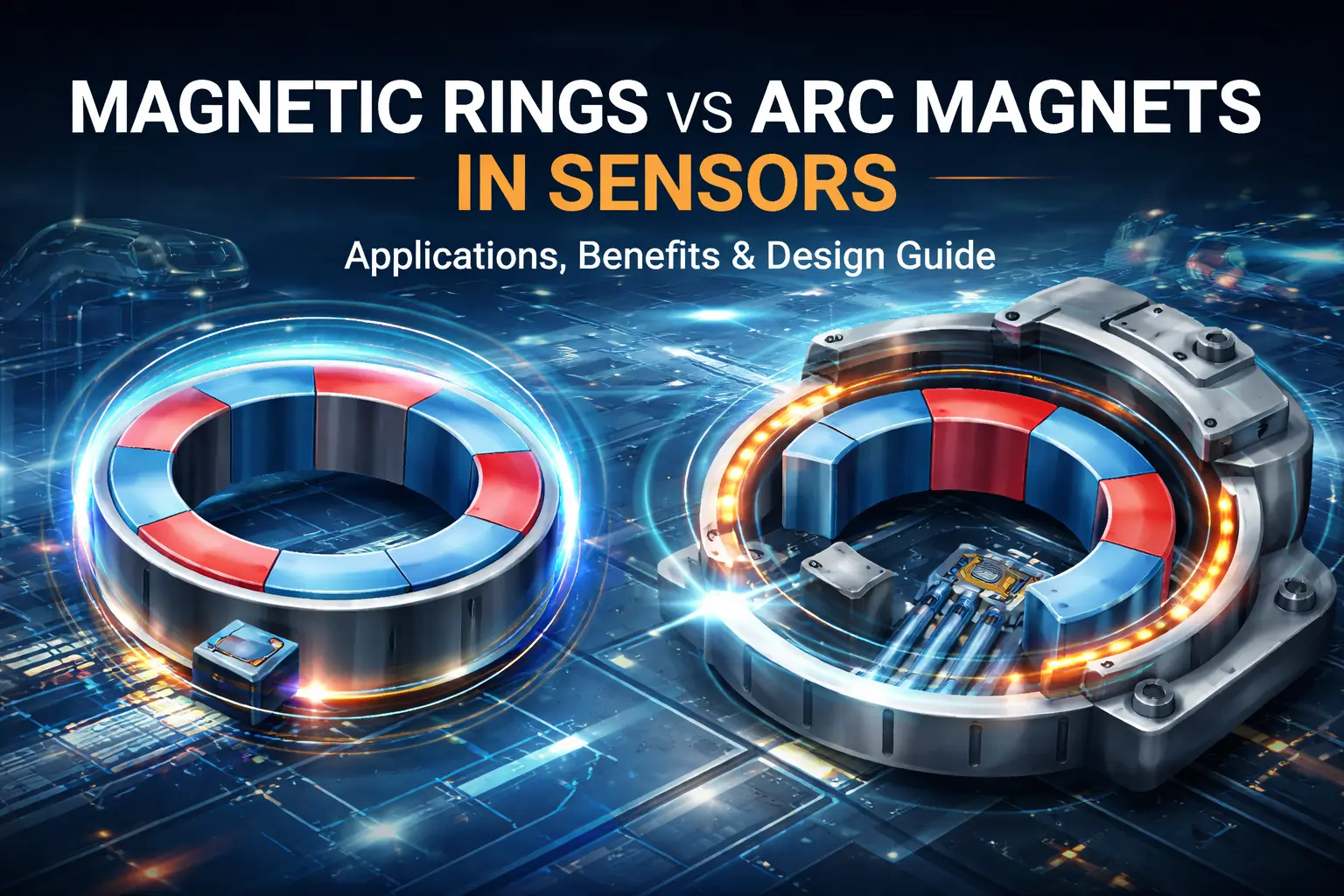
As sensor technologies evolve toward higher precision, miniaturization, and energy efficiency, magnetic components are becoming increasingly strategic in system design. Among them, magnetic rings and magnetic tiles (arc magnets) play a critical role in enabling advanced sensing capabilities across automotive, industrial, and consumer electronics sectors.
This article provides a structured analysis of how these two magnet geometries are applied in next-generation sensors, highlighting their functional advantages, limitations, and emerging trends.
Magnetic Rings in Sensor Systems
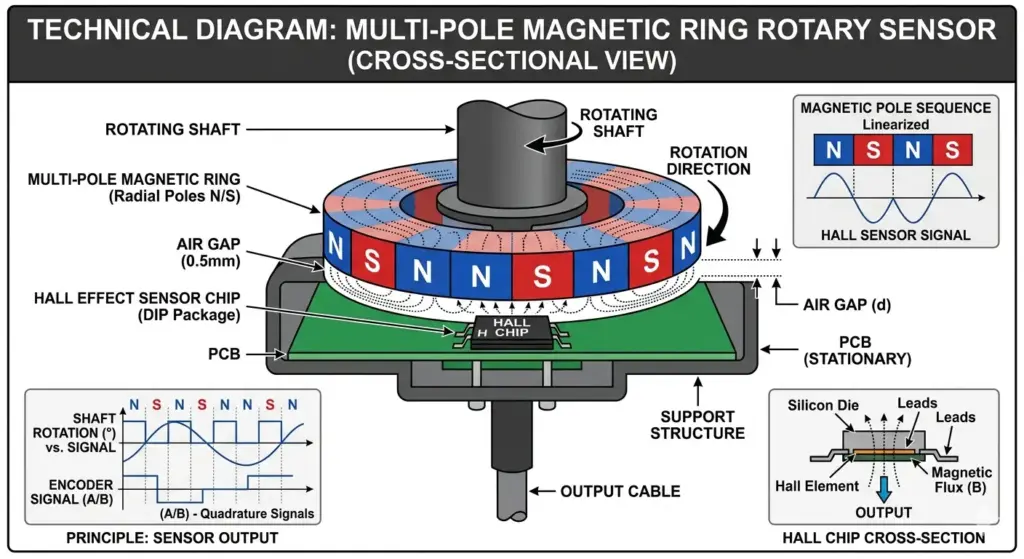
Magnetic rings are typically circular magnets with either axial or radial magnetization. Their symmetrical geometry makes them highly suitable for rotational sensing applications.
Key Application Scenarios
1. Rotary Position Sensors
Magnetic rings are widely used in rotary encoders and angle sensors. When paired with Hall effect or magnetoresistive sensors, they enable accurate detection of angular position, speed, and direction.
Typical use cases include:
- Electric vehicle motor position sensing
- Robotics joint control systems
- Industrial automation equipment
2. Contactless Speed Measurement
Magnetic rings facilitate non-contact sensing, reducing mechanical wear and improving system longevity. This is particularly valuable in harsh environments such as automotive drivetrains.
3. Multi-Pole Magnetization for High Resolution
Advanced magnetic rings can be magnetized into multiple poles, allowing high-resolution signal output. This supports precise feedback systems in servo motors and closed-loop control systems.
Strategic Advantages
- Uniform magnetic field distribution
- High compatibility with integrated sensor ICs
- Scalable for miniaturized designs
Limitations
- Higher manufacturing complexity for multi-pole magnetization
- Cost sensitivity in high-precision applications
Magnetic Tiles (Arc Magnets) in Sensor Systems
Magnetic tiles, also known as arc magnets, are segments of a ring and are typically used in assemblies where a full ring is either unnecessary or impractical.
Key Application Scenarios
1. Linear and Angular Sensing Systems
Magnetic tiles are often arranged in partial arcs to generate controlled magnetic fields for position sensing in limited-angle applications.
2. Magnetic Field Shaping in Sensor Modules
Arc magnets are used to shape and direct magnetic flux in sensor housings, improving signal stability and sensitivity.
3. Cost-Optimized Sensor Designs
For applications that do not require full 360° sensing, magnetic tiles provide a more economical solution compared to complete magnetic rings.
Strategic Advantages
- Flexible configuration for customized sensing ranges
- Lower material cost compared to full rings
- Easier integration into constrained mechanical designs
Limitations
- Less uniform magnetic field compared to full rings
- Additional alignment complexity during assembly
Technology Trends Driving Adoption
1. Electrification and Smart Mobility
The rapid growth of electric vehicles is accelerating demand for high-precision magnetic sensors. Magnetic rings dominate in motor feedback systems, while arc magnets are used in auxiliary sensing modules.
2. Industrial Automation and Industry 4.0
Smart factories require reliable, real-time sensing. Magnetic components enable robust, contactless measurement solutions that align with predictive maintenance strategies.
3. Miniaturization and Integration
As sensors become smaller and more integrated, magnet design must adapt. Thin magnetic rings and customized arc segments are increasingly used in compact sensor packages.
4. Advanced Materials and Coatings
The use of rare earth materials such as NdFeB enhances magnetic performance, while coatings (Ni-Cu-Ni, epoxy, Parylene) improve corrosion resistance and durability in demanding environments.
Magnetic Rings vs. Magnetic Tiles: Decision Framework
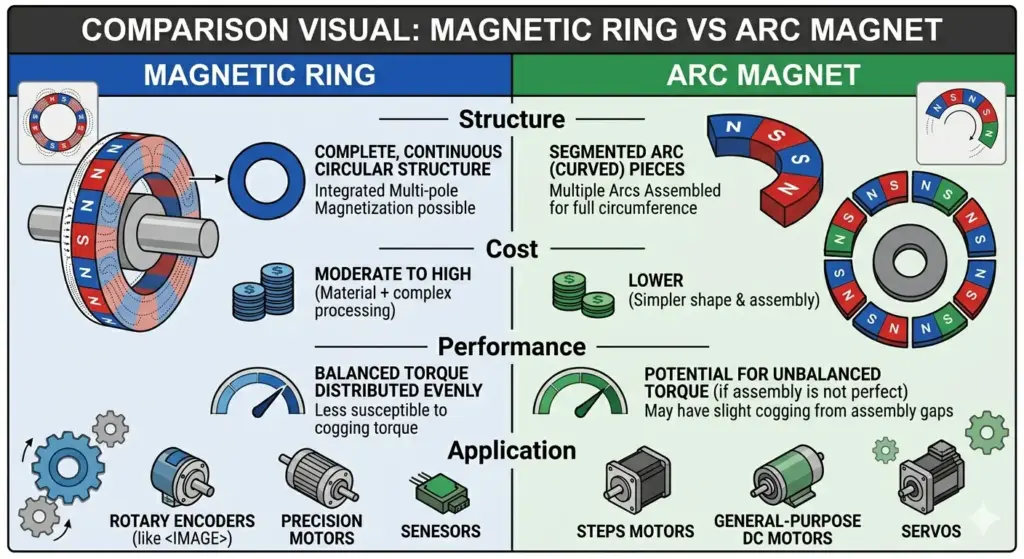
From a product development perspective, selecting between magnetic rings and arc magnets should be based on the following criteria:
- Sensing Range: Full rotation favors rings; partial rotation favors tiles
- Cost Structure: Tiles offer better cost efficiency for segmented applications
- Precision Requirements: Rings provide superior uniformity and resolution
- Assembly Constraints: Tiles allow more flexible mechanical integration
Conclusion
Magnetic rings and magnetic tiles are not competing solutions but complementary components within modern sensor architectures. Their adoption is driven by application-specific requirements, system constraints, and cost-performance trade-offs.
For manufacturers and system integrators, the ability to customize magnet geometry, magnetization patterns, and surface treatments will be a key differentiator in next-generation sensor design.
As a professional magnet manufacturer, HSmagnet provide tailored magnetic solutions—including precision magnetic rings and arc magnets—to support high-performance sensor applications across industries.
Leave a Reply