
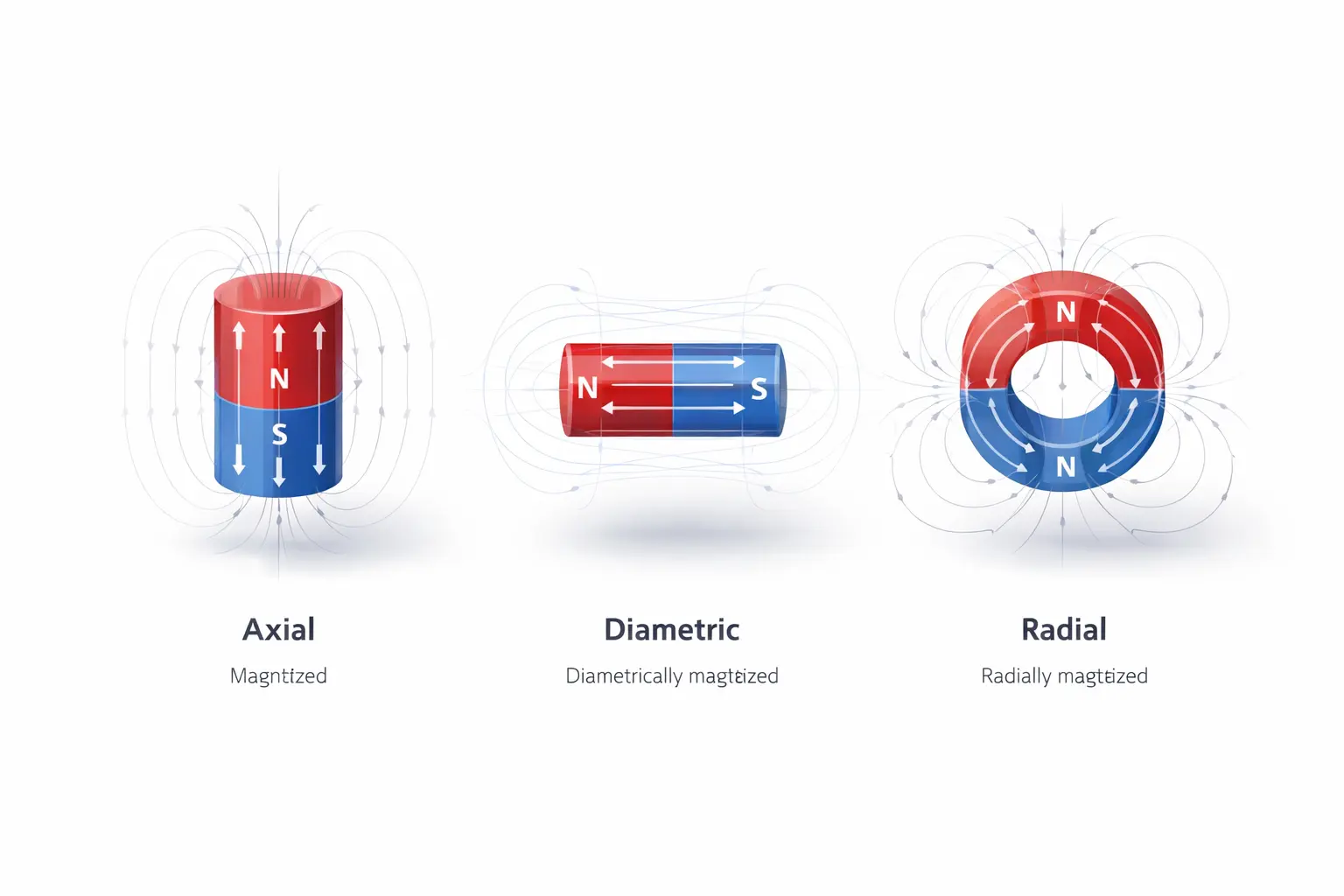
Magnetization direction is one of the most critical yet frequently misunderstood parameters in permanent magnet design. Whether used in motors, sensors, medical devices, or magnetic assemblies, the direction in which a magnet is magnetized directly determines flux distribution, torque performance, holding force, and system efficiency.
In this guide, we explain the three primary magnetization directions—axial, diametric, and radial—with clear technical comparisons. We also explore why radial magnetization is significantly more expensive and complex to manufacture.
Table of Contents
- What Is Magnetization Direction?
- 1. Axial Magnetization (Most Common and Cost-Effective)
- 2. Diametric Magnetization (Side-to-Side Magnetization)
- 3. Radial Magnetization (High-Performance, High-Cost)
- 3D Illustration of Radial Magnetization
- Why Radial Magnetization Is Expensive and Difficult
- Why Engineers Still Choose Radial Magnetization
- Cost Comparison Overview
- How to Choose the Right Magnetization Direction
- Final Thoughts
What Is Magnetization Direction?
Magnetization direction refers to the orientation of the magnetic poles within a magnet. It determines how magnetic flux exits and re-enters the material.
The three most common magnetization types are:
- Axial magnetization
- Diametric magnetization
- Radial magnetization
Each configuration serves different engineering objectives and cost structures.
1. Axial Magnetization (Most Common and Cost-Effective)
Definition:
The magnet is magnetized through its thickness. One flat face is North, and the opposite flat face is South.
Typical shapes:
- Disc magnets
- Block magnets
- Rings (axially magnetized)
Applications:
- Magnetic clamps
- Hall sensors
- Linear actuators
- General-purpose holding systems
3D Concept Illustration (Axial)
        N
     ┌───────┐
     │       │
     │       │  ← Flux travels vertically
     │       │
     └───────┘
        S
Why it’s economical:
- Simple magnetizing fixtures
- Uniform magnetic field during magnetization
- High production yield
- Standard tooling
Axial magnetization is the industry baseline due to manufacturing simplicity and scalability.
2. Diametric Magnetization (Side-to-Side Magnetization)
Definition:
The magnet is magnetized across its diameter. One curved side becomes North, the opposite curved side becomes South.
Typical shapes:
- Cylindrical rods
- Small precision motor components
Applications:
- Rotary encoders
- Miniature motors
- Magnetic couplings
3D Concept Illustration (Diametric)
        N  →  ←  S
     ┌───────────┐
     │           │
     │           │  ← Flux travels horizontally
     │           │
     └───────────┘
Manufacturing characteristics:
- Requires specialized magnetizing coils
- More complex field alignment
- Moderate cost increase vs. axial
Diametric magnetization demands more precision but remains manageable at scale.
3. Radial Magnetization (High-Performance, High-Cost)
Definition:
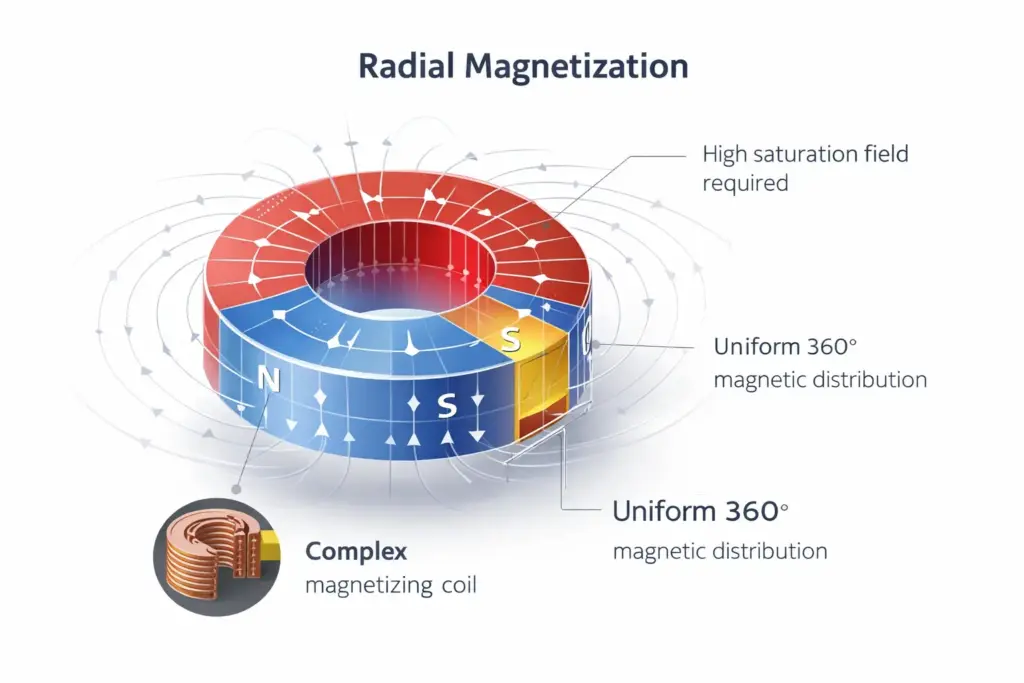
Radial magnetization is primarily used for ring magnets. The magnet is magnetized from the inner diameter (ID) to the outer diameter (OD).
- Inner surface = North
- Outer surface = South
(or segmented multipole configuration)
This creates a 360° magnetic field distribution, ideal for motor rotors.
3D Illustration of Radial Magnetization
Cross-Section View
          S S S S S S
        ┌──────────────┐
        │              │
        │     ↑ ↑ ↑    │
        │   ←  N  →    │
        │     ↓ ↓ ↓    │
        │              │
        └──────────────┘
          N N N N N N
Field Flow Explanation
- Flux flows outward from the inner diameter
- Magnetic lines radiate through the thickness
- Magnetic field is uniformly distributed along the circumference
Why Radial Magnetization Is Expensive and Difficult
Radial magnetization offers superior motor performance—but comes with substantial engineering and manufacturing challenges.
1. Complex Magnetizing Equipment
Unlike axial magnetization (uniform vertical field), radial magnetization requires:
- Custom magnetizing coils
- High-precision circular field control
- Specialized fixture tooling
- Extremely high pulse current
The magnetizing field must be perfectly symmetric to avoid flux imbalance.
Equipment investment is significantly higher.
2. High Magnetizing Field Requirement
Sintered NdFeB magnets require very strong magnetic fields to fully saturate.
In radial magnetization:
- The field must penetrate from inner diameter to outer diameter
- Field intensity drops across thickness
- Thick rings are difficult to fully magnetize
This requires:
- Higher capacitor discharge energy
- Larger magnetizing machines
- Increased energy consumption
Operational cost increases accordingly.
3. Low Production Yield Risk
Radial magnetization has higher scrap risk due to:
- Incomplete saturation
- Field non-uniformity
- Demagnetization at corners
- Cracking risk during magnetizing pulse
Yield management requires strict process control and advanced inspection.
4. Often Requires Segmented Design
For large-diameter motor rotors, fully sintered radial rings are sometimes impractical.
Instead, manufacturers use:
- Arc segments magnetized axially
- Then assembled into a radial magnetic structure
This adds:
- Assembly complexity
- Adhesive bonding cost
- Rotor balancing procedures
Although segmented design reduces magnetizing difficulty, it increases mechanical integration cost.
5. Tight Tolerance Requirements
Radial magnets are commonly used in:
- High-speed EV motors
- Industrial servo motors
- Aerospace rotating systems
These applications demand:
- Excellent concentricity
- Minimal magnetic imbalance
- Strict dimensional control
Quality assurance requirements further increase cost.
Why Engineers Still Choose Radial Magnetization
Despite higher cost, radial magnetization offers decisive performance advantages:
- Higher torque density
- Smoother rotational field
- Reduced cogging torque
- Better motor efficiency
- Optimized flux distribution
For high-performance motors, the performance-to-volume ratio justifies the investment.
Cost Comparison Overview
| Magnetization Type | Manufacturing Complexity | Cost Level | Typical Use |
|---|---|---|---|
| Axial | Low | $ | General purpose |
| Diametric | Medium | $$ | Small motors |
| Radial | High | $$$$ | High-end motors |
How to Choose the Right Magnetization Direction
Decision factors include:
- Application type
- Required torque or holding force
- Budget constraints
- Production volume
- Available magnetizing capability
For cost-sensitive projects, axial magnetization remains optimal.
For precision rotation sensing, diametric is ideal.
For high-torque motor systems, radial magnetization delivers superior system performance.
Final Thoughts
Magnetization direction is not merely a geometric preference—it is a strategic engineering decision that directly impacts system efficiency, manufacturing complexity, and total cost of ownership.
Understanding the differences between axial, diametric, and radial magnetization enables smarter specification decisions and avoids unnecessary material escalation.
Radial magnetization may be expensive and technically demanding, but in high-performance motor applications, it remains the gold standard for maximizing magnetic flux utilization and rotational efficiency.
When selecting magnetization direction, prioritize system-level optimization—not just material strength.
Leave a Reply