
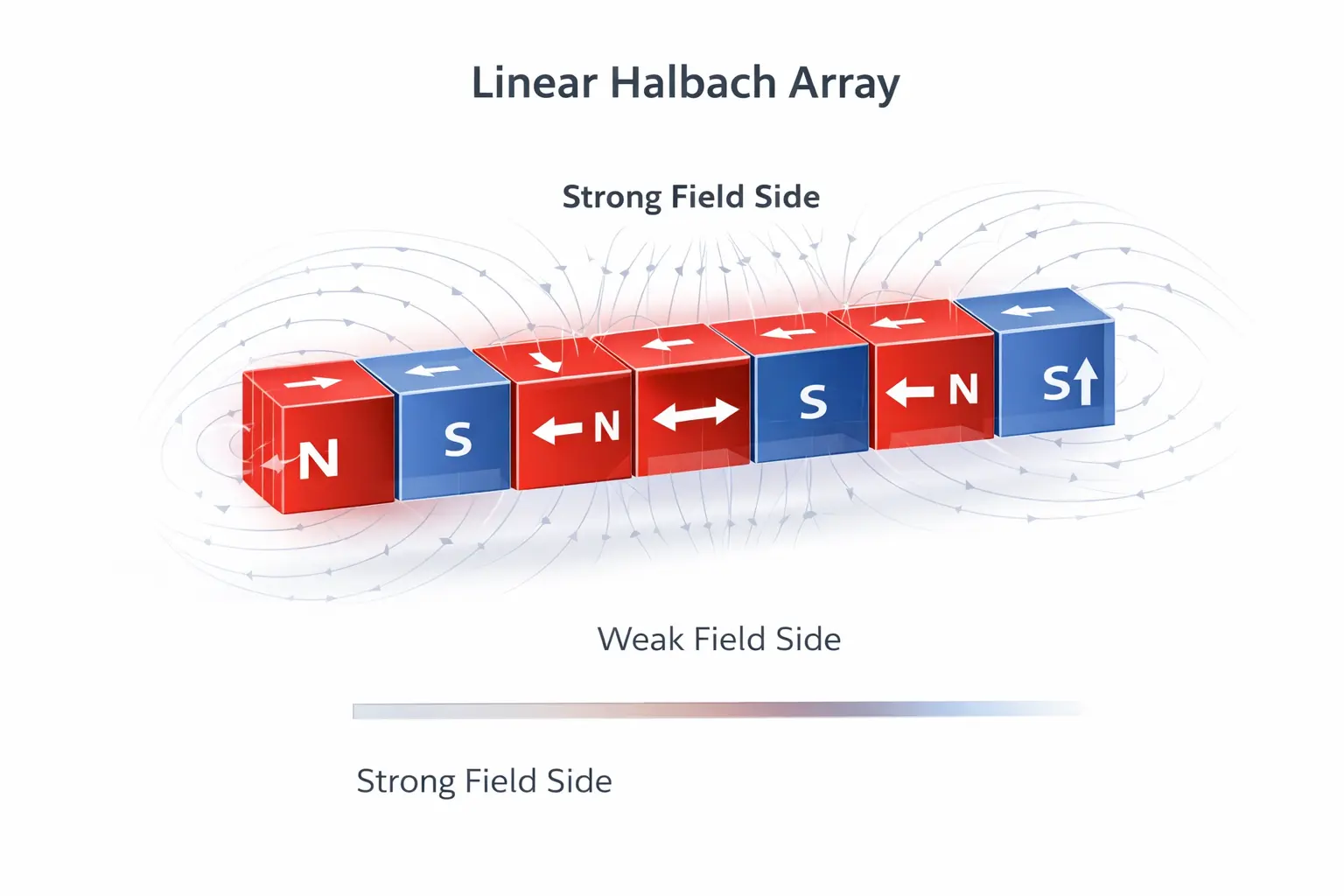
In advanced magnetic engineering, performance is no longer driven solely by stronger magnets—it depends on smarter field control. A Halbach array is a specialized magnet arrangement that concentrates magnetic flux on one side while significantly reducing it on the opposite side. This asymmetric field distribution enables higher efficiency, improved power density, and reduced stray magnetic interference.
What Is a Halbach Array?
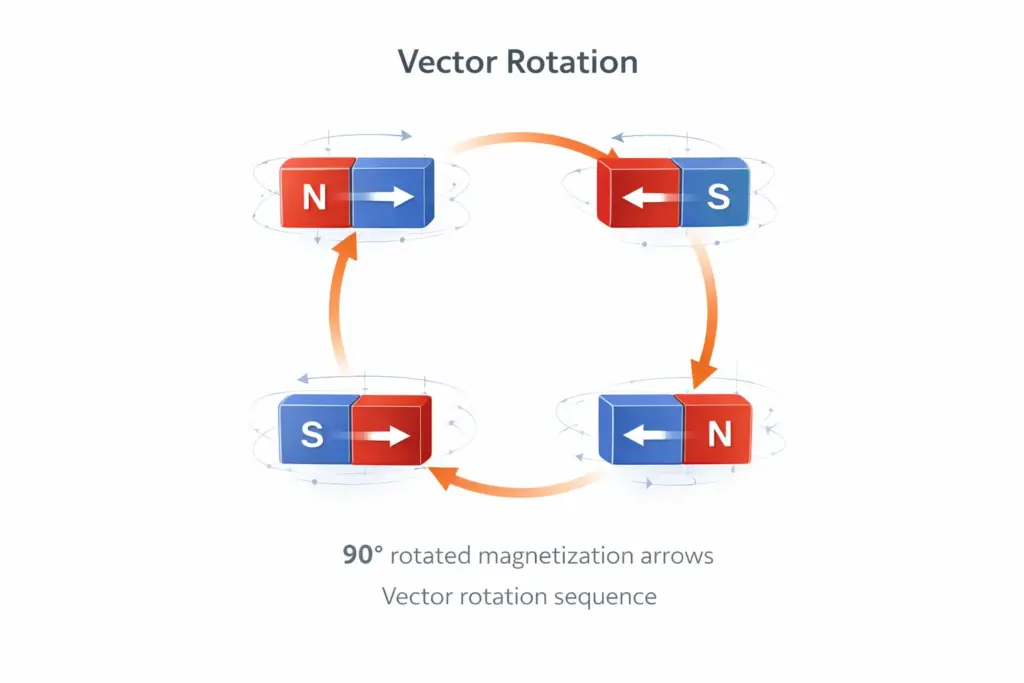
A Halbach array is a sequence of permanent magnets arranged so that each segment’s magnetization direction rotates relative to the next. This rotating magnetic vector pattern reinforces the magnetic field on one working side and cancels it on the other.
The concept was developed by physicist Klaus Halbach for particle accelerator applications at Lawrence Berkeley National Laboratory. Today, it is widely used in motors, generators, magnetic bearings, and precision motion systems.
How Does a Halbach Array Work?
In a basic four-segment linear Halbach array:
- Magnet 1 – North facing upward
- Magnet 2 – North facing right
- Magnet 3 – North facing downward
- Magnet 4 – North facing left
Because magnetic fields are vector quantities, this rotating orientation causes:
- Constructive interference on one side (strong field)
- Destructive interference on the opposite side (weak field)
The result is higher usable flux density without increasing total magnet volume.
Types of Halbach Arrays
Linear Halbach Array
Flat magnet arrangement commonly used in:
- Linear motors
- Magnetic conveyors
- Magnetic separation systems
It increases force output while reducing backside magnetic leakage.
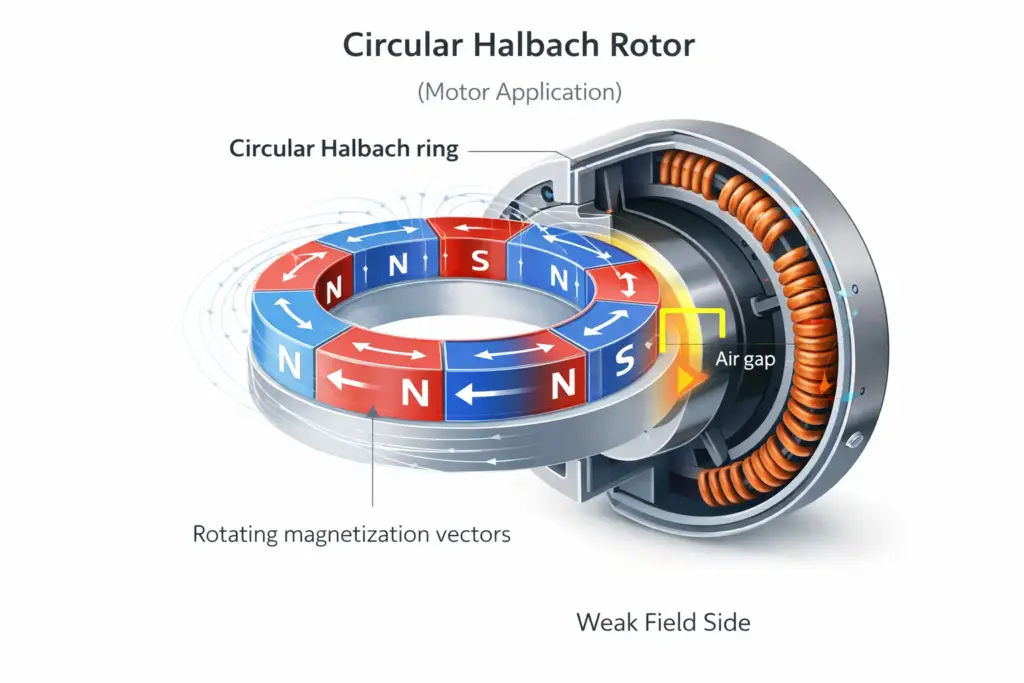
Circular (Halbach Ring)
Magnets are arranged in a circular pattern with rotating magnetization. This design is widely used in:
- Brushless DC motors
- Permanent magnet synchronous motors
- High-speed generators
Halbach rotors improve air-gap flux density and reduce cogging torque.
Key Advantages
1. Higher Magnetic Efficiency
More flux is directed into the working air gap, improving system performance.
2. Reduced Stray Field
Backside field suppression lowers electromagnetic interference and shielding requirements.
3. Increased Power Density
Motors using Halbach rotors can achieve higher torque in a compact structure.
4. Compact Design
Better field utilization allows smaller magnet assemblies.
Engineering Challenges
Despite its advantages, Halbach design introduces complexity.
Precise Magnet Orientation
Each magnet must be magnetized in a specific direction. Even minor angular errors reduce performance.
Assembly Difficulty
Multiple segments require accurate positioning and strong bonding. Automation is often necessary for high-volume production.
Cost Considerations
Halbach arrays may use more segments and require tighter tolerances, increasing manufacturing cost. A cost-performance evaluation is essential before implementation.
How to Maximize Magnetic Field on One Side
To optimize a Halbach array:
Increase Segment Count
More segments approximate a smoother rotating field and improve flux uniformity.
Optimize Magnet Grade
Select appropriate energy product (e.g., N42–N52) based on simulation rather than over-specifying.
Minimize Air Gap
Magnetic strength drops quickly with distance. Reducing the air gap significantly enhances performance.
Use Finite Element Analysis (FEA)
Magnetic simulation allows engineers to model flux density, uniformity, and demagnetization risk before production.
When to Use a Halbach Array
Halbach arrays are ideal when:
- Magnetic field must be concentrated in one direction
- Stray field must be minimized
- Space is limited
- High torque density is required
They may not be necessary in cost-sensitive applications where conventional magnet layouts already meet performance targets.
Conclusion
A Halbach array is a powerful magnetic configuration that maximizes magnetic field strength on one side while suppressing it on the other. By strategically rotating magnetization direction, engineers can improve flux utilization, increase power density, and reduce magnetic losses.
For high-performance motors, precision motion systems, and compact magnetic assemblies, Halbach arrays provide a competitive engineering advantage—when properly designed and executed.
Leave a Reply