
In permanent magnet selection, understanding material structure is just as important as choosing the right magnet grade. One of the most fundamental distinctions is between isotropic and anisotropic magnets. This difference directly affects magnetic performance, cost, and application suitability.
For engineers and buyers, selecting the right type can significantly impact product efficiency and overall system cost.
What Are Isotropic Magnets?
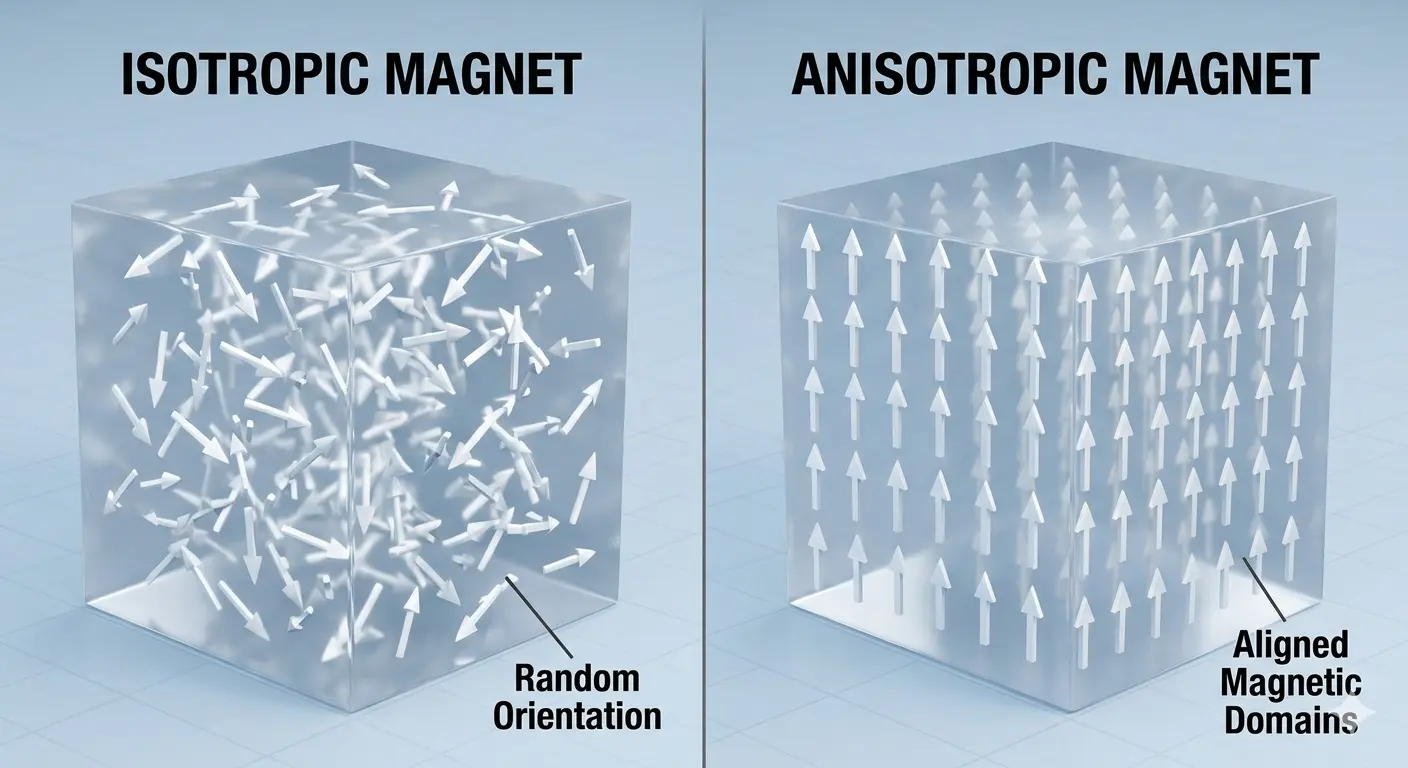
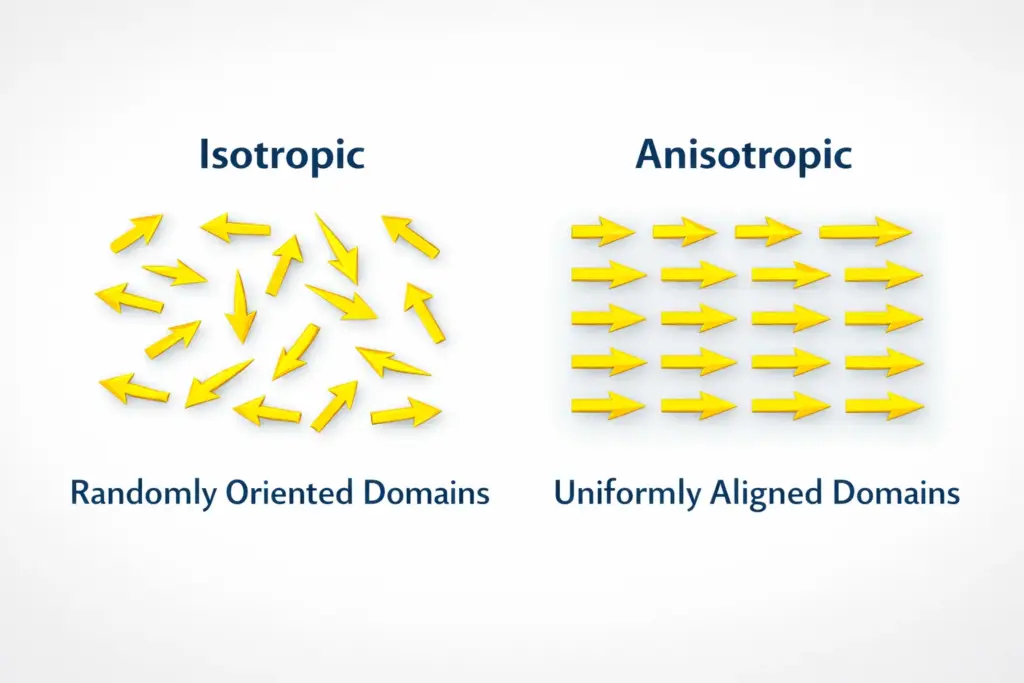
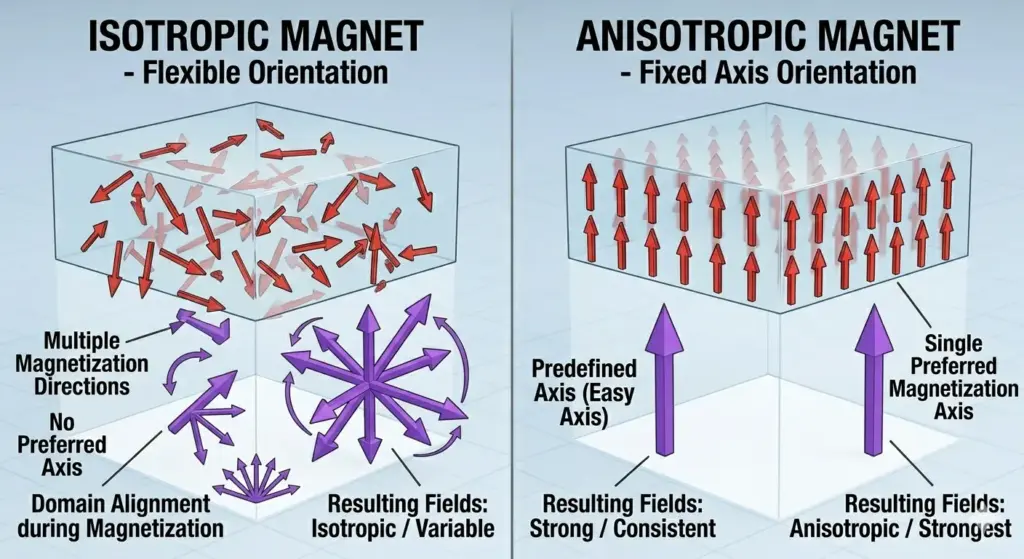
Isotropic magnets have magnetic properties that are the same in all directions. During manufacturing, the magnetic particles are randomly oriented, meaning the magnet does not have a preferred direction of magnetization.
Key Characteristics
- Can be magnetized in any direction
- Lower magnetic performance
- More flexible for complex magnetization patterns
- Typically lower cost
Common Materials
- Bonded NdFeB magnets
- Ferrite magnets (isotropic grades)
Typical Applications
- Sensors
- Small motors
- Consumer electronics
- Multi-pole magnet applications
Because isotropic magnets can be magnetized after shaping in different directions, they are ideal for applications requiring flexible magnetic patterns.
What Are Anisotropic Magnets?
Anisotropic magnets have a preferred direction of magnetization, known as the “easy axis.” During manufacturing, magnetic particles are aligned under a strong magnetic field before sintering or bonding.
This alignment significantly improves magnetic performance—but limits magnetization direction.
Key Characteristics
- Higher magnetic strength and energy product
- Must be magnetized along the predefined orientation
- Better resistance to demagnetization
- Higher cost compared to isotropic magnets
Common Materials
- Sintered NdFeB magnets
- Samarium cobalt (SmCo) magnets
- Anisotropic ferrite magnets
Typical Applications
- Electric motors
- Generators
- Magnetic separators
- High-performance industrial systems
Anisotropic magnets are widely used where maximum magnetic output and efficiency are required.
Key Differences Between Isotropic and Anisotropic Magnets
| Feature | Isotropic Magnets | Anisotropic Magnets |
|---|---|---|
| Magnetic Direction | Random | Pre-aligned (preferred direction) |
| Magnetization Flexibility | High | Limited |
| Magnetic Strength | Lower | Higher |
| Manufacturing Process | No alignment field | Requires alignment field |
| Cost | Lower | Higher |
| Typical Use | Low to medium performance | High-performance systems |
Why Orientation Matters
The main advantage of anisotropic magnets comes from magnetic domain alignment.
In anisotropic materials:
- Domains are aligned in one direction
- Magnetic flux is concentrated
- Higher remanence and coercivity are achieved
In isotropic materials:
- Domains are randomly oriented
- Magnetic output is distributed and weaker
This difference explains why anisotropic magnets deliver stronger and more efficient magnetic performance.
Cost vs Performance Trade-Off
From a commercial perspective, the choice between isotropic and anisotropic magnets is a balance between cost and performance.
- Isotropic magnets are more cost-effective and versatile
- Anisotropic magnets provide higher efficiency and power density
Over-specifying anisotropic magnets in low-demand applications can increase cost unnecessarily. Conversely, using isotropic magnets in high-performance systems may lead to insufficient output.
How to Choose the Right Type
When selecting between isotropic and anisotropic magnets, consider:
Performance requirements
If high magnetic strength is critical, anisotropic magnets are the preferred choice.
Magnetization flexibility
If the application requires complex or multi-directional magnetization, isotropic magnets offer more flexibility.
Cost constraints
For large-volume, cost-sensitive applications, isotropic magnets may provide better value.
Application environment
High-temperature or high-load environments typically favor anisotropic materials.
Industry Applications Overview
- Isotropic magnets are commonly used in consumer electronics, small devices, and sensors where flexibility and cost efficiency are priorities.
- Anisotropic magnets dominate in electric vehicles, industrial motors, renewable energy systems, and heavy-duty equipment where performance is critical.
Conclusion
The difference between isotropic and anisotropic magnets lies in their internal structure and magnetic alignment. Isotropic magnets offer flexibility and lower cost, while anisotropic magnets deliver superior magnetic performance and efficiency.
Selecting the right type depends on application requirements, cost targets, and system design priorities. By understanding these differences, engineers and buyers can optimize both performance and budget—ensuring the most effective use of magnetic materials in their products.
Leave a Reply