

Rare earth magnets—especially NdFeB (neodymium-iron-boron)—are essential for high-performance applications such as electric vehicles, wind turbines, robotics, and industrial motors. Despite their small size, they often represent a significant portion of system cost.
Understanding why these magnets are expensive requires analyzing both material fundamentals and global market dynamics. For procurement teams and engineers, this insight is critical for cost control and supply chain strategy.
Table of Contents
- 1. Raw Material Costs Dominate Pricing
- 2. Complex and Costly Extraction Process
- 3. Supply Chain Concentration and Geopolitical Risk
- 4. High Manufacturing Complexity
- 5. Explosive Demand from High-Growth Industries
- 6. Limited Substitutes for High Performance
- 7. Recycling Challenges Limit Supply Relief
- 8. Price Volatility and Market Uncertainty
- Strategic Insight: Cost Is a System-Level Issue
- Conclusion
- About HSMagnet
1. Raw Material Costs Dominate Pricing
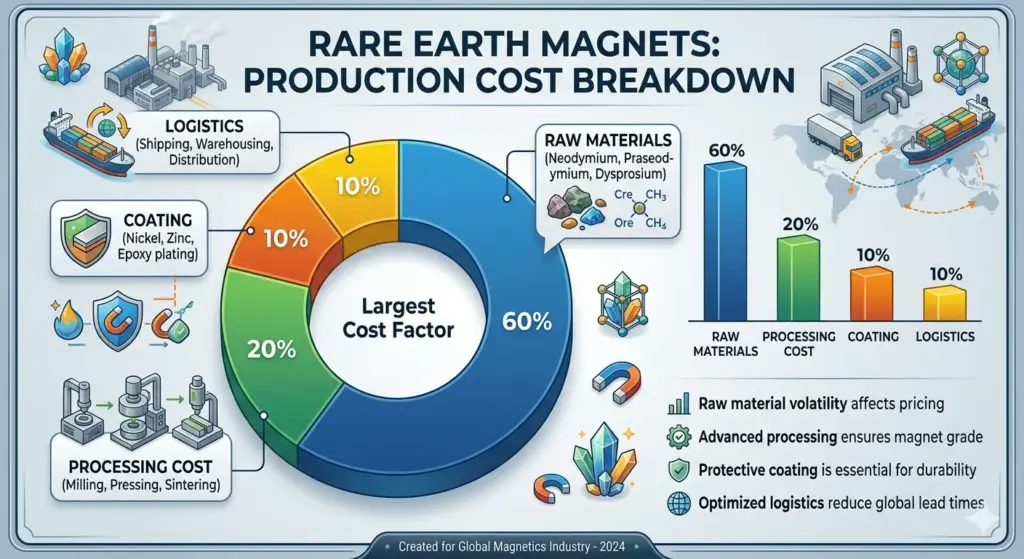
The primary cost driver of rare earth magnets is not machining or coating—it is the raw material itself.
Key elements include:
- Neodymium (Nd)
- Praseodymium (Pr)
- Dysprosium (Dy)
- Terbium (Tb)
Among these, NdPr accounts for the majority of magnet cost—often up to 70% of total cost structure .
Prices of these materials are highly volatile. For example, NdPr prices surged significantly in recent years due to supply constraints and growing demand .
Heavy rare earths like dysprosium and terbium are even more expensive due to scarcity and limited supply sources .
2. Complex and Costly Extraction Process
Rare earth elements are not truly rare, but they are difficult and expensive to extract and refine.
Challenges include:
- Low concentration in ore deposits
- Complex separation processes
- High energy consumption
- Strict environmental regulations
Extracting neodymium requires advanced chemical processing and generates waste that must be managed responsibly, increasing operational costs .
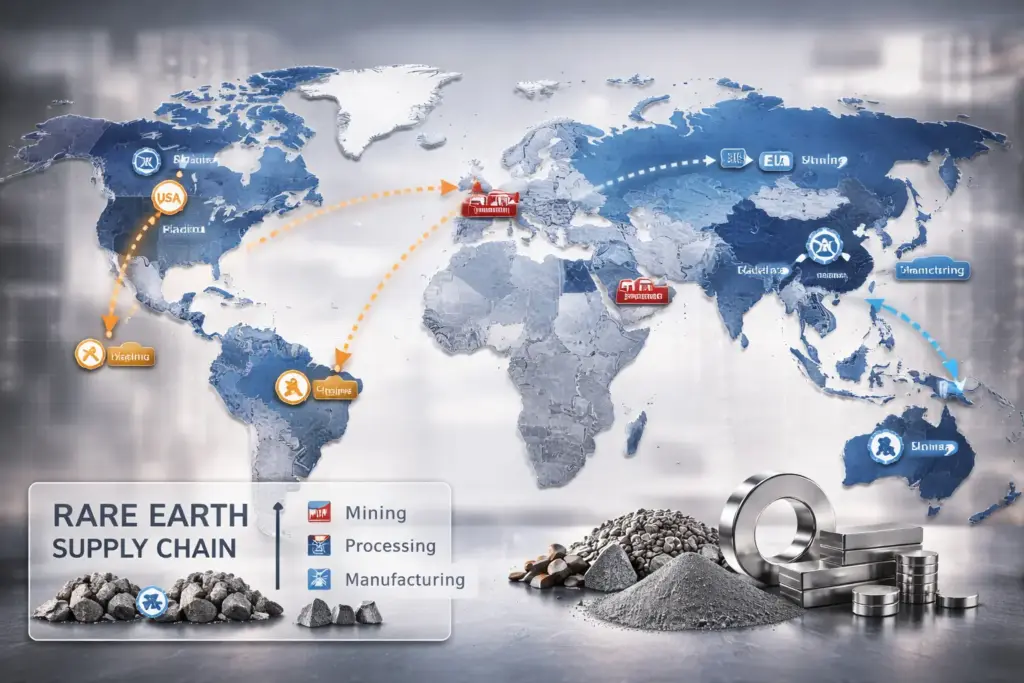
3. Supply Chain Concentration and Geopolitical Risk
One of the most critical factors is global supply concentration.
- A large portion of rare earth mining and refining is controlled by China
- Export policies and quotas can influence global availability
- Trade tensions can disrupt supply and increase prices
Because of this concentration, even small policy changes can trigger significant price fluctuations .
This geopolitical factor transforms rare earth magnets from a commodity into a strategic resource.
4. High Manufacturing Complexity
Producing high-performance NdFeB magnets involves multiple precision steps:
- Alloy melting
- Powder milling
- Magnetic field pressing
- Sintering
- Precision grinding
- Surface coating
Each stage requires specialized equipment, tight process control, and technical expertise. Any defect can lead to scrap, increasing overall production cost .
Additionally, high-performance magnets require very high purity materials, which further increases cost .
5. Explosive Demand from High-Growth Industries
Demand for rare earth magnets is growing rapidly due to:
- Electric vehicles (EVs)
- Wind energy systems
- Consumer electronics
- Industrial automation
These sectors require compact, high-efficiency motors—something only rare earth magnets can provide at scale.
As demand continues to outpace supply growth, prices remain under upward pressure .
6. Limited Substitutes for High Performance
While alternatives like ferrite magnets exist, they cannot match the performance of rare earth magnets in:
- Power density
- Efficiency
- Miniaturization
This lack of substitutes creates inelastic demand, meaning buyers must accept higher prices to achieve required performance.
7. Recycling Challenges Limit Supply Relief
In theory, recycling could reduce material costs. However:
- Magnets are difficult to extract from products
- Material contamination is common
- Recycling processes are complex and expensive
As a result, recycled supply remains limited and cannot yet significantly offset demand .
8. Price Volatility and Market Uncertainty
Rare earth magnet pricing is highly sensitive to:
- Raw material fluctuations
- Policy changes
- Currency exchange rates
- Supply disruptions
For example, sudden increases in NdPr prices can immediately impact magnet costs across the supply chain .
This volatility makes long-term procurement planning more complex for OEMs.
Strategic Insight: Cost Is a System-Level Issue
From a business perspective, magnet cost should not be evaluated in isolation.
Instead, leading manufacturers focus on:
- Magnetic circuit optimization
- Reducing magnet volume
- Lowering heavy rare earth usage
- Improving system efficiency
In many cases, better engineering design can offset high material costs more effectively than sourcing cheaper magnets.
Conclusion
Rare earth magnets are expensive due to a combination of material cost, complex processing, supply concentration, and strong global demand. Despite these challenges, their unmatched performance makes them indispensable in modern engineering applications.
For businesses, managing magnet cost requires more than sourcing—it demands engineering optimization and strategic supplier collaboration.
About HSMagnet
As a professional magnet manufacturer, HSMagnet specializes in providing high-performance NdFeB magnets and customized magnetic solutions for industrial applications.
With strong capabilities in:
- Precision magnet manufacturing
- Magnetic circuit optimization
- Cost-performance analysis
- Custom magnet design
HSMagnet helps customers reduce material costs while maintaining high system efficiency. By combining engineering expertise with stable supply chain management, HSMagnet supports clients in achieving both performance and cost objectives in competitive global markets.
For OEMs and industrial buyers seeking reliable magnet solutions, HSMagnet serves as a strategic partner in optimizing both product design and long-term sourcing strategies.
Leave a Reply