
Magnetic materials play a crucial role in modern technology and industry. Their properties are largely determined by crystal structure and magnetic anisotropy.
In applications such as high-performance motors, magnetic sensors, and data storage systems, understanding and controlling magnetic anisotropy is key to optimizing performance.
This article explores the relationship between crystal structure and magnetic anisotropy, explaining how they influence material properties and how these principles can be applied in magnetic engineering and manufacturing.
2. Relationship Between Crystal Structure and Magnetism
The magnetic behavior of a material is governed by the arrangement of atomic magnetic moments.
Different crystal structures affect electron spin alignment, exchange interactions, and magnetic domain formation, leading to distinct magnetic characteristics.
2.1 Common Crystal Structures and Their Magnetic Features
| Crystal Type | Example Materials | Characteristics | Magnetic Behavior |
|---|---|---|---|
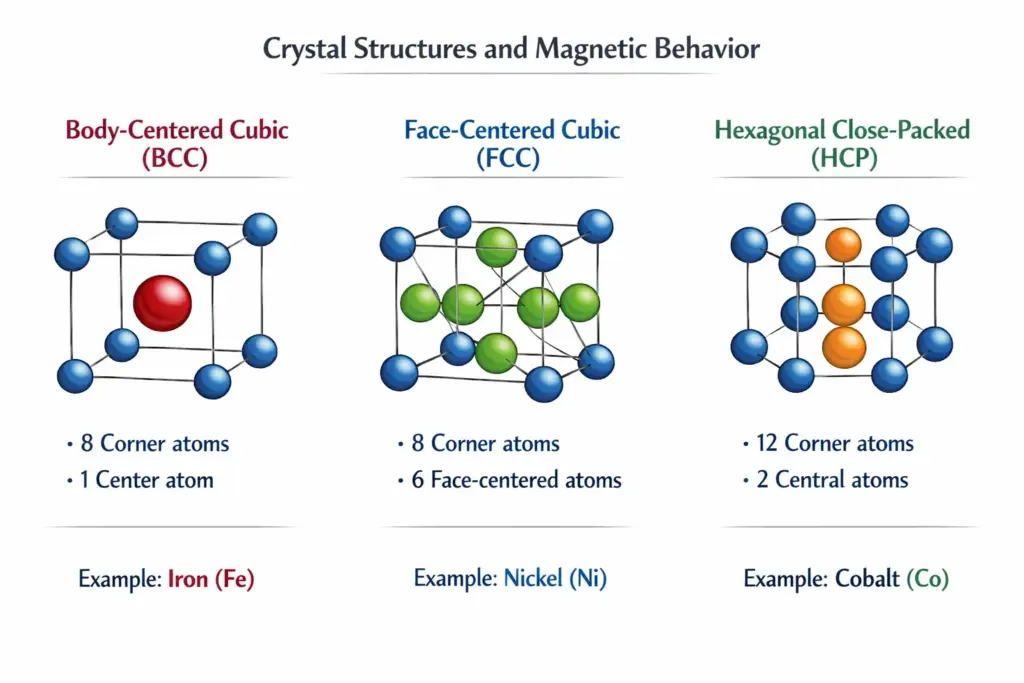
| Body-Centered Cubic (BCC) | α-Fe | Larger atomic spacing; easy spin alignment | Strong ferromagnetism |
| Face-Centered Cubic (FCC) | Ni, γ-Fe | Compact lattice; restricted spin orientation | Weak ferromagnetism |
| Hexagonal Close-Packed (HCP) | Co | Clear axial anisotropy | Strong anisotropic ferromagnet |
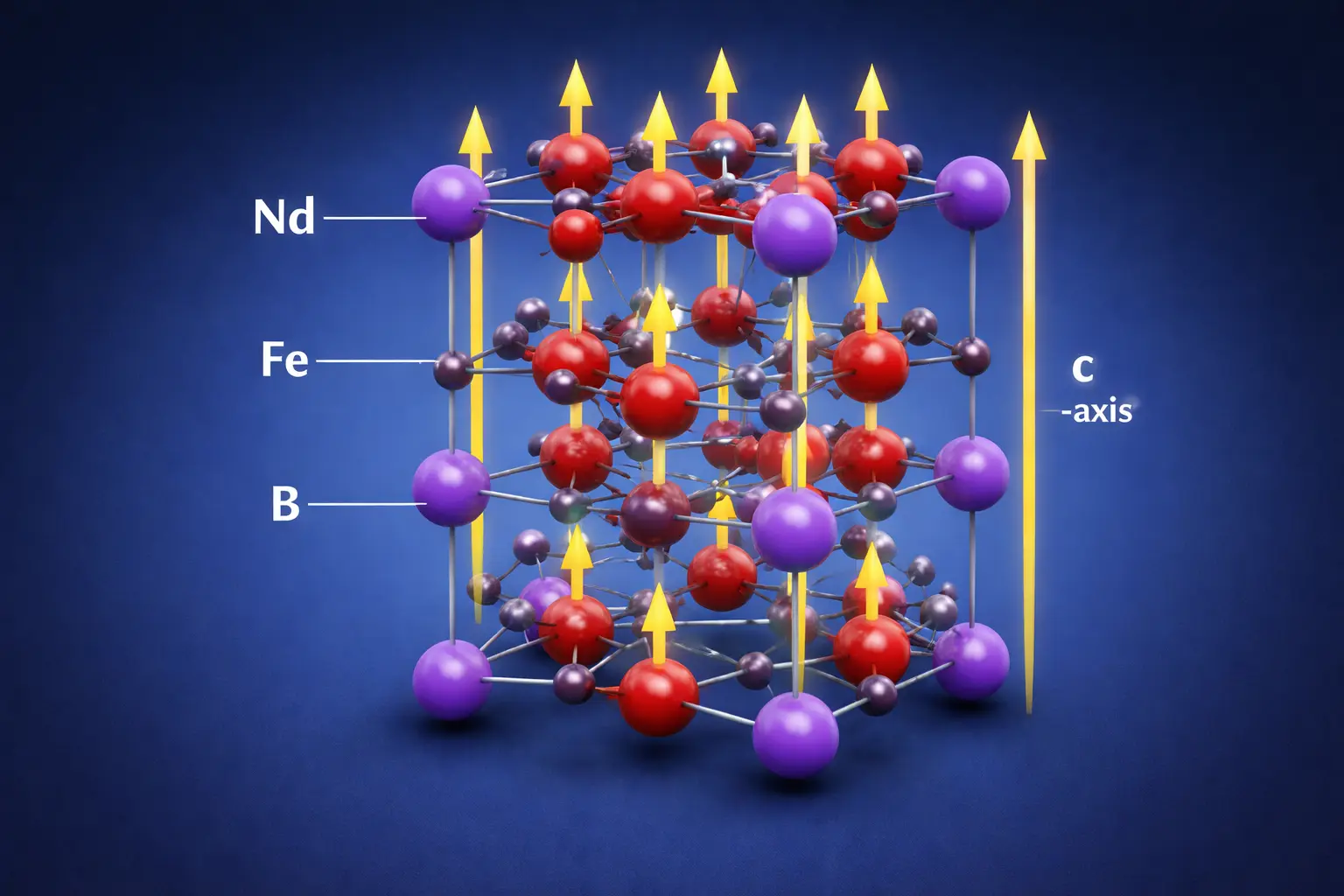
| Hexagonal (Rare Earth) | Nd₂Fe₁₄B, SmCo₅ | Significant lattice distortion | Basis for high-performance permanent magnets |
2.2 Crystal Symmetry and Magnetic Orientation
Lower crystal symmetry leads to stronger magnetic anisotropy.
For instance, hexagonal crystal systems like SmCo₅ exhibit significant differences in magnetization energy along different axes, resulting in a strong preference for magnetization along the easy axis.
3. Types and Mechanisms of Magnetic Anisotropy
Magnetic anisotropy describes how easily a material can be magnetized along different crystallographic directions.
It originates from the interaction between electron orbital motion and the crystal electric field.
3.1 Crystalline Magnetic Anisotropy
This form of anisotropy is intrinsic to the lattice structure.
The anisotropy energy can be expressed as:E=K1sin2θ+K2sin4θ+…
Where K1 and K2 are anisotropy constants, and θ is the angle between the magnetization direction and the easy axis.
- For Nd₂Fe₁₄B, K1≈4.9×10⁷J/m3, demonstrating extremely high uniaxial anisotropy — the foundation of its powerful magnetic properties.
3.2 Shape Anisotropy
Caused by geometric shape differences.
For example, elongated rods or thin films tend to magnetize along their long axis.
This is critical in magnetic circuit design and field optimization.
3.3 Magnetoelastic (Stress-Induced) Anisotropy
Mechanical stress can distort the lattice and alter magnetic domain orientation.
During sintering, residual stress can modify the domain structure and affect coercivity or remanence.
4. Influence of Anisotropy on Magnetic Performance
| Performance Parameter | Affected by Anisotropy | Typical Effect |
|---|---|---|
| Coercivity (Hc) | ↑ Strong anisotropy increases domain reversal resistance | Enhances demagnetization resistance |
| Remanence (Br) | Depends on grain orientation | Improves flux density |
| Maximum Energy Product (BHmax) | Determined by easy magnetization direction | Defines magnetic performance limit |
| Temperature Stability | High-anisotropy materials exhibit better stability | Suitable for high-temperature applications |
5. Engineering Implications and Design Insights
- Permanent Magnet Design
Materials such as Nd₂Fe₁₄B and SmCo₅ exhibit exceptionally high crystalline anisotropy, making them ideal for high-energy permanent magnets.
Oriented sintering techniques can further align grains, maximizing performance. - Electric Motors and Generators
Axially magnetized designs can improve torque output and efficiency in permanent magnet motors. - High-Temperature Applications
SmCo-based magnets maintain superior magnetic stability and coercivity even above 250°C, ideal for aerospace and automotive use.
6. Conclusion
The crystal structure of magnetic materials fundamentally determines their magnetic behavior, while magnetic anisotropy defines performance limits.
By controlling structural and processing parameters—such as crystal orientation, stress state, and geometry—engineers can design magnets with higher energy density, stability, and efficiency for advanced applications.
📞 Technical Support
HSMagnet specializes in the research, development, and production of high-performance magnetic materials, including NdFeB and SmCo magnets.
We provide custom design, engineering consultation, and OEM services for industrial applications.
Leave a Reply