
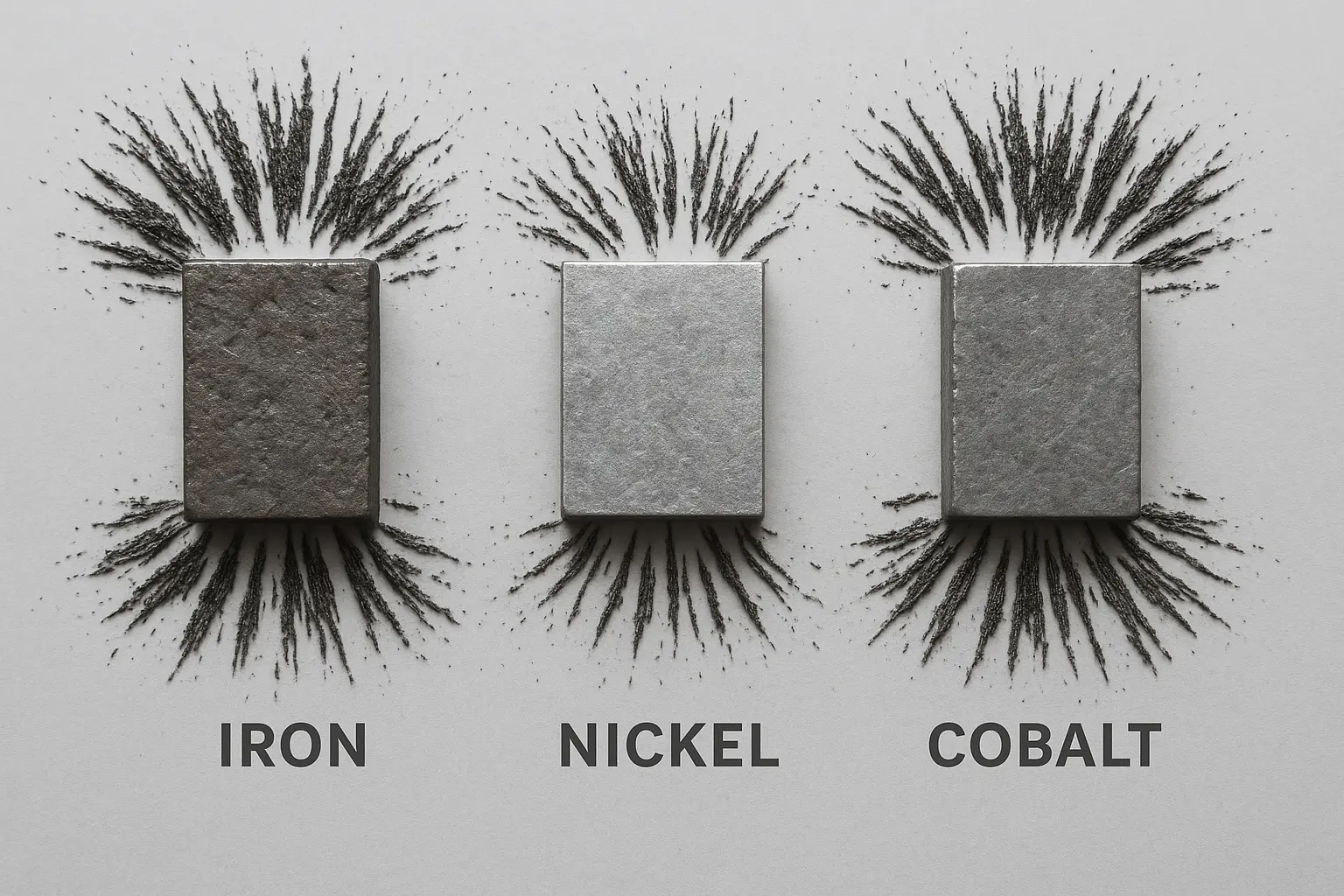
Ferromagnetism is one of the most fascinating and practically important magnetic phenomena in materials science. It is the property that allows certain materials to become strongly magnetized — even after an external magnetic field is removed. Understanding which materials are ferromagnetic is essential for industries such as electronics, energy, automotive, and advanced manufacturing.
What Does Ferromagnetic Mean?
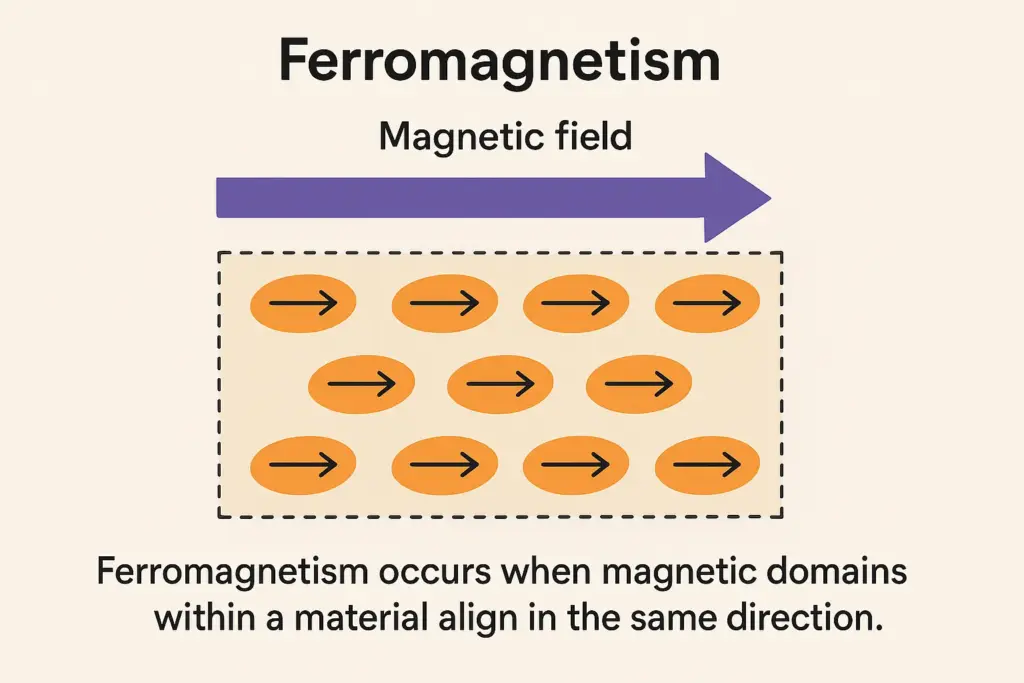
A ferromagnetic material is one that exhibits a strong attraction to magnets and can retain magnetization permanently. This happens because of the alignment of magnetic moments (spins of electrons) within microscopic regions called magnetic domains. When these domains align in the same direction, the material becomes magnetized.
Ferromagnetic behavior is what enables magnets, transformers, electric motors, and data storage devices to function efficiently.
The Most Common Ferromagnetic Materials
Only a few elements and alloys exhibit ferromagnetism at room temperature. These include:
1. Iron (Fe)
Iron is the most well-known and widely used ferromagnetic metal. Its atomic structure allows for strong magnetic domain alignment, making it the foundation for most industrial magnets and magnetic components.
Applications: Electric motors, transformers, electromagnets, and steel manufacturing.
2. Nickel (Ni)
Nickel is another classic ferromagnetic metal with high magnetic strength and excellent corrosion resistance. It is also a key element in many magnetic alloys.
Applications: Magnetic shielding, batteries, and permanent magnets.
3. Cobalt (Co)
Cobalt exhibits stable ferromagnetic properties even at high temperatures, making it valuable in high-performance magnetic alloys.
Applications: Aerospace components, magnetic recording media, and high-temperature magnets.
4. Rare-Earth Elements (e.g., Neodymium and Samarium)
Certain rare-earth elements and their alloys — particularly neodymium-iron-boron (NdFeB) and samarium-cobalt (SmCo) — are exceptionally powerful ferromagnets. These are used where maximum magnetic strength and compact size are critical.
Applications: Electric vehicles, wind turbines, precision motors, and high-performance magnetic assemblies.
5. Ferromagnetic Alloys
A number of iron-, nickel-, and cobalt-based alloys exhibit tailored ferromagnetic properties. Examples include:
- Permalloy (Nickel-Iron Alloy): Used for magnetic shielding and transformers.
- Alnico (Aluminium-Nickel-Cobalt Alloy): Known for high coercivity and stability in permanent magnets.
- FeCo Alloys: Utilized in high-flux-density applications and magnetic sensors.
Temperature and Ferromagnetism
The magnetic behavior of ferromagnetic materials changes with temperature. Each ferromagnetic substance has a specific Curie temperature, above which it loses its permanent magnetism and becomes paramagnetic. For example:
- Iron: ~770°C
- Nickel: ~358°C
- Cobalt: ~1,115°C
This thermal property is crucial in designing magnetic devices that operate under varying temperature conditions.
Industrial Importance of Ferromagnetic Materials

Ferromagnetic materials form the backbone of modern magnetic and electromagnetic technologies. They are essential for:
- Electric motors and generators — converting electrical energy to mechanical energy and vice versa.
- Transformers and inductors — enhancing magnetic flux efficiency.
- Data storage — encoding information in magnetic domains.
- Magnetic separation and sensing systems — enabling precision detection and sorting.
Their ability to maintain magnetization, combined with structural strength and thermal stability, makes them irreplaceable in high-performance magnetic systems.
Conclusion
Ferromagnetic materials such as iron, nickel, cobalt, and their alloys play a vital role in industrial innovation. Their unique magnetic properties enable the functioning of countless devices, from electric motors to renewable energy systems.
For advanced ferromagnetic materials, precision-engineered magnets, and custom magnetic assemblies, HSMAGNET delivers industry-leading expertise and reliable magnetic solutions tailored to your applications.

Leave a Reply