
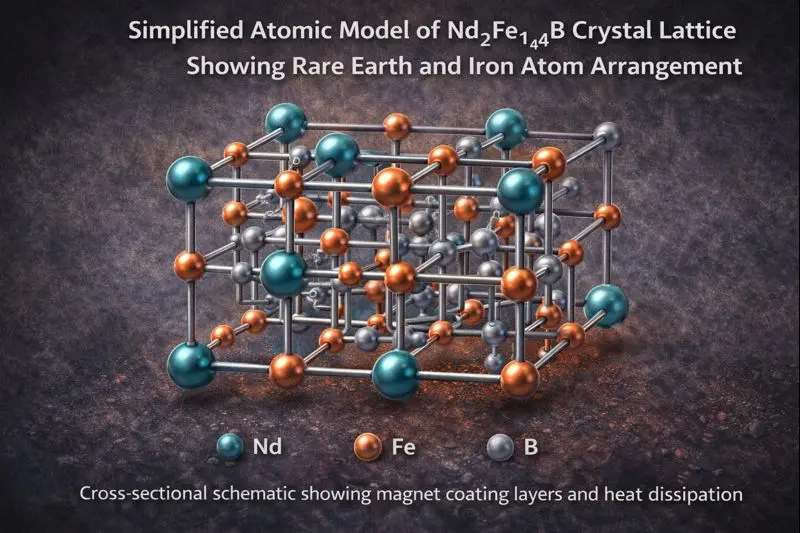
Neodymium–Iron–Boron (NdFeB) magnets are the most powerful permanent magnets available today and are essential components in electric vehicles, wind turbines, industrial motors, robotics, and aerospace systems.
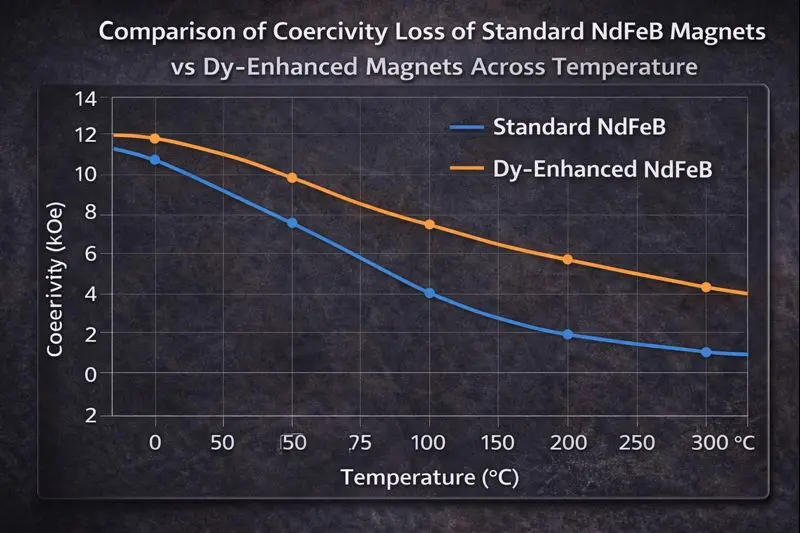
However, standard NdFeB magnets suffer from performance degradation at elevated temperatures, particularly due to a rapid loss of coercivity. To address this limitation, manufacturers often introduce heavy rare earth (HRE) elements, such as dysprosium (Dy) and terbium (Tb).
This article explains how heavy rare earth elements improve the high-temperature stability of NdFeB magnets, the mechanisms behind coercivity enhancement, and the trade-offs involved.
Table of Contents
- The Challenge: NdFeB Magnet Performance at High Temperatures
- What Are Heavy Rare Earth Elements?
- How Heavy Rare Earth Elements Improve Coercivity
- Methods of Introducing Heavy Rare Earths into NdFeB Magnets
- Trade-Offs of Heavy Rare Earth Usage
- Future Trends in High-Temperature NdFeB Magnet Design
- Conclusion
The Challenge: NdFeB Magnet Performance at High Temperatures
As operating temperature increases, NdFeB magnets experience:
- Decreased magnetic remanence
- Significant loss of coercivity
- Higher risk of irreversible demagnetization
In applications like high-speed motors or EV traction systems, operating temperatures can exceed 150–200 °C. Without sufficient coercivity, magnetic reversal can occur, leading to permanent performance loss.
What Are Heavy Rare Earth Elements?
Rare earth elements used in permanent magnets are typically classified into:
- Light rare earths (LREs): Neodymium (Nd), Praseodymium (Pr)
- Heavy rare earths (HREs): Dysprosium (Dy), Terbium (Tb)
Among them:
- Dysprosium (Dy) is the most widely used heavy rare earth in NdFeB magnets
- Terbium (Tb) offers even stronger coercivity enhancement but is more scarce and costly
Both elements are critical for applications requiring high-temperature permanent magnets.
How Heavy Rare Earth Elements Improve Coercivity
1. Enhanced Magnetocrystalline Anisotropy
Coercivity in NdFeB magnets is strongly linked to magnetocrystalline anisotropy, which determines how resistant a material is to magnetization reversal.
- Dy and Tb have higher anisotropy fields than Nd
- Partial substitution of Nd with Dy or Tb in the Nd₂Fe₁₄B phase increases resistance to demagnetization
- This effect becomes especially important at elevated temperatures, where anisotropy naturally decreases
2. Grain Boundary Stabilization
Modern sintered NdFeB magnets are composed of fine magnetic grains. Demagnetization often begins at grain boundaries.
Heavy rare earth elements:
- Concentrate at grain boundary regions
- Form a “core–shell” microstructure
- Suppress reverse domain nucleation
- Significantly enhance intrinsic coercivity
This mechanism allows magnets to maintain stability under strong external magnetic fields and high temperatures.
Methods of Introducing Heavy Rare Earths into NdFeB Magnets
Bulk Alloying Method
Heavy rare earths are added during the melting and sintering process.
- ✔ Simple manufacturing process
- ❌ Significant reduction in remanence
- ❌ High consumption of expensive rare earth elements
Grain Boundary Diffusion (GBD) Technology
HRE elements are diffused into the magnet after sintering.
- ✔ Strong coercivity improvement
- ✔ Minimal loss of magnetic flux
- ✔ Reduced dysprosium or terbium usage
- ✔ Industry-standard for high-performance magnets
Grain boundary diffusion is now considered the most efficient solution for high-temperature NdFeB magnets.
Trade-Offs of Heavy Rare Earth Usage
Despite their benefits, heavy rare earth elements introduce several challenges:
- Lower magnetic moment compared to Nd, reducing remanence
- High material cost and supply risk
- Environmental impact associated with mining and refining
For these reasons, minimizing heavy rare earth content while maintaining performance is a key objective in magnet research and manufacturing.
Future Trends in High-Temperature NdFeB Magnet Design
Current industry and research trends focus on:
- Advanced grain boundary engineering
- Core–shell microstructure optimization
- Reduced Dy/Tb content with maintained coercivity
- Magnet design optimization to lower demagnetizing fields
The ultimate goal is to produce high-temperature-resistant NdFeB magnets with minimal heavy rare earth dependency.
Conclusion
Heavy rare earth elements such as dysprosium and terbium play a critical role in improving the coercivity and thermal stability of NdFeB magnets. By enhancing magnetocrystalline anisotropy and stabilizing grain boundaries, they enable reliable operation in demanding high-temperature environments.
As sustainability and cost efficiency become increasingly important, the future of NdFeB magnet technology lies in smart, targeted use of heavy rare earth elements, rather than large-scale alloying.
Leave a Reply